Contatti
Info
Tarot. Tarot, first known as trionfi and later as tarocchi or tarocks) is a set of playing cards used in tarot games and in fortune-telling or divination. From at least...
mostra di più
Tarot.
Tarot, first known as trionfi and later as tarocchi or tarocks) is a set of playing cards used in tarot games and in fortune-telling or divination. From at least the mid-15th century, the tarot was used to play trick-taking card games such as Tarocchini. From their Italian roots, tarot games spread to most of Europe, evolving into new forms including German Grosstarok and modern examples such as French Tarot and Austrian Königrufen.
Tarot is commonly found in many countries, especially in English- and Spanish-speaking countries where tarot games are not as widely played, in the form of specially designed cartomantic decks used primarily for tarot card reading, in which each card corresponds to an assigned archetype or interpretation for divination, fortune-telling or for other non-gaming uses.
The emergence of custom decks for use in divination via tarot card reading and cartomancy began after French occultists made elaborate, but unsubstantiated, claims about their history and meaning in the late 18th century. Thus, there are two distinct types of tarot packs in circulation: those used for card games and those used for divination. However, some older patterns, such as the Tarot de Marseille and the Swiss Tarot, originally intended for playing card games, are also used for cartomancy.
Tarot has four suits that vary by region: French suits are used in western, central and eastern Europe, and Latin suits in southern Europe. Each suit has 14 cards: ten pip cards numbering from one (or Ace) to ten; and four face cards: King, Queen, Knight, and Jack/Knave/Page. In addition, the tarot also has a separate 21-card trump suit and a single card known as the Fool. Depending on the game, the Fool may act as the top trump or may be played to avoid following suit. These tarot cards are still used throughout much of Europe to play trick-taking card games.
mostra meno
Tarot, first known as trionfi and later as tarocchi or tarocks) is a set of playing cards used in tarot games and in fortune-telling or divination. From at least the mid-15th century, the tarot was used to play trick-taking card games such as Tarocchini. From their Italian roots, tarot games spread to most of Europe, evolving into new forms including German Grosstarok and modern examples such as French Tarot and Austrian Königrufen.
Tarot is commonly found in many countries, especially in English- and Spanish-speaking countries where tarot games are not as widely played, in the form of specially designed cartomantic decks used primarily for tarot card reading, in which each card corresponds to an assigned archetype or interpretation for divination, fortune-telling or for other non-gaming uses.
The emergence of custom decks for use in divination via tarot card reading and cartomancy began after French occultists made elaborate, but unsubstantiated, claims about their history and meaning in the late 18th century. Thus, there are two distinct types of tarot packs in circulation: those used for card games and those used for divination. However, some older patterns, such as the Tarot de Marseille and the Swiss Tarot, originally intended for playing card games, are also used for cartomancy.
Tarot has four suits that vary by region: French suits are used in western, central and eastern Europe, and Latin suits in southern Europe. Each suit has 14 cards: ten pip cards numbering from one (or Ace) to ten; and four face cards: King, Queen, Knight, and Jack/Knave/Page. In addition, the tarot also has a separate 21-card trump suit and a single card known as the Fool. Depending on the game, the Fool may act as the top trump or may be played to avoid following suit. These tarot cards are still used throughout much of Europe to play trick-taking card games.
Episodi & Post
Episodi
Post
Contenuto generato con l’IA
Trascritto
19 GIU 2026 · Cartomancy. (part 3).
Cultural and Social Impact.
Traditional and Folkloric Roles.
In Romani traditions, cartomancy formed an integral part of cultural practices, primarily conducted by women known as drabardi who used playing cards alongside methods like palmistry and tea-leaf reading to provide insights for non-Romani clients. These readings often intertwined with oral storytelling, drawing on ancestral narratives to interpret cards as guides for survival and decision-making during the Romani migrations from India through Europe beginning in the 14th century. Taboos governed the practice, including prohibitions against divining for fellow Romani to avoid invoking misfortune within the community, reflecting a broader ethic of protecting internal harmony amid external persecution.
During the 18th century, cartomancy embedded itself in rural European folk practices, particularly in France where it gained widespread popularity as a tool for personal guidance amid social upheavals. In agrarian communities, readings with standard playing cards offered solace and foresight.
Cartomancy also held symbolic roles in rites of passage across European folklore, serving as a medium for divinations related to love, marriage, or career transitions at local fairs and markets. In 18th-century France, itinerant practitioners at these gatherings used cards to ritually mark life changes, providing symbolic affirmation for young adults navigating betrothals or apprenticeships, thus reinforcing community bonds through predictive rituals. This folkloric application emphasized cartomancy's function as a bridge between the mundane and the mystical in everyday transitions.
Representations in Literature and Media.
Cartomancy has appeared in literature as a symbol of introspection and fate, often intertwined with modernist narratives. In James Joyce's Ulysses (1922), a tarot reading occurs in the "Penelope" episode, where Molly Bloom reflects on fortune-telling by cards, drawing from contemporary guides like P.R.S. Foli's Fortune-Telling by Cards (1904) to evoke themes of destiny and femininity. This scene underscores cartomancy's role in exploring psychological depth and cultural mysticism within the novel's stream-of-consciousness style. Similarly, H. Rider Haggard's adventure novels, such as She (1887), incorporate elements of exotic divination to heighten the aura of ancient secrets and imperial intrigue in non-Western settings.
In film and television, cartomancy frequently serves as a narrative device for suspense and supernatural elements, portraying cards as conduits for prophecy and witchcraft. The James Bond film Live and Let Die (1973) features the character Solitaire, a psychic who uses a custom tarot deck—the "Tarot of the Witches" designed by Fergus Hall—for divination, linking the practice to voodoo mysticism and plot foreshadowing through card readings that predict Bond's encounters. Likewise, in the Netflix series The Chilling Adventures of Sabrina (2018–2020), tarot cards are integral to witchcraft rituals, as seen in episodes like "Chapter Fifteen: In the Cards," where readings by characters such as Mrs. McGarvey reveal hidden truths and guide moral dilemmas, emphasizing cartomancy's ties to dark magic and adolescent rebellion.
Artistic representations of cartomancy blend divination with avant-garde expression, transforming decks into cultural artifacts. Salvador Dalí's Tarot Universel de Salvador Dalí (1971) exemplifies this through surrealist collages and paintings overlaid on classical tarot imagery, merging mysticism with dreamlike symbolism to critique rationality and explore the subconscious, as evidenced in cards like The Magician that fuse Renaissance art with psychedelic elements. This deck, initially conceived for broader cultural projects, highlights cartomancy's evolution as a medium for artistic innovation beyond mere fortune-telling.
Contemporary Usage and Communities.
In the New Age movement, cartomancy has become integrated into wellness and spiritual retreats, where tarot readings serve as tools for personal transformation and introspection. For instance, events like the Masters of the Tarot Conference held at the Omega Institute July 18–20, 2025, featured workshops on tarot interpretation alongside meditation and energy work, attracting participants seeking holistic guidance. Digital platforms further democratize access, with apps like Labyrinthos—launched in 2016—offering interactive tarot lessons, daily readings, and journaling features that combine traditional card meanings with user-friendly interfaces for beginners and practitioners alike.
Online communities play a central role in contemporary cartomancy, enabling enthusiasts to share interpretations, seek advice, and build supportive networks. Platforms such as Reddit's r/tarot facilitate discussions on card symbolism and personal experiences, contributing to a vibrant digital ecosystem that reflects the practice's mainstream appeal. Influencers and educators, including Lindsay Mack and Chris Corsini, lead virtual workshops and produce content like annual tarot forecasts, helping participants develop intuitive skills through structured online programs. Events like the North West Tarot Symposium held September 5–7, 2025, further strengthen these communities by hosting in-person and hybrid gatherings focused on divination techniques.
Globally, cartomancy adapts to cultural contexts, particularly within the African diaspora, where it merges with ancestral spiritual traditions like Hoodoo and Yoruba Ifá for empowerment and healing. Decks such as the AfroTarot incorporate African symbolism to honor heritage, allowing practitioners to connect with ancestors through readings that emphasize protection and communal wisdom. In Asian fusions, tarot evolves through decks inspired by regional myths, as seen in Japanese adaptations that blend Western card structures with local folklore and aesthetics, creating culturally resonant tools for introspection. These innovations highlight cartomancy's flexibility in diverse spiritual landscapes.
Criticism and Perspectives.
Skeptical and Scientific Critiques.
Skeptics and scientists argue that cartomancy lacks empirical support for its claims of predicting future events or revealing hidden knowledge through cards. Controlled studies on fortune-telling practices, including card readings, consistently show results no better than random chance. For example, an experimental study involving participants rating the accuracy of both real and fabricated fortunes found nearly identical perceived accuracy levels (M = 2.59 for true fortunes versus M = 2.61 for false ones), linking this perception to prior beliefs in the paranormal rather than genuine predictive ability. The Committee for Skeptical Inquiry (CSI), founded in 1976, has examined numerous paranormal claims through rigorous scientific testing and found no verifiable evidence of supernatural efficacy in such divinations.
Critics highlight psychological and performative techniques used in cartomancy to simulate insight. Cold reading involves delivering broad, ambiguous statements that apply to many individuals, then adjusting based on the querent's verbal and nonverbal feedback to create an illusion of specificity. Psychologist Ray Hyman, in his analysis of these methods, described how cold readers employ high-probability guesses—such as references to common life experiences—and exploit confirmation bias, where clients focus on hits while ignoring misses. Hot reading, a related tactic, entails secretly obtaining background information on the querent beforehand, often through accomplices or research, and presenting it as divinely revealed knowledge. These strategies, common in mentalism and pseudopsychic performances, account for reported successes without requiring paranormal mechanisms.
In the 19th century, magician and inventor John Nevil Maskelyne actively debunked fraudulent spiritualists and mediums. Maskelyne began his career in 1865 by publicly replicating the "spirit cabinet" illusions of the Davenport Brothers, demonstrating them as mechanical tricks rather than supernatural feats. In his 1876 book Modern Spiritualism: A Short Account of Its Rise and Progress, with Some Exposures of So-Called Spirit Media, he systematically exposed techniques used by mediums, asserting that all such practices relied on deception and showmanship.
Psychological and Cultural Analyses.
Cartomancy, including practices like tarot reading, leverages psychological mechanisms such as the Barnum effect to facilitate self-reflection, where individuals tend to accept vague or general descriptions as personally applicable, thereby encouraging introspection into life themes like relationships or personal growth. This effect, named after showman P.T. Barnum, enhances the perceived relevance of card interpretations, allowing users to project their own experiences onto ambiguous symbols and derive meaningful insights without requiring supernatural validation.
In therapeutic settings, cartomancy serves as a projective technique in counseling, where clients select and arrange cards to externalize unconscious thoughts and emotions, mirroring established methods like the Rorschach inkblot test to reduce defensiveness and foster insight. Therapists use spreads, such as the Celtic Cross, to explore narratives, drawing on Jungian archetypes or narrative therapy principles to reframe personal stories and develop treatment plans, ultimately promoting empowerment through heightened self-awareness and emotional clarity. Research highlights its role in providing comfort during uncertainty and aiding goal-setting by offering symbolic perspectives on challenges.
From a cultural anthropological viewpoint, cartomancy has functioned.. This episode includes AI-generated content.
Contenuto generato con l’IA
Trascritto
19 GIU 2026 · Cartomancy. (part 2).
Tarot Card Systems.
Tarot decks are structured around a standard composition of 78 cards, comprising the 22 Major Arcana and 56 Minor Arcana, a format that emerged in 15th-century Italy and became foundational for divinatory practices. The Major Arcana cards illustrate an archetypal journey through life's transformative stages, with each card embodying symbolic figures or events; for instance, The Fool represents innocence, new beginnings, and the leap into the unknown. These cards, often called trumps, depict universal themes influenced by Renaissance humanism and Christian iconography, serving as a narrative arc from potential to enlightenment in cartomantic interpretations.
The Minor Arcana, mirroring aspects of everyday existence, are organized into four suits—Wands (fire, creativity), Cups (water, emotions), Swords (air, intellect), and Pentacles (earth, material concerns)—each containing 14 cards: ten numbered pips (ace through ten) and four court cards (page, knight, queen, king). This suit-based division draws from Italian playing card traditions, with the pips illustrating escalating intensities within their elemental domains, while court cards personify roles or personalities in relational dynamics. In divination, the Minor Arcana provide practical insights into mundane challenges and opportunities, contrasting the Major Arcana's broader existential focus.
Among the earliest surviving examples is the Visconti-Sforza deck, commissioned around 1450 in Milan for the noble Visconti and Sforza families, featuring hand-painted gold-leaf illustrations by artist Bonifacio Bembo; approximately 61 to 69 cards remain, preserved across institutions like Yale University's Beinecke Rare Book & Manuscript Library and the Morgan Library & Museum. This deck established the iconic imagery, such as triumphant allegorical figures in the Major Arcana, though it was originally used for gaming rather than fortune-telling. By the 17th and 18th centuries, the Tarot de Marseille emerged in southern France as a printed standard, adapting Italian designs with simplified, bold woodblock illustrations that emphasized numerological and symbolic clarity, making it a benchmark for traditional European cartomantic readings.
In cartomantic applications, particularly those evolving from 18th-century occult traditions, tarot cards are often interpreted based on their orientation: upright for direct manifestation of the card's energy or reversed for internalized, blocked, or inverted expressions. This dual reading, pioneered by French occultist Jean-Baptiste Alliette (Etteilla) around 1780, adds nuance to interpretations; for example, The Tower upright signifies abrupt upheaval or revelation, whereas reversed it may indicate delayed crisis or personal avoidance of necessary change. Such positional meanings enhance the deck's versatility in exploring subconscious patterns, though traditional Marseille-style readings sometimes forgo reversals in favor of contextual suit interactions.
Specialized Decks (Lenormand and Oracle).
The Lenormand deck, consisting of 36 cards, emerged in early 19th-century Germany as a specialized tool for cartomancy, distinct from both playing cards and tarot systems. Named after the renowned French fortune-teller Marie Anne Adelaide Lenormand (1772–1843), who was celebrated for her consultations with figures such as Napoleon Bonaparte and Empress Joséphine, the deck draws its association from her legacy rather than direct authorship, as no evidence confirms she created it. Each card features simple, symbolic imagery paired with a corresponding playing card inset, such as the Rider representing news or movement and the House symbolizing home or security. Interpretations in Lenormand emphasize card combinations over individual meanings, where proximity or sequences in a layout—often arranged in a Grand Tableau of all 36 cards—create contextual narratives, such as the Rider preceding the House to indicate incoming domestic news.
Oracle decks represent a highly flexible category of cartomancy tools, typically comprising 30 to 50 cards with custom designs tailored to specific themes, allowing for intuitive guidance rather than rigid structures. Unlike the fixed symbolism of tarot, oracle cards feature thematic imagery—such as angels for spiritual messages or animals for instinctual wisdom—to evoke personal insights during readings, often without predefined spreads. These decks proliferated in the 20th century amid the New Age movement, which popularized esoteric practices for self-reflection and healing, leading to diverse creations like Doreen Virtue's angel oracles that emphasize uplifting, affirmative interpretations.
While influenced by broader cartomantic traditions including tarot, both Lenormand and oracle decks prioritize practical, everyday divination over archetypal exploration. Their rise reflects a shift toward accessible, thematic fortune-telling in modern esoteric communities.
Methods and Techniques.
Preparation and Card Handling.
In cartomancy, selecting an appropriate deck is the foundational step, guided by the specific tradition and purpose of the reading. Early practitioners, such as the French occultist Etteilla (Jean-Baptiste Alliette), preferred a 78-card tarot deck adapted from the Tarot de Marseille, featuring custom designs with Egyptian-inspired symbolism to align with esoteric interpretations. For simpler forms like playing card cartomancy, a standard 52-card deck suffices, sometimes augmented with a significator card representing the querent.
Preparation emphasizes creating a conducive atmosphere for divination, including a quiet environment and mental focus to ensure clarity of intent. The querent is instructed to concentrate deeply on their question or concern, fostering a personal connection with the cards before handling begins. This ritualistic mindset, introduced in structured cartomancy by Etteilla in the late 18th century, transforms the deck from a mere tool into a conduit for insight.
Shuffling infuses the deck with the querent's energy and randomizes the cards, a practice central to traditional methods. The querent typically shuffles thoroughly, using techniques such as the overhand shuffle—pulling small packets from the top with the thumb—or the riffle shuffle, which interleaves the two halves of the deck for even distribution. In Etteilla's system, the shuffled deck is then cut into three piles by the querent, with the central pile selected to proceed, symbolizing a balance of past, present, and future influences. Incantations or silent affirmations may accompany shuffling to embed intent, though historical accounts stress the querent's direct involvement over elaborate ceremonies.
Drawing cards follows shuffling and cutting, with methods varying by tradition for quick or detailed insights. Single card pulls provide rapid guidance, drawn from the top of the deck after focus is established. For selection-based draws, the deck may be fanned out, allowing the querent to choose intuitively. In tarot-based cartomancy, reversals—cards appearing upside down—are integral, a innovation by Etteilla that doubles interpretive layers by denoting blocked, internalized, or contrary energies to the upright meaning. This orientation-based handling, formalized in his 1783–1785 works, requires careful placement to preserve card direction during the session.
Common Spreads and Layouts.
In cartomancy, spreads are deliberate arrangements of cards following the shuffling and cutting process, designed to organize the reading around a querent's question or general life inquiry by assigning positional meanings to reveal temporal, situational, or relational insights. These layouts provide a structured framework that varies by deck tradition, enabling diviners to navigate the cards' collective narrative while adapting to the query's scope. Common across practices, they range from simple linear patterns for quick guidance to complex grids for holistic overviews.
For playing card cartomancy, the three-card spread serves as an accessible entry point, involving the selection and placement of three cards in a horizontal line to denote the past, present, and future, thereby offering a streamlined temporal progression of influences or events. A more expansive option is the horseshoe spread, which draws seven cards arranged in a downward-curving arc resembling a horseshoe; this layout encompasses the recent past at the starting position, the immediate present, concealed influences, obstacles, external factors, recommended attitudes or actions, and the probable outcome, providing a multifaceted life overview suitable for broader queries. Both spreads leverage the standard 52-card deck and emphasize progression and balance in their design.
Tarot-specific spreads often employ more intricate formations to capture nuanced layers of a situation. The Celtic Cross, a ten-card pattern dating back to at least the early 20th century as documented in Arthur Edward Waite's writings, consists of a central cross of six cards—central (heart of the matter), crossing (challenges), above (crown or goal), below (subconscious root), left (recent past), right (near future)—flanked by a vertical staff of four cards for the querent's self or attitude, environment or surroundings, hopes and fears, and ultimate outcome. For relational inquiries, the relationship cross spread utilizes six cards configured in a cross shape to probe partnership dynamics, with positions typically covering one partner's viewpoint, the other's perspective, the connection's foundation, current energies, obstacles, and evolving potential.
In Lenormand cartomancy, the Grand Tableau represents the pinnacle of elaborate layouts, incorporating all 36 cards into a large grid—commo This episode includes AI-generated content.
Contenuto generato con l’IA
Trascritto
19 GIU 2026 · Cartomancy. (part 1).
Cartomancy is a form of divination that involves interpreting a deck of cards, typically playing cards or specialized decks like tarot, to gain insights into personal circumstances, future events, or spiritual matters. The practice relies on symbolic meanings assigned to individual cards or combinations, often arranged in spreads or layouts to form narratives or predictions.
The origins of cartomancy trace back to Europe in the 14th century, shortly after playing cards were introduced from the Islamic world, with early divinatory uses documented in the 15th century through simple fortune-telling books that paired card draws with pre-written interpretations. By the early 16th century, tarot cards—initially developed in Italy around 1450 as a card game—began to be adapted for esoteric purposes, as evidenced in Teofilo Folengo's 1527 work, which described using them to derive destinies. The practice gained significant traction in late 18th-century France amid social upheavals like the Revolution, where it served both as entertainment and a tool for navigating uncertainty.
Key developments include the formalization of card meanings by Jean-Baptiste Alliette, known as Etteilla, who in 1770 published the first book on cartomancy and created dedicated divination decks blending Egyptian symbolism with playing cards. Prominent figures such as Marie Anne Lenormand further elevated its status; arriving in Paris in 1786, she practiced cartomancy for over 40 years, advising elites including Napoleon and Robespierre, and her fame led to decks named after her, such as the 36-card Petit Lenormand.[4] In the 19th century, occultists like Éliphas Lévi integrated cartomancy with Kabbalistic and Hermetic traditions, transforming tarot into a cornerstone of Western esotericism.
Today, cartomancy encompasses diverse traditions, from traditional playing card readings to modern oracle decks, and remains popular in spiritual and self-reflective practices worldwide, though it has historically faced skepticism and legal restrictions in various cultures.
Definition and Overview.
Etymology and Terminology.
The term cartomancy derives from the combining form carto-, ultimately from the Greek khártēs, meaning "leaf of paper" or "papyrus sheet," and -mancy, from the Greek manteía, meaning "divination" or "prophecy." This etymological structure reflects the practice's reliance on paper cards as a medium for prophetic insight, blending Latin influences via carta (paper) with Greek divinatory roots. The word first entered the English language in 1852, denoting "divination by means of playing cards."
Early variants of the term appeared in European languages prior to its English adoption; for instance, the Italian cartomanzia is attested as early as 1450 in references to using playing cards for fortune-telling and revealing hidden matters such as fate or destiny. These initial uses often described informal, ad hoc practices rather than formalized systems, evolving from broader folk traditions of cleromancy (divination by lots).
Key terminology in cartomancy includes cartomancer, referring to the practitioner who interprets cards for divination purposes. A significator is a designated card selected to represent the querent (the person seeking the reading) or a specific aspect of their inquiry, often chosen from court cards based on age, gender, or personality traits. These terms establish a foundational vocabulary that distinguishes cartomancy from related practices like tarot divination.
Core Principles and Practices.
Cartomancy operates on the core principle that card symbols serve as conduits to the practitioner's intuition, enabling access to psychological or spiritual insights that illuminate aspects of the past, present, or future. Unlike deterministic forecasting, this divinatory art emphasizes reflective guidance, where cards act as projective tools for self-exploration and meaning-making rather than fixed prophecies. The practice draws on the symbolic richness of decks to evoke subconscious associations, fostering a dialogue between the conscious mind and deeper layers of awareness.
The basic process of a cartomancy reading typically begins with the querent formulating a clear question or focusing intent on a life matter, followed by the cartomancer shuffling the deck to infuse it with energy. Cards are then drawn and arranged in a spread, such as a linear layout representing temporal progression, with interpretations derived from the interplay of suits (symbolizing elemental or thematic domains like emotions or challenges), numerical values (indicating stages or intensities), and evocative imagery (prompting personal symbolic resonance). This methodical yet flexible approach relies heavily on the reader's intuitive synthesis to tailor meanings to the querent's circumstances, transforming abstract symbols into relevant counsel.
The cartomancer's role is pivotal, blending symbolic knowledge with intuitive discernment to provide transformative insights.
History.
Origins and Early Development.
The origins of cartomancy trace back to the broader history of playing cards, which emerged in China during the Tang Dynasty (618–907 CE) as narrow slips of paper resembling dominoes, inspired by printed paper money used in gambling games. These early cards spread westward through trade routes, reaching Persia and eventually the Mamluk Sultanate in Egypt by the 13th century, where they evolved into structured decks known as "na'ib" or Mamluk cards.
By the mid-14th century, Mamluk playing cards featured four suits—coins, cups, swords, and polo sticks—each with 10 numbered cards and three court cards (king, deputy, and second deputy), reflecting Islamic cultural elements like the polo sticks symbolizing aristocratic sports. These suits served as direct precursors to European designs, with coins becoming pentacles or diamonds, cups remaining as a suit symbol, swords staying similar, and polo sticks transforming into batons, clubs, or wands to suit local familiarity. Arab traders and sailors introduced these cards to European ports in Italy and Spain around the 1370s, marking their rapid proliferation across the continent by the late 14th century, initially for gaming but soon adapting to other uses.
The earliest documented instances of cartomancy, or divination using playing cards, appeared in Europe in the late 15th century, with cards employed for moral guidance and predictive fortune-telling in Italy. Works like Lorenzo Spirito Gualtieri's Libro delle Sorti (Book of Lots), completed as a manuscript in 1482, reflected the Renaissance cultural shift toward using chance and prophecy for divination, paralleling emerging card-based sortilege practices. This work, later printed in multiple editions starting around 1488, built on the moralistic tone of earlier lot books while incorporating visual elements that echoed card imagery.
European Popularization.
The popularization of cartomancy in Europe gained momentum during the 16th century, particularly through the dissemination of printed fortune-telling books in Germany and France, which transformed informal card-reading practices into more accessible and structured methods. These early publications, such as Teofilo Folengo's 1527 work documenting tarot divination, introduced systematic interpretations of cards drawn from standard playing decks introduced to Europe in the previous century. In these texts, suits were often associated with social classes, reflecting the hierarchical structure of Renaissance society—for instance, hearts symbolizing the clergy or nobility, diamonds the merchant class, clubs the peasantry, and spades the military or laborers—allowing readers to predict outcomes related to status, relationships, and daily affairs.
Romani communities played a pivotal role in spreading these practices across Europe starting from the 15th century, as they migrated from Eastern Europe and integrated divination traditions into their nomadic lifestyles, adapting card-based fortune-telling to local customs and popularizing it among both rural and urban populations. Arriving in Western Europe around 1417, Romani women in particular were noted in historical records for employing cards alongside palmistry and other forms of prognostication, often as a means of livelihood amid marginalization, which embedded cartomancy deeper into folk culture despite associations with superstition and occasional persecution. This dissemination helped bridge early Italian and German card games with broader European adoption, fostering oral and printed traditions that emphasized intuitive readings over gaming.
By the 18th century, during the Enlightenment, cartomancy evolved with more esoteric refinements, exemplified by the work of Jean-Baptiste Alliette, known as Etteilla, who published Manière de se récréer avec le jeu de cartes nommées tarots in 1783—the first dedicated guide to tarot cartomancy. This treatise outlined specific spreads, upright and reversed meanings, and correspondences between cards, astrology, and the four classical elements (e.g., hearts or cups linked to water and emotions), shifting interpretations from mere social omens to psychological and spiritual insights. In 1789, Etteilla released the first esoteric tarot deck, Livre de Thot, explicitly designed for divination rather than play, complete with Egyptian-inspired symbolism and a 78-card structure, marking a seminal advancement that professionalized the practice and influenced subsequent European occult traditions.
Modern Evolution.
In the 19th century, cartomancy experienced a significant occult revival, particularly through the works of French esotericist Éliphas Lévi, who profoundly influenced tarot interpretation by..... This episode includes AI-generated content.
Contenuto generato con l’IA
Trascritto
19 GIU 2026 · Tarot Cartomancy. (part 4).
Professional vs. Personal Readings
Professional tarot readings typically involve structured sessions lasting 30 to 60 minutes, with fees ranging from $50 to $200 depending on the reader's experience and location. These sessions often occur in person, via phone, or online, allowing the reader to guide the querent through card interpretations tailored to specific questions. Professional readers adhere to established codes of ethics, such as maintaining client confidentiality, providing honest interpretations without judgment, and avoiding fear-mongering or unsubstantiated predictions of doom. To support their practice, many professionals use dedicated journals or record-keeping tools to document client details, session notes, and reading outcomes for reference and ethical record-keeping.
In contrast, personal tarot readings are self-directed practices where individuals perform readings for themselves, often using solo journaling to record card draws, interpretations, and reflections for daily guidance or introspection. Mobile apps, such as those offering digital card decks and prompt-based readings, facilitate this process by providing accessible tools for on-the-go self-exploration. The primary benefits include fostering self-reflection, enhancing personal intuition, and avoiding external biases from a reader's perspective, thereby promoting independent emotional processing and growth.
Individuals pursuing professional tarot reading often follow structured training paths, including certifications from institutions like The Tarot School, founded in 1995 by Wald and Ruth Ann Amberstone, which offers courses emphasizing ethical and interpretive skills. Online communities, such as the Aeclectic Tarot forums established in 1996, provide platforms for learners to discuss techniques, share experiences, and build networks without formal accreditation.
Legally, in the United States, tarot readings are frequently classified as entertainment to mitigate liability, with practitioners required to include disclaimers stating that services are "for entertainment purposes only" since the 1980s to comply with regulations against fortune-telling fraud. This approach protects readers under First Amendment free speech protections while ensuring clients understand the non-predictive nature of the practice.
Cultural Impact and Modern Use.
Influence in Literature and Media.
Tarot card reading has profoundly influenced literature, often serving as a symbol of mysticism, fate, and psychological depth. In T.S. Eliot's modernist poem The Waste Land (1922), the character Madame Sosostris conducts a reading with a "wicked pack of cards," referencing specific Tarot trumps like the drowned Phoenician Sailor (aligned with The Hanged Man) to evoke themes of fragmentation and spiritual desolation in post-World War I society. This integration draws on the Tarot's esoteric symbolism to underscore the poem's prophetic and apocalyptic tone, as analyzed in scholarly examinations of Eliot's sources. In contemporary fiction, Erin Morgenstern's The Night Circus (2011) employs Tarot cards as a motif for foreshadowing and character revelation; for instance, the Le Bateleur (The Magician) card unveils protagonist Marco's magical identity, while readings by fortune-teller Isobel predict relational tensions and the circus's fate, blending divination with narrative enchantment.
In film and television, Tarot readings frequently heighten dramatic tension and supernatural elements. The 1973 James Bond film Live and Let Die features the villain's psychic aide Solitaire using a custom Tarot deck—originally designed by Salvador Dalí but replaced due to production issues—for prophetic visions that guide the plot, including foretelling Bond's arrival and actions in a voodoo-infused thriller. Similarly, the supernatural series Charmed (1998–2006) incorporates Tarot in multiple episodes for divination and plot propulsion; in season 4's "Marry-Go-Round," Phoebe gifts Paige a deck that yields cards like The Lovers, Despair, and Death, symbolizing personal and familial crises among the witch sisters.
Tarot's presence extends to music and visual arts, where it inspires thematic and aesthetic explorations. Artists like Lana Del Rey have woven Tarot symbolism into lyrics and album artwork, evoking archetypes of mystery and introspection in contemporary pop genres. In visual art, illustrator Matt Hughes reinterprets traditional Tarot through an Art Nouveau lens in his Ethereal Visions Tarot deck (2018), featuring ornate, ethereal figures that blend historical iconography with modern gothic romanticism, influencing digital and print media aesthetics.
Pop culture representations of Tarot have evolved from 19th-century stereotypes associating it with "mystical gypsy" fortune-tellers—rooted in anti-Romani prejudices portraying them as occult nomads using cards for deception or curses—to 21st-century depictions as empowering tools for self-reflection in diverse narratives. These tropes, originating in European folklore and literature, persist in media but increasingly challenge exoticization by highlighting Tarot's broader cultural and psychological roles.
Contemporary Therapeutic and Spiritual Applications.
In the mid-20th century, particularly from the 1950s onward, Jungian psychology began incorporating Tarot cards as a medium for exploring archetypes and facilitating shadow work, the process of integrating unconscious aspects of the psyche into conscious awareness. Carl Jung himself expressed interest in Tarot's symbolic depth during this period, viewing the cards as visual representations of universal archetypes that could aid individuation, though he did not develop a formal system. Sallie Nichols' influential 1980 book, Jung and Tarot: An Archetypal Journey, expanded this framework by mapping the Major Arcana to Jungian concepts, such as the Fool representing the nascent self and the Devil embodying repressed shadows, thereby promoting personal development through reflective interpretation.
Contemporary therapeutic applications of Tarot emphasize its role in counseling as a projective technique, where clients project unconscious emotions onto card imagery to enhance self-reflection and decision-making, functioning similarly to bibliotherapy by using symbolic narratives for emotional processing. Tarot readings can address specific questions such as "What do I project to someone else?", which explores psychological projection—the unconscious attribution of one's own repressed qualities, emotions, fears, or desires to another person. Such readings use the cards to reveal hidden aspects of the self mirrored in perceptions of others, thereby fostering self-reflection, greater empathy, and healthier relationships, rather than providing literal predictions. This aligns with tarot's use as a projective tool in therapeutic contexts, building on Jungian applications and counseling studies that highlight the externalization of unconscious material, including shadow elements projected onto others. For instance, spreads like the Celtic Cross help clients organize concerns across past, present, and future dimensions, fostering clarity and empowerment, as demonstrated in case studies where 13 out of 15 participants reported improved insight after readings. In the 2010s, research such as Semetsky's analysis highlighted Tarot's alignment with narrative therapy, enabling clients to reframe personal stories and address emotional blocks without reliance on verbal articulation alone. Additionally, mindfulness applications like Labyrinthos Tarot integrate daily card pulls with journaling prompts to cultivate inner awareness and navigate life challenges, blending Tarot with reflective practices for ongoing personal growth.
Within spiritual communities, Tarot has been integrated into neo-pagan and Wiccan rituals since the post-1970s resurgence of these movements, serving as a divinatory tool alongside herbs, crystals, and invocations to symbolize natural cycles and spiritual energies. In Wiccan practice, cards such as the Ace of Cups represent elemental forces like water for emotional rebirth, enhancing ceremonial focus and group meditations. This adoption aligns with the broader neo-pagan emphasis on feminist and environmental themes, where Tarot facilitates intuitive guidance in solitary or coven-based rites. Furthermore, Tarot is often combined with meditation and yoga for deepened spiritual exploration; for example, daily card pulls can set intentions for yoga sessions, promoting mindfulness and emotional integration as seen in practices that link card symbolism to asanas for holistic alignment.
Empirical research on Tarot's therapeutic benefits remains limited, with most evidence drawn from small-scale studies and surveys in the 2020s indicating potential for reducing anxiety through reflective engagement. A 2023 study found that Tarot readings leveraging the Barnum effect—generalized interpretations perceived as personal—improved adolescent mental health and ego identity by alleviating uncertainty. Similarly, a case study involving 20 participants showed post-reading reductions in anxiety and depressive symptoms, attributed to the cards' provision of intuitive guidance and positive reframing. However, experts caution that while Tarot can complement therapy by easing worry associated with ambiguity, excessive reliance may exacerbate issues like obsessive tendencies, underscoring the need for ethical, moderated use.
Global Variations and Accessibility.
Tarot card reading has adapted to diverse cultural contexts beyond its European origins, incorporating local spiritual traditions and artistic styles. In Japan, manga-inspired decks emerged in the 2000s, blending the traditional Rider-Waite-Smith structure with vibrant.... This episode includes AI-generated content.
Contenuto generato con l’IA
Trascritto
19 GIU 2026 · Tarot Cartomancy. (part 3).
Methods and Practices.
Common Spreads and Layouts.
Tarot card reading often employs specific layouts, known as spreads, to position cards in relation to a querent's question, providing structured insights into various life aspects. These configurations assign distinct meanings to each card's location, facilitating a positional interpretation that reveals temporal, emotional, or relational dynamics. Common spreads vary in complexity, from simple single-card draws to more elaborate ten-card arrangements, allowing readers to adapt to the depth required for a session.
The Celtic Cross spread, a ten-card layout, is one of the most widely used configurations, featuring a central cross formation overlaid by a staff of four cards. It originated in the late 19th century through influences from the Hermetic Order of the Golden Dawn, an occult society that integrated tarot into esoteric practices, and was formalized by member A.E. Waite in his 1911 publication The Pictorial Key to the Tarot. The spread gained broader popularity in the 1970s amid the New Age revival, as tarot entered mainstream spiritual exploration. Positions typically include: the present situation (card 1), crossing obstacle (card 2), subconscious foundation (card 3, below), recent past (card 4, left), potential future or conscious goals (card 5, above), near future (card 6, right), querent's attitude (card 7, bottom of staff), external influences (card 8), hopes or fears (card 9), and overall outcome (card 10, top of staff). This structure offers a comprehensive view of influences surrounding a query, balancing internal and external factors.
For simpler inquiries, the three-card spread provides an accessible entry point, particularly for beginners, due to its linear format and minimal cards, which reduce interpretive overwhelm while building foundational skills. Common variations include the past-present-future layout, where the first card reflects recent influences, the second the current state, and the third potential developments, offering a timeline-based overview. Another variant, body-mind-spirit, assigns positions to physical well-being (first card), mental or emotional state (second), and spiritual alignment (third), promoting holistic self-reflection. These spreads emphasize narrative flow, connecting cards sequentially to form coherent guidance without requiring advanced expertise.
The Horseshoe spread, a seven-card arc-shaped layout, is favored for exploring interpersonal dynamics, such as in relationships, by mapping evolving influences in a curved progression reminiscent of a protective emblem. Positions generally cover: past influences (card 1), present circumstances (card 2), near future (card 3, about 3-4 months), the querent's attitude or key advice (card 4, center), surrounding energies or others' perceptions (card 5), hopes and fears (card 6), and probable outcome (card 7). This configuration highlights relational tensions and resolutions, with the central card often serving as a pivotal insight into personal stance amid external factors.
Custom layouts allow flexibility beyond fixed spreads, accommodating daily or thematic needs. A particularly simple and popular method is the one-card draw, also known as Single Intention Tarot, which uses a single card to provide direct guidance or an answer to a specific question or intention, such as matters of love, decisions, or yes/no queries. It is valued for its speed and simplicity, offering fast insights, and is commonly performed online through virtual card selection. Readings are typically regarded as tools for entertainment and personal reflection.
To perform a one-card draw:
- Calm your mind with deep breaths and create a quiet space.
- Clearly define your intention or question (e.g., "What should I know about my relationship?").
- Shuffle the Tarot deck while focusing on your intention.
- Draw one card.
- Interpret the card's meaning in relation to your question, using standard Tarot symbolism, intuition, or guides.
The one-card draw can also be used for quick daily guidance, selecting a single card to represent the day's overarching theme and encouraging focused awareness on its energy throughout routine activities. For broader annual overviews, the 12 Houses spread draws one card per astrological house, arranged in a circle to forecast developments across life sectors: self and identity (house 1), finances (house 2), communication (house 3), home and family (house 4), creativity and romance (house 5), health and routines (house 6), partnerships (house 7), shared resources (house 8), travel and learning (house 9), career (house 10), community (house 11), and spirituality (house 12). This method provides a yearly panorama, integrating tarot with astrological frameworks for contextual depth.
Step-by-Step Guide for Beginners.
For those new to tarot seeking to read independently, the following steps offer a foundational process drawn from widely recommended practices in tarot education. This approach prioritizes simplicity to build familiarity and confidence.
- Choose a beginner-friendly deck, such as the Rider-Waite-Smith Tarot, renowned for its clear symbolic illustrations that aid in learning traditional meanings.
- Study the 78 cards: the 22 Major Arcana, which represent significant life themes and archetypal experiences, and the 56 Minor Arcana, organized into four suits (Cups, Pentacles, Swords, Wands) addressing everyday matters and practical concerns.
- Cleanse the deck (e.g., with incense, moonlight, knocking, or other methods) and connect with it through meditation, frequent handling, or intentional bonding to establish a personal relationship with the cards.
- Formulate a clear, open-ended question, avoiding yes/no formats to allow for nuanced guidance (see Interpretation Principles for question-framing details).
- Shuffle the deck while focusing on the question; optionally cut the deck afterward.
- Use a simple spread: start with a one-card draw for direct insight or a three-card spread (e.g., past-present-future or situation-advice-outcome; see above for spread details).
- Lay out the cards in the chosen positions, noting upright or reversed orientations.
- Interpret using traditional meanings, the significance of each card's position, intuition, and relationships among surrounding cards. Record the reading in a journal for later reflection and pattern recognition.
- Practice daily or regularly to develop confidence, refine intuition, and deepen understanding over time.
Tarot interpretation is inherently personal and subjective, with no universal "right" way to read. Beginners benefit from starting simply, focusing on upright meanings first, and avoiding heavy reliance on reversals until more experienced.
Interpretation Principles.
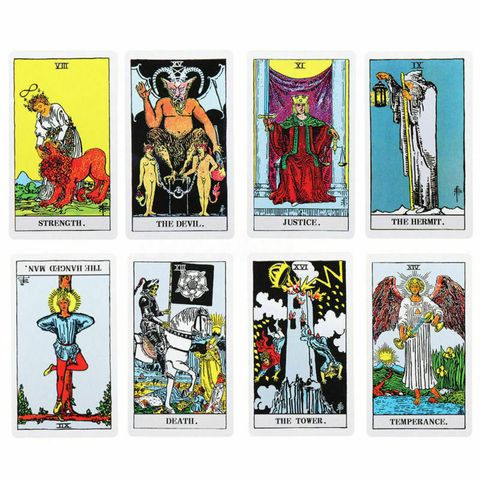
A typical tarot reading begins with the querent formulating a clear question or focus area while the reader prepares the deck, often by cleansing it (e.g., with smoke, intention, or crystals such as selenite or smoky quartz) to clear prior energies absorbed from previous readings or emotions. In esoteric traditions, such crystals are believed to remove negative energy, recharge and amplify positive vibrations for greater sensitivity, provide protection against adverse influences and grounding, balance the deck's energies, and enhance intuition, sometimes through associations with chakras like the third eye. The querent or reader then shuffles the deck, concentrating on the query, and may cut the deck before drawing cards for the chosen spread. Interpretation in Tarot card reading relies on assigning meanings to drawn cards based on their orientation, symbolism, and relationships within a spread. A common principle used by many readers is the distinction between upright and reversed positions, though some practitioners do not use reversals and instead derive nuance from card positions, surrounding cards, or intuition. Upright cards typically represent the direct, unhindered expression of their core energy, such as sudden upheaval or revelation in The Tower, symbolizing disruption that leads to necessary transformation, as well as anxiety, hopelessness, and intense mental anguish in the 9 of Swords; intellectual authority, clear thinking, logic, and fairness in the King of Swords; fulfillment, harmony, completion, and integration in The World; surrender, letting go, new perspective, and voluntary sacrifice in The Hanged Man; self-sufficiency, abundance, independence, and enjoying the rewards of hard work in the 9 of Pentacles; and balance, moderation, harmony, and blending opposites in Temperance. These are standard Rider-Waite upright interpretations, serving as foundational examples even as actual readings blend traditional symbolism with intuition and contextual factors. Reversed cards, by contrast, indicate blocked, delayed, or internalized aspects of that energy; for The Tower reversed, this might manifest as oppression or prolonged avoidance of change rather than abrupt crisis. This orientation affects interpretation by highlighting whether forces are flowing freely or encountering resistance, with reversals often suggesting a need for introspection or resolution of internal conflicts.
For beginners, interpretation often starts with learning keywords and basic meanings for each card, focusing on the standard Rider-Waite-Smith deck. Meanings depend on context, the card's position (upright or reversed), and the reader's intuition. Beginners should practice with simple spreads to build skills and familiarity. Reliable resources provide detailed upright and reversed interpretations for each of the 78 cards.
Tarot is not ideally suited for strict yes/no questions, as it provides nuanced..... This episode includes AI-generated content.
Contenuto generato con l’IA
Trascritto
18 GIU 2026 · Tarot Cartomancy. (part 2).
Post-1970 Global Spread.
The post-1970 era marked a significant democratization of Tarot card reading, driven by the New Age movement's emphasis on personal spirituality and self-reflection, which shifted Tarot from esoteric circles to mainstream accessibility. Eden Gray's books, such as The Tarot Revealed (1960) and A Complete Guide to the Tarot (1970), played a pivotal role by presenting Tarot as a tool for psychological insight rather than strict fortune-telling, influencing a broad audience during the 1970s countercultural surge. This approach aligned with New Age ideals of holistic growth, making Tarot appealing to those seeking empowerment amid social upheavals.
In the 1980s and 1990s, feminist and queer communities further adapted Tarot to reflect marginalized perspectives, fostering decks that centered women's spirituality and non-normative identities. The Daughters of the Moon Tarot (1984), created by Ffiona Morgan, exemplifies this by featuring all-female imagery and round cards symbolizing equality, drawing from goddess archetypes to support lesbian and feminist spiritual practices. Such innovations challenged traditional gender roles in Tarot iconography, promoting inclusivity and self-affirmation within women's and queer circles.
The 1990s onward saw digital technologies propel Tarot's global expansion, enabling online readings and apps that transcended geographical barriers. The Labyrinthos Tarot app, launched in the mid-2010s, offers interactive learning and virtual readings, amassing millions of users by integrating gamified lessons with traditional symbolism. Concurrently, multicultural decks emerged, incorporating diverse symbols; for instance, the Sacred Roots Tarot blends Afro-Indigenous ancestral motifs with Tarot structure, while the Chinese Tarot (1993) fuses Eastern philosophy and artwork. These adaptations reflect Tarot's internationalization, appealing to global audiences seeking culturally resonant divination.
Commercialization accelerated this spread, with Tarot festivals and celebrity involvement boosting visibility since the 2000s. Events like the Los Angeles Festival of Tarot (inaugurated in 2025) and earlier conventions such as TarotCon (starting in the 1990s but expanding post-2000) gather practitioners for workshops and vendor expos, fostering community and commerce. Celebrities including Jada Pinkett Smith and Beyoncé have publicly endorsed Tarot for guidance, amplifying its cultural cachet. The global Tarot cards market, valued at approximately $1.3 billion in 2023, underscores this growth, projected to rise with increasing digital and inclusive offerings.
The Tarot Deck.
Structure of Major and Minor Arcana.
The standard Tarot deck consists of 78 cards, divided into the Major Arcana and the Minor Arcana. This structure, while rooted in 15th-century Italian playing cards, was formalized for occult purposes in the 19th century.
The Major Arcana comprises 22 cards, often referred to as trumps, numbered from 0 to 21. The sequence begins with The Fool (0), symbolizing the start of a journey, and culminates with The World (21), representing completion. These cards depict archetypal figures and concepts, such as The Magician, The Lovers, and Death, and were originally added as special trumps to the Italian tarocchi game's suits in the 1440s. The term "Major Arcana" was coined by French occultist Éliphas Lévi in his 1856 work Dogme et Rituel de la Haute Magie, emphasizing their significance in esoteric traditions.
The Minor Arcana includes 56 cards, organized into four suits, each containing 14 cards: numbered cards from Ace to 10, plus four court cards (Page, Knight, Queen, and King). The suits are Wands (or Batons), Cups, Swords, and Pentacles (or Coins), derived from the Latin-suited playing cards of 15th-century Italy. In occult interpretations, these suits correspond to the classical elements: Wands to fire (creativity and action), Cups to water (emotions and intuition), Swords to air (intellect and conflict), and Pentacles to earth (materiality and stability). This elemental association was elaborated in early 20th-century esoteric texts, such as P.D. Ouspensky's The Symbolism of the Tarot (1913), which linked the suits to elemental spirits like salamanders for fire.
Historically, the Tarot deck evolved from the tarocchi packs of northern Italy in the 1440s, used primarily for card games without a fixed divinatory sequence. By the 19th century, occultists like Lévi standardized the numbering and arcana divisions, integrating Kabbalistic and astrological influences to create a cohesive esoteric framework. This shift marked the transition from gaming to symbolic divination.
In Tarot readings, the Major Arcana cards address overarching life themes and spiritual lessons, while the Minor Arcana provide insights into daily events and practical matters.[46] This distinction allows readers to balance profound archetypes with situational details.
The Rider-Waite-Smith deck, published in 1909 and widely regarded as the standard for modern tarot practice and beginners, features detailed pictorial scenes on all 78 cards that support intuitive interpretation. The Major Arcana represent major life events, spiritual lessons, and archetypes—for example, The Fool signifies new beginnings, The Lovers represent relationships and significant choices, and Death indicates transformation and endings that lead to renewal rather than literal mortality. The Minor Arcana cover everyday situations, divided into four suits: Wands (fire) associated with action, creativity, and energy; Cups (water) associated with emotions, relationships, and intuition; Swords (air) associated with intellect, challenges, and conflict; and Pentacles (earth) associated with the material world, finances, and the physical body. Card meanings depend on context within the spread, position (upright or reversed, where reversed often suggests blocked, internalized, or opposite energies), surrounding cards, and the reader's intuition. Beginners should start by learning key words and phrases for each card and practice with simple spreads to develop familiarity.
Symbolism and Iconography.
Tarot cards are replete with symbolic elements that convey layered meanings through visual motifs, drawing from diverse esoteric traditions. Common motifs include colors, numbers, and archetypal figures, each contributing to interpretive depth. For instance, red often symbolizes passion and energy, as seen in the Justice card's gown, while blue represents intuition and the feminine, evident in the High Priestess's robes. Numbers carry numerological significance, such as the number three denoting growth and creativity in cards like the Empress, and seven implying spiritual introspection in the Chariot. Figures like Death embody transformation rather than literal mortality, depicted as a skeletal rider to signify renewal, while the Fool represents naive beginnings and potential, often shown with a bindle and a cliff-edge journey. These elements, including suits' icons like wands for fire and creativity or cups for water and emotion, form a universal language independent of specific historical contexts.
Esoteric correspondences further enrich Tarot iconography, linking cards to astrological, Kabbalistic, and alchemical frameworks. Astrologically, the Emperor corresponds to Aries, embodying structured authority and initiative, while the High Priestess aligns with the Moon, symbolizing subconscious wisdom. In Kabbalah, the Major Arcana map onto the 22 paths of the Tree of Life, a diagrammatic representation of divine emanations; for example, the Fool connects Path 11 between Kether (crown) and Chokmah (wisdom), illustrating the soul's initiatory descent. Alchemical stages are reflected in the cards' progression, with the Major Arcana paralleling the Great Work: the Magician initiates calcination (purification by fire), Temperance embodies conjunction (balancing opposites), and the World signifies coagulation (spiritual completion). The suits correspond to alchemical elements—wands to fire, cups to water—mirroring processes of transmutation from base to enlightened states.
The evolution of Tarot imagery shifted from sparse, unillustrated designs in 17th-century decks like the Tarot de Marseille to richly narrative scenes in the 1909 Rider-Waite-Smith (RWS) deck. Marseille cards featured minimalist woodcut-style illustrations primarily in the 22 Major Arcana, with Minor Arcana pips (e.g., unadorned swords or coins) relying on numerical symbolism for interpretation, evoking a sense of ancient, unrefined wisdom through bold colors like sky blues and earthy greens. In contrast, the RWS deck, designed by Pamela Colman Smith under A.E. Waite's guidance and influenced by the Hermetic Order of the Golden Dawn, illustrated all 78 cards with detailed, Art Nouveau-inspired scenes, enhancing symbolic accessibility; for example, the Three of Cups depicts celebratory figures to visually convey communal joy, absent in Marseille's abstract pips. This transition democratized esoteric meanings, making iconography more intuitive for modern users.
Cultural adaptations in non-Western Tarot decks reinterpret core symbols to resonate with local traditions, fostering hybrid iconographies. In Japanese decks, such as those by artists like Akatsuki Reika, European figures are replaced with indigenous motifs—Himiko as the High Priestess or Abeno Seimei as the Magician—integrating Shinto mythology and kawaii aesthetics, where animals like rabbits substitute human archetypes for relatable, non-anthropocentric symbolism. Similarly, Native American-inspired decks, like the Medicine Wheel Tarot, adapt suits to tribal elements—e.g., pipes for wands symbolizing vision quests—and incorporate animal totems such as the eagle.. This episode includes AI-generated content.
Contenuto generato con l’IA
Trascritto
18 GIU 2026 · Tarot Cartomancy. (part 1).
Tarot card reading.
Tarot card reading is a form of cartomancy, or divination using cards, in which a practitioner interprets a deck of 78 illustrated cards to provide insights into a querent's past, present, future, or personal circumstances. The practice draws on the symbolic meanings of the cards, often arranged in specific layouts known as spreads, to facilitate self-reflection, guidance, or prediction of events, with ethical guidelines often advising against readings that seek information about third parties without their consent. While rooted in esoteric traditions, it is also employed for psychological exploration and therapeutic purposes, helping individuals process emotions and motivations without relying on supernatural claims.
The Tarot deck originated in 15th-century northern Italy as a playing card game called tarocchi, with the earliest known decks dating to the 1440s in cities like Milan and Ferrara. These early decks were commissioned by wealthy families, such as the Visconti-Sforza, and featured hand-painted artwork by artists like Bonifacio Bembo, emphasizing themes from classical mythology, virtues, and cosmology. The association with fortune-telling emerged much later, in the late 18th century, when French occultists like Antoine Court de Gébelin proposed mystical origins linking the cards to ancient Egyptian wisdom, though historical evidence supports only the gaming roots. By the 19th century, Tarot had become integrated into Western esotericism, influencing movements like the Hermetic Order of the Golden Dawn and inspiring modern decks such as the Rider-Waite-Smith, which standardized symbolic imagery for divinatory use.
Structurally, the Tarot consists of two main divisions: the Major Arcana, 22 cards representing archetypal life themes and spiritual lessons (e.g., The Fool symbolizing new beginnings, The Hanged Man representing surrender and new perspectives, Temperance embodying balance and moderation, The World signifying fulfillment and completion, or The Tower denoting upheaval), and the Minor Arcana, 56 cards divided into four suits—Wands (fire, creativity), Cups (water, emotions), Swords (air, intellect), and Pentacles (earth, material matters)—each containing numbered cards from Ace to 10 and four court cards (Page, Knight, Queen, King); for instance, in the Swords suit, the 9 of Swords symbolizing anxiety and despair, the King of Swords representing intellectual authority and logic, and in the Pentacles suit, the 9 of Pentacles signifying self-sufficiency and abundance. In a reading, the querent typically shuffles the deck while focusing on a question, after which the reader lays out cards in spreads ranging from simple one-card draws to more complex spreads like the Celtic Cross (10 cards) to interpret their upright or reversed positions relative to the query. Interpretations blend card symbolism, numerology, astrology, and intuition, with psychological explanations attributing efficacy to phenomena like the Barnum effect, where vague statements feel personally applicable.
In contemporary contexts, Tarot reading spans entertainment, spirituality, and therapy, with decks adapted for diverse cultural and social applications, including social justice and personal development. Studies highlight its role in fostering self-awareness, as practitioners use it to externalize inner conflicts and gain perspective, supported by its multi-sensory engagement through visuals and narrative. Despite skepticism from scientific communities regarding predictive accuracy, its enduring popularity underscores its value as a reflective tool rather than a literal oracle.
Origins and History.
Early Associations with Divination.
The origins of cartomancy trace back to the introduction of playing cards to Europe, which derived from Mamluk decks originating in the Islamic world of Egypt and Syria during the 13th and 14th centuries. These early cards featured suits such as cups, coins, swords, and polo sticks, as evidenced by a preserved 15th-century deck in the Topkapi Sarayi Museum in Istanbul. Traders and sailors brought these cards to European ports, particularly in Italy and Spain, around the 1370s, where they were adapted with local suits like batons replacing polo sticks. Initially used exclusively for gaming, these cards laid the groundwork for later divinatory practices by providing a medium for chance-based interpretation.
The first documented associations between cards and divination emerged in late 15th-century Europe, amid growing moral and religious opposition. Sermons in German-speaking regions during the 1480s explicitly condemned the use of cards for fortune-telling, portraying such predictions as sinful inventions linked to gambling and superstition. These prohibitions, including early bans in Switzerland from 1377 that extended to predictive uses, reflected broader ecclesiastical concerns over cards as tools for glimpsing the future. By this period, rudimentary forms of cartomancy appeared in lotbooks (Losbücher), where drawn cards or dice determined verses for prophetic readings, marking an initial shift from mere entertainment.
In Renaissance Italy and France, the transition from gaming to divination gained traction through textual references and cultural adaptation. Bavarian physician Johannes Hartlieb's 1456 treatise Das Buch aller verbotenen Kunst (The Book of All Forbidden Arts) critiqued card-based prophecy as a forbidden art, describing methods where cards were drawn to select interpretive verses from fortune books, thus documenting early predictive techniques. This evolution occurred alongside the spread of tarocchi cards in northern Italy, where decks like those commissioned by the Visconti family in Milan around 1440 served primarily as games but occasionally inspired reflective or omen-based consultations. In France, cards arrived via diplomatic exchanges, such as a 1449 tarocchi deck gifted to Queen Isabella, fostering similar experimental uses amid Renaissance humanism.
While tarocchi remained a popular trick-taking game throughout the 15th and 16th centuries, distinct from its emerging divinatory role, cartomancy solidified as a separate practice by the mid-18th century, when occultists began attributing esoteric meanings to the cards.
Key Figures in 18th-19th Century Development.
Antoine Court de Gébelin, a French Protestant pastor and Freemason, played a foundational role in establishing Tarot's esoteric significance through his multi-volume work Le Monde Primitif, analysé et comparé avec le monde moderne (The Primitive World, Analyzed and Compared to the Modern World), published starting in 1773 and including a key section on Tarot in Volume VIII in 1781. In this text, de Gébelin posited that the Tarot originated as an ancient Egyptian book of wisdom, with the 22 Major Arcana cards representing hieroglyphic symbols encoding profound philosophical and mystical knowledge that had been preserved through gypsy migrations to Europe. Although his claims of Egyptian origins were later debunked as speculative, de Gébelin's writings sparked widespread interest in Tarot as a divinatory and symbolic system, shifting perceptions from mere playing cards to a repository of hidden truths.
Building on de Gébelin's ideas, Jean-Baptiste Alliette, known by his pseudonym Etteilla (his surname spelled backward), emerged as the first documented professional Tarot reader in the late 1770s and 1780s in Paris. A former merchant and hairdresser, Alliette published Manière de se récréer avec le jeu de cartes nommées Tarots in 1770, outlining a structured method for Tarot divination, and followed with Etteilla, ou manière de lire dans l'avenir in 1776, which formalized card interpretations. In 1783, he created the first Tarot deck specifically designed for fortune-telling, the Grand Etteilla or Livre de Thot, featuring renamed cards, associations with zodiac signs, and the introduction of reversed meanings to indicate negative or blocked energies, thereby professionalizing Tarot as a predictive tool. Etteilla's approach emphasized timing, planetary influences, and combinations, influencing subsequent cartomantic practices in France.
Marie Anne Adélaïde Lenormand (1772–1843), a renowned French clairvoyante and cartomancer active from the 1790s through the early 19th century, further popularized Tarot in elite and political circles despite the illegality of fortune-telling under French law. Operating from her Paris salon, Lenormand used a modified version of the Etteilla Tarot deck, adapting it with intuitive overlays and astrological elements to deliver predictions that attracted figures like Empress Joséphine and other revolutionaries. Her forecasts, including warnings of Napoleon's downfall and the rise of Marie Louise, gained legendary status, enhancing Tarot's reputation as a medium for political and personal prophecy, though she did not create her own deck—later "Lenormand" oracle cards were posthumously named in her honor. Lenormand's dramatic style and accuracy stories cemented her as a cultural icon, bridging esoteric Tarot with public fascination during the Revolutionary and Napoleonic eras.
In the mid-19th century, Alphonse Louis Constant, writing as Éliphas Lévi, synthesized Tarot with Western occult traditions in his seminal Dogme et Rituel de la Haute Magie (Dogma and Ritual of High Magic), published in two volumes from 1854 to 1856. A former Catholic seminarian turned occultist, Lévi portrayed the 22 Major Arcana as an archetypal "wheel of life" mirroring the Kabbalistic Tree of Life and Hermetic principles, explicitly assigning each trump a corresponding Hebrew letter from the Sephiroth to unlock mystical correspondences. This integration transformed Tarot from a mere divinatory aid into a philosophical mandala for meditation.... This episode includes AI-generated content.
Contenuto generato con l’IA
Trascritto
18 GIU 2026 · Tarot card reading. (part 2).
Waite and Crowley.
The Rider–Waite–Smith deck, released in 1909, was the first complete cartomantic tarot deck other than those derived from Etteilla's Egyptian tarot. (Oswald Wirth's 1889 deck had only depicted the major arcana.) The deck, designed by Arthur Edward Waite, was executed by Pamela Colman Smith, a fellow Golden Dawn member, and was the first tarot deck to feature complete scenes for each of the 36 suit cards between 2 and 10 since the Sola Busca tarot of the 15th century, with certain designs likely based in part on a number of photographs of them held by the British Museum. The deck followed the Golden Dawn in its choice of suit names and in swapping the order of the trumps of Justice and Strength, but essentially preserved the traditional designations of the court cards. The deck was followed by the release of The Key to the Tarot, also by Waite, in 1910.
The Thoth deck, first released as part of Aleister Crowley's The Book of Thoth in 1944, represent a somewhat different evolution of the original Golden Dawn designs. The deck, executed by Lady Frieda Harris as a series of paintings between 1938 and 1942, owes much to Crowley's development of Thelema in the years following the dissolution of the Hermetic Order. While the deck follows Golden Dawn teachings with respect to the zodiacal associations of the major arcana and the associations of the minor arcana with the various astrological decans, it also:
- reverted to the traditional Marseille numbering of Justice and Strength as arcana 8 and 11, respectively (though it retained the swapped associations with respect to the Hebrew alphabet).
- swapped the Hebrew alphabet associations of the fourth and seventeenth arcana (The Emperor and The Star, respectively), in accordance with Crowley's Liber Legis of 1913.
- renamed several of the major arcana.
- renamed the suits of Batons and Coins to Wands and Disks (the latter instead of the Golden Dawn's "Pentacles"), and,
- adopted the Golden Dawn's court cards, except that the Knight was not renamed.
While Crowley managed to print a partial test run of the standalone deck using seven color plates included in The Book of Thoth, it was not until the 1960s, after Crowley and Harris's deaths, that the deck was first printed in its entirety.
Tarot divination in the United States.
Two of the earliest publications on tarot in the English language were published in the United States, including a book by Madame Camille Le Normand entitled Fortune-Telling by Cards; or, Cartomancy Made Easy, published in 1872, and an anonymous American essay on the tarot published in The Platonist in 1885 entitled "The Taro". The latter essay is implied by Decker and Dummett to have been written by an individual with a connection to the occult order known as the Hermetic Brotherhood of Luxor. While it is not clear to what extent the Hermetic Brotherhood used tarot cards in its practices, it influenced later occult societies such as Elbert Benjamine's Church of Light, which had tarot practices (and an accompanying deck) of its own.
Adoption of the esoteric tarot practices of the Golden Dawn in the United States was driven in part by the American occultist Paul Foster Case, whose 1920 book An Introduction to the Study of the Tarot made use of the Rider–Waite–Smith deck and assorted esoteric associations first adopted by the Golden Dawn. By the 1930s, however, Case had formed his own occult order, the Builders of the Adytum, and began to promote the Revised New Art Tarot,[m] by Manly P. Hall with art by J. Augustus Knapp, as well as Case's own deck. Executed by Jessie Burns Parke, the artwork of Case's deck, the B.O.T.A. Tarot, generally resembles that of the Rider–Waite–Smith deck, but the deck also shows influences from Oswald Wirth and the original design of the Hermetic Order of the Golden Dawn tarot. Case promoted the deck in his 1947 book The Tarot: A Key to the Wisdom of the Ages, which also marked one of the first references to the work of Carl Jung by a tarotist.
Esoteric use of the Rider–Waite–Smith Tarot was also promoted in the works of Eden Gray, whose three books on the tarot made extensive use of the deck. Gray's books were adopted by members of the 1960s counter-culture as standard reference works on divinatory use of tarot cards, and her 1970 book A Complete Guide to the Tarot was the first work to use the metaphor of the "Fool's Journey" to explain the meanings of the major arcana.
Tarot divination since 1970.
The work of Eden Gray and others in the 1960s led to an explosion of popularity in tarot card reading beginning in 1969. Stuart R. Kaplan's U.S. Games Systems, which had been founded in 1968 to import copies of the Swiss 1JJ Tarot, was well positioned to take advantage of this explosion and reissued the then out-of-print Rider–Waite–Smith Tarot in 1970, which has not gone out of print since. Tarot card reading quickly became associated with New Age thought, signaled in part by the popularity of David Palladini's Rider–Waite–Smith-inspired Aquarian Tarot, first issued in 1968. Artists soon began to create their own interpretations of the tarot for artistic purposes rather than purely esoteric ones, such as the Mountain Dream Tarot of Bea Nettles, the first photographic tarot deck, released in 1975.
The 1980s and 1990s saw the rise of a new generation of tarotists, influenced by the writings of Eden Gray and the work of Carl Jung and Joseph Campbell on psychological archetypes. These tarotists sought to apply tarot card reading to personal introspection and growth, and included Mary K. Greer, the author of Tarot for Your Self: A Workbook for the Inward Journey (1984), and Rachel Pollack, the author of Seventy-Eight Degrees of Wisdom (1980/1983). Tarot cards also began to gain popularity as a divinatory tool in countries like Japan, where hundreds of new decks have been designed in recent years. The democratization of digital publishing in the 2000s and 2010s led to a new explosion of tarot decks as artists became increasingly able to self-publish their own.
Use.
Tarot is often used in conjunction with the study of the Hermetic Qabalah. In these decks all the cards are illustrated in accordance with Qabalistic principles, most being influenced by the Rider–Waite deck. Its images were drawn by artist Pamela Colman Smith, to the instructions of Christian mystic and occultist Arthur Edward Waite, and published in 1911.
A difference from Marseilles-style decks is that Waite and Smith use scenes with esoteric meanings on the suit cards. These esoteric, or divinatory meanings were derived in great part from the writings of the Hermetic Order of the Golden Dawn group, of which Waite had been a member. The meanings and many of the illustrations showed the influence of astrology as well as Qabalistic principles.
Personal use.
Next to the usage of tarot cards to divine for others by professional cartomancers, tarot is also used widely as a device for seeking personal guidance and spiritual growth. Practitioners often believe tarot cards can help the individual explore one's spiritual path. A 2025 Pew Research Center survey found that 11% of U.S. adults consult tarot cards at least once a year, with most saying they do so primarily for fun rather than for guidance.
People who use the tarot for personal divination may seek insight on topics ranging widely from health or economic issues to what they believe would be best for them spiritually. Thus, the way practitioners use the cards in regard to such personal inquiries is subject to a variety of personal beliefs. For example, some tarot users may believe the cards themselves are magically providing answers, while others may believe a supernatural force or a mystical energy is guiding the cards into a layout.
Alternatively, some practitioners believe tarot cards may be utilized as a psychology tool based on their archetypal imagery, an idea often attributed to Carl Jung. Jung wrote, "It also seems as if the set of pictures in the Tarot cards were distantly descended from the archetypes of transformation, a view that has been confirmed for me in a very enlightening lecture by Professor Bernoulli." During a 1933 seminar on active imagination, Jung described the symbolism he saw in the imagery:
The original cards of the Tarot consist of the ordinary cards, the king, the queen, the knight, the ace, etc., only the figures are somewhat different, and besides, there are twenty-one [additional] cards upon which are symbols, or pictures of symbolical situations. For example, the symbol of the sun, or the symbol of the man hung up by the feet, or the tower struck by lightning, or the wheel of fortune, and so on. Those are sort of archetypal ideas, of a differentiated nature, which mingle with the ordinary constituents of the flow of the unconscious, and therefore it is applicable for an intuitive method that has the purpose of understanding the flow of life, possibly even predicting future events, at all events lending itself to the reading of the conditions of the present moment.
Criticism.
Skeptic James Randi once said that:
For use as a divinatory device, the tarot deck is dealt out in various patterns and interpreted by a gifted "reader." The fact that the deck is not dealt out into the same pattern fifteen minutes later is rationalized by the occultists by claiming that in that short span of time, a person's fortune can change, too. That would seem to call for rather frequent readings if the system is to be of any use whatsoever.
Tarot historian Michael Dummett similarly critiqued occultist uses throughout his various works, remarking that "the history of the esoteric use of Tarot cards is an oscillation between the two.... This episode includes AI-generated content.
Contenuto generato con l’IA
Trascritto
17 GIU 2026 · Tarot card reading. (part 1).
Tarot card reading is a form of cartomancy whereby practitioners use tarot cards to purportedly gain insight into the past, present or future. The process typically begins with formulation of a question, followed by drawing and interpreting cards to uncover meaning. A traditional tarot deck consists of 78 cards, which can be split into two groups, the Major Arcana and Minor Arcana. French-suited playing cards (Marseille tarot) can also be used; as can any card system with suits assigned to identifiable elements (e.g., air, earth, fire, water).
History.
The first written references to tarot packs occurred between 1440 and 1450 in northern Italy, for example in Milan and Ferrara, when additional cards with allegorical illustrations were added to the common four-suit pack. These new packs were called carte da trionfi, triumph packs, and the additional cards were simply known as trionfi, which became "trumps" in English.
One of the earliest references to tarot triumphs appears around c. 1450–1470 mentioned by a Dominican preacher in a sermon condemning dice, playing cards and 'triumphs'. References to the tarot as a social plague or as exempt from the bans that affected other games continued throughout the 16th and 17th centuries, but there are no indications that the cards were used for anything but games. As philosopher and tarot historian Michael Dummett noted, "it was only in the 1780s, when the practice of fortune-telling with regular playing cards had been well established for at least two decades, that anyone began to use the tarot pack for cartomancy."
Claims by the early French occultists that tarot cards had esoteric links to ancient Egypt, the Kabbalah, Indic Tantra, or the I Ching have been frequently repeated by authors on card divination. However, scholarly research reveals that there is no evidence of any significant use of tarot cards for divination until the late 18th century as it was believed to be invented in Italy in the early 15th century. In fact, historians have described western views of the Tarot pack as "the subject of the most successful propaganda campaign ever launched... An entire false history and false interpretation of the Tarot pack was concocted by the occultists; and it is all but universally believed".
The belief in the divinatory meaning of the cards is closely associated to the notion of their occult properties, a view commonly held in early modern Europe propagated by prominent Protestant Christian clerics and Freemasons.
From its uptake as an instrument of divination in 18th-century France, the cards went on to be used in hermeneutic, magical, mystical, semiotic, and psychological practices. It was used by Romani people while telling fortunes, as a Jungian psychological apparatus for tapping into "absolute knowledge in the unconscious", a tool for archetypal analysis, and even for facilitating the Jungian process of individuation.
Court de Gébelin.
Many involved in occult and divinatory practices attempt to trace the tarot to ancient Egypt, divine hermetic wisdom, and the mysteries of Isis.
The first was Antoine Court de Gébelin, a French clergyman, who wrote that after seeing a group of women playing cards he had the idea that tarot was not merely a game of cards but was in fact of ancient Egyptian origin, of mystical Qabalistic import, and of deep divine significance. Court de Gébelin published a dissertation on the origins of the symbolism in the tarot in volume VIII of the work Le Monde primitif in 1781. He believed that the tarot represented ancient Egyptian Theology, including Isis, Osiris, and Typhon. For example, he thought the card he knew as the Papesse and known in occult circles today as the High Priestess represented Isis. He also related four tarot cards to the four Christian Cardinal virtues: Temperance, Justice, Strength and Prudence. He related The Tower to a Greek fable about avarice.
Although the ancient Egyptian language had not yet been deciphered, Court de Gébelin asserted the name "Tarot" came from the Egyptian words Tar, 'path' or 'road', and the word Ro, Ros, or Rog, meaning 'king' or 'royal', and that the word literally translated to 'the Royal Road of Life'. Subsequent research by Egyptologists found nothing in the Egyptian language to support Court de Gébelin's etymologies. Despite this lack of any evidence, the belief that the tarot cards are linked to the Egyptian Book of Thoth continues to the present day.
The actual source of the occult tarot can be traced to two articles in volume eight, one written by Court de Gébelin and one written by M. le C. de M.***, who has been identified as Major General Louis-Raphaël-Lucrèce de Fayolle, Comte de Mellet. This second essay is "considerably more impressive" than de Gébelin's, albeit "as full of assertions with no basis in truth", and has been even more influential than Court de Gébelin's. The author makes no acknowledgement of de Gébelin and, although he agrees with all his main conclusions, he also contradicts de Gébelin over such details as the meaning of the word "Tarot" and in how the cards spread across Europe. Moreover, he takes de Gébelin's speculations even further, agreeing with him about the mystical origins of the tarot in ancient Egypt, but making several additional, and influential, statements that continue to influence mass understanding of the occult tarot even to this day. He made the first statements proposing that the tarot was "The Book of Thoth" and made the first association of tarot with cartomancy. Meanwhile Court de Gébelin was the first to imply the existence of a connection between the Tarot and Romani people, although this connection did not become well established in the public consciousness until other French authors such as Boiteau d'Ambly and Jean-Alexandre Vaillant began in the 1850s to promote the theory that tarot cards had been brought to Europe by the Romani. In fact, there is virtually no evidence that Romani people used any form of playing cards for telling fortunes until the 20th century.
Etteilla.
Cartomancer Etteilla, the pseudonym of Jean-Baptiste Alliette, was the first to assign divinatory meanings to tarot cards. Etteilla devised a method of tarot divination in 1783, and published his cartomantic treatise comparing the cards to the Book of Thoth in 1785. Etteilla established the Société des Interprètes du Livre de Thot, the first society for tarot cartomancy, in 1788.
He promoted the Grand Etteilla deck as the first corrected tarot (supposedly fixing errors that resulted from misinterpretation and corruption through the mists of antiquity); he created the first Egyptian tarot to be used exclusively for cartomancy, and published Dictionnaire synonimique du Livre de Thot, which "systematically tabulated all the possible meanings which each card could bear, when upright and reversed." Etteilla expanded tarot lore by describing the deck as a repository of the wisdom of Hermes Trismegistus, a book of eternal medicine, an account of the creation of the world, and claimed the first copy of the tarot was imprinted on leaves of gold.
In his 1980 book, The Game of Tarot, Michael Dummett argued that Etteilla was attempting to supplant Court de Gébelin as the author of the occult tarot.[e] Etteilla in fact claimed to have been involved with tarot longer than Court de Gébelin.
Marie Anne Lenormand.
Mlle Marie-Anne Adelaide Lenormand outshone even Etteilla and was the first cartomancer to people in high places, through her claims to be the personal confidant of Empress Josephine, Napoleon and other notables. Lenormand used both regular playing cards, in particular the Piquet pack, as well as tarot cards likely derived from the Tarot de Marseille. Following her death in 1843, several different cartomantic decks were published in her name, including the Grand Jeu de Mlle Lenormand, based on the standard 52-card deck, first published in 1845, and the Petit Lenormand, a 36-card deck derived from the German game Das Spiel der Hoffnung, first published around 1850.
Éliphas Lévi.
The concept of the cards as a mystical key was extended by Éliphas Lévi. Lévi (whose actual name was Alphonse-Louis Constant) was educated in the seminary of Saint-Sulpice, and was ordained as a deacon, but never became a priest. Michael Dummett noted that it is from Lévi's book Dogme et rituel that the "whole of the modern occultist movement stems." Lévi's magical theory was based on a concept he called the Astral Light and according to Dummett, he claimed to be the first to:
"have discovered intact and still unknown this key of all doctrines and all philosophies of the old world... without the tarot", he tells us, "the Magic of the ancients is a closed book...."
Lévi accepted Court de Gébelin's claims that the deck had an Egyptian origin, but rejected Etteilla's interpretation and rectification of the cards in favor of a reinterpretation of the Tarot de Marseille. He called it The Book of Hermes and claimed that the tarot was antique, existed before Moses, and was in fact a universal key of erudition, philosophy, and magic that could unlock Hermetic and Qabalistic concepts. According to Lévi, "An imprisoned person with no other book than the Tarot, if he knew how to use it, could in a few years acquire universal knowledge, and would be able to speak on all subjects with unequaled learning and inexhaustible eloquence."
According to Dummett, Lévi's notable contributions included the following:
- Lévi was the first to suggest that the Magus (Bagatto) was to be depicted in conjunction with the symbols of the four suits.
- Inspired by de Gébelin, Lévi associated the Hebrew alphabet with the Major Arcana (tarot trumps) and attributed an "onomantic astrology" system.... This episode includes AI-generated content.
Contenuto generato con l’IA
Trascritto
17 GIU 2026 · Tarocco Piemontese. (part 2).
Gameplay.
Basic Rules.
The Tarocco Piemontese deck is primarily used for trick-taking games in northern Italy, with the most common being Scarto, a game for three individual players (no partnerships). Other variants exist for four players in fixed partnerships, such as regional games in the Piedmont valleys. Play generally proceeds anticlockwise, starting with the player to the dealer's right. The full 78-card deck is used, consisting of 22 trumps numbered from 0 (Matto, or Fool) to 21, and four suits (batons, cups, coins, swords) of 14 cards each (10 pips plus king, queen, knight, and jack). In Scarto and most Piemontese games, the trump hierarchy ranks the Angel (20) highest, followed by the World (21), then 19 down to 1, with the Matto as a special card.
In Scarto, the dealer shuffles and deals packets of five cards to each player three times, giving each 25 cards. The remaining three cards form the scarto (discard pile), placed face down; the dealer also discards three cards from their hand face down onto the scarto (avoiding high-value cards like 5-point honors or the Fool where possible). The objective is to capture the most card points over one or more deals, with the player having the lowest cumulative score losing (traditionally paying for drinks or a stake). There are no declarations or bonuses beyond card points and the scarto.
Trick-taking follows standard rules: the leader plays any card, and subsequent players must follow suit if possible; if unable, they must trump if able, otherwise play any card. The highest card of the led suit wins unless trumped, in which case the highest trump wins (with 20 > 21 > 19 > ... > 1). The Matto can be played at any time as an excuse, without following suit or trumping; it does not win the trick but is returned to the player's won tricks pile. The winner of each trick leads the next, and all 25 tricks per player are played (though the scarto is added to the dealer’s tricks if they win the last trick or per variant rules).
At the end of the deal, card points are tallied using the nominal system: kings and trumps 1 & 20 score 5 points each; queens and the Fool score 4; knights 3; jacks 2; all other cards (including trumps 2–19 except 20) score 1. The total raw points approximate 91 (exact varies by method); points are counted in batches of three cards from each player's won tricks (last batch may have 1–2 cards), subtracting 2 points per full batch of three, with adjustments for incomplete batches (e.g., +1 then -2 for Fool's 2-card batch). Each player's effective score is their adjusted points minus 26 (or half the total divided by 3). The scarto cards are typically added to the dealer's score. Multiple deals continue until a player reaches a loss threshold. Four-player partnership variants adjust dealing (e.g., 18–19 cards each with a small talon) and scoring to team totals, often aiming for over half the card points (around 45–57 depending on variant).
Strategies and Variants.
Effective strategies in Tarocco Piemontese games focus on controlling tricks with high trumps, particularly preserving the Angel (20) and World (21) to capture honors and pips while forcing opponents to use lower trumps early. In individual play like Scarto, players balance aggressive leading of suits they are long in to draw trumps versus saving them for key moments. The Matto is valuable for evading unwanted tricks containing low points or avoiding ruffs. Timing is crucial, as over-trumping can deplete resources needed later.
In partnership variants, signaling via card plays or gestures conveys information about trump length or voids, such as leading specific low trumps to indicate holdings in high trumps (15–21). Declarations of combinations (buon gioco), like sequences of trumps or matings (king-queen pairs), may be allowed for bonus points in some 4-player games, declared before play. The pozzetto (dealer's discard) encourages the dealer to win at least one trick to claim those points. Risk assessment weighs trumping for immediate gains against developing suits for length wins.
The Piedicavallo variant, played in Piedmontese valleys, uses a 62-card deck (removing low pips: 1–4 swords/batons, 7–10 cups/coins), emphasizing trump play due to shorter suits. It is for four partnerships, with 15 cards each plus dealer's 17 (discarding 2), targeting 57+ points from 114 total, including vola bonus for all tricks. Signaling is explicit with words and gestures, and the Matto acts as a permanent excuse. Three-player adaptations like basic Scarto dominate, but 4-player versions vary regionally, such as in Turin-Milan areas with full deck, adjusted hierarchies, or declaration values. These preserve core mechanics while fitting local preferences.
Cultural and Symbolic Aspects.
Role in Piedmontese Culture.
Tarocco Piemontese has long served as a cornerstone of social interaction in Piedmontese society, particularly in urban centers like Turin and rural areas such as Pinerolo and the Biellese valleys. Traditionally played in piole—the region's historic taverns that functioned as communal gathering spots after work or on Sundays—the game facilitated lively exchanges over wine, strengthening bonds among locals and contrasting with more formal social venues. These settings, prevalent in the 19th and early 20th centuries, underscored the deck's role in everyday leisure, where groups of three or four players engaged in matches that blended strategy with camaraderie, often extending into late-night sessions known as veglioni or family evenings.
In the 19th century, the game was embedded in Piedmont's agrarian and working-class life, with references to its play in military diaries, reflecting its accessibility across social strata during periods of rest from labor. By the mid-1800s, production by Turin-based families like the Vergnanos ensured widespread availability, embedding Tarocco Piemontese in local customs from taverns to informal home gatherings in areas like Cuneo and Turin. This era saw the deck evolve into a symbol of regional identity, played not just for amusement but to preserve dialect-infused rituals and storytelling.
Preservation efforts have sustained its cultural vitality amid modern challenges. Local organizations, such as Pro Loco associations in Piedicavallo, Biella, and Viù, host annual tournaments like the Campionato di Tarocchi dell'Alta Valle del Cervo and Torneo di Tarocchi, drawing participants and spectators to foster intergenerational play and community spirit. These events integrate the game into regional tourism, featured in itineraries that highlight Piedmont's folk heritage, countering the post-1950s decline driven by urbanization and the disappearance of traditional piole due to economic shifts. Through such initiatives, Tarocco Piemontese continues to reinforce social ties in festivals and gatherings across Turin, Cuneo, and surrounding valleys, with the most recent Campionato di Tarocchi dell'Alta Valle del Cervo concluding on March 24, 2025, in Piedicavallo.
Symbolism and Interpretations.
The arcani maggiori of the Tarocco Piemontese, comprising 22 trumps, embody moral allegories drawn from Renaissance-era Italian tarot traditions, reflecting themes of human virtue, vice, and spiritual progression similar to those in earlier decks like the Visconti-Sforza. For instance, the Hanged Man (L'Appeso) depicts a figure suspended upside down, symbolizing sacrifice, self-surrender, and a reversal of perspective to achieve enlightenment, a motif adapted through centuries of Italian card iconography. Likewise, the Devil (Il Diavolo) portrays a horned figure with a face embedded in its abdomen, representing temptation, materialism, and bondage to earthly desires, echoing allegorical warnings against moral corruption in pre-occult tarot imagery.
The four suits—batons, cups, swords, and coins—carry interpretive layers in symbolic readings, rooted in classical cartomantic associations that predate modern occult systems. Batons signify creativity, action, and enterprise, often linked to growth and initiative; cups evoke emotions, intuition, and interpersonal bonds; swords denote conflict, intellect, and challenges; while coins symbolize material prosperity, stability, and practical concerns, with their circular motifs underscoring cycles of wealth and trade in regional contexts. These meanings, while not inherent to the deck's gaming origins, align with broader Italian tarot symbolism as documented in historical analyses of Marseille-influenced patterns.
Although the Tarocco Piemontese was developed primarily for trick-taking games in 19th-century Piedmont, it has seen limited adaptation for divination since the 20th century, particularly in European occult practices that interpret the cards through narrative spreads without the elaborate esoteric overlays of decks like the Rider-Waite-Smith. Modern reproductions, such as those by Il Meneghello, emphasize the deck's unadorned Marseille-style visuals for intuitive readings focused on personal insight rather than arcane esotericism.
Interpretations of the cards have evolved from their folk gaming roots to incorporate subtle regional nuances tied to Piedmontese daily life, though remaining less standardized than in French tarot traditions. For example, the Tower (La Torre), showing a structure struck by lightning, is commonly read as sudden disruption or misfortune, while the World (Il Mondo) signifies completion and harmony, as seen in its depiction of a dancing figure within a laurel wreath, symbolizing cosmic unity and fulfillment. This evolution reflects a blend of historical allegory and contemporary occult adaptation, preserving the deck's cultural integrity without imposing external mythologies. This episode includes AI-generated content.
Tarot. Tarot, first known as trionfi and later as tarocchi or tarocks) is a set of playing cards used in tarot games and in fortune-telling or divination. From at least...
mostra di più
Tarot.
Tarot, first known as trionfi and later as tarocchi or tarocks) is a set of playing cards used in tarot games and in fortune-telling or divination. From at least the mid-15th century, the tarot was used to play trick-taking card games such as Tarocchini. From their Italian roots, tarot games spread to most of Europe, evolving into new forms including German Grosstarok and modern examples such as French Tarot and Austrian Königrufen.
Tarot is commonly found in many countries, especially in English- and Spanish-speaking countries where tarot games are not as widely played, in the form of specially designed cartomantic decks used primarily for tarot card reading, in which each card corresponds to an assigned archetype or interpretation for divination, fortune-telling or for other non-gaming uses.
The emergence of custom decks for use in divination via tarot card reading and cartomancy began after French occultists made elaborate, but unsubstantiated, claims about their history and meaning in the late 18th century. Thus, there are two distinct types of tarot packs in circulation: those used for card games and those used for divination. However, some older patterns, such as the Tarot de Marseille and the Swiss Tarot, originally intended for playing card games, are also used for cartomancy.
Tarot has four suits that vary by region: French suits are used in western, central and eastern Europe, and Latin suits in southern Europe. Each suit has 14 cards: ten pip cards numbering from one (or Ace) to ten; and four face cards: King, Queen, Knight, and Jack/Knave/Page. In addition, the tarot also has a separate 21-card trump suit and a single card known as the Fool. Depending on the game, the Fool may act as the top trump or may be played to avoid following suit. These tarot cards are still used throughout much of Europe to play trick-taking card games.
mostra meno
Tarot, first known as trionfi and later as tarocchi or tarocks) is a set of playing cards used in tarot games and in fortune-telling or divination. From at least the mid-15th century, the tarot was used to play trick-taking card games such as Tarocchini. From their Italian roots, tarot games spread to most of Europe, evolving into new forms including German Grosstarok and modern examples such as French Tarot and Austrian Königrufen.
Tarot is commonly found in many countries, especially in English- and Spanish-speaking countries where tarot games are not as widely played, in the form of specially designed cartomantic decks used primarily for tarot card reading, in which each card corresponds to an assigned archetype or interpretation for divination, fortune-telling or for other non-gaming uses.
The emergence of custom decks for use in divination via tarot card reading and cartomancy began after French occultists made elaborate, but unsubstantiated, claims about their history and meaning in the late 18th century. Thus, there are two distinct types of tarot packs in circulation: those used for card games and those used for divination. However, some older patterns, such as the Tarot de Marseille and the Swiss Tarot, originally intended for playing card games, are also used for cartomancy.
Tarot has four suits that vary by region: French suits are used in western, central and eastern Europe, and Latin suits in southern Europe. Each suit has 14 cards: ten pip cards numbering from one (or Ace) to ten; and four face cards: King, Queen, Knight, and Jack/Knave/Page. In addition, the tarot also has a separate 21-card trump suit and a single card known as the Fool. Depending on the game, the Fool may act as the top trump or may be played to avoid following suit. These tarot cards are still used throughout much of Europe to play trick-taking card games.
Informazioni
| Autore | Popular Culture and Religion. |
| Organizzazione | Popular Culture and Religion. |
| Categorie | Fisica , Astronomia , Spiritualità |
| Sito | euram-radio.blogspot.com |
| - |

Copyright 2026 - Spreaker Inc. an iHeartMedia Company
