Trascritto
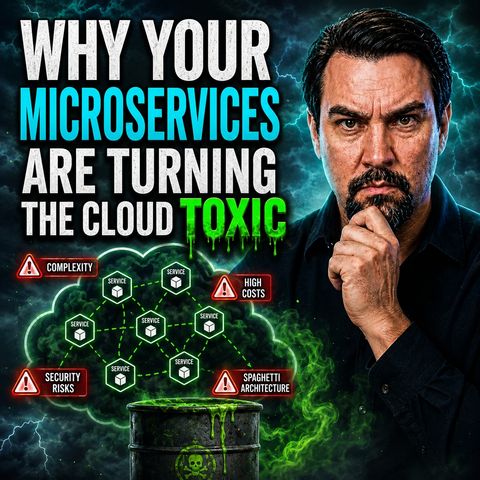
Why Your Microservices Are Turning the Cloud Toxic
7 mag 2026 ·
20 min. 50 sec.
Scarica e ascolta ovunque
Scarica i tuoi episodi preferiti e goditi l'ascolto, ovunque tu sia! Iscriviti o accedi ora per ascoltare offline.
Why Your Microservices Are Turning the Cloud Toxic
Questa trascrizione automatica è offerta da
Sounder.AI
Questa è una trascrizione generata automaticamente. Si prega di notare che non è garantita la completa accuratezza.
Descrizione
One slow dependency can quietly poison an entire cloud platform long before any dashboard shows a major outage. The systems still appear healthy. CPU looks normal. Containers remain online. Health...
mostra di più
One slow dependency can quietly poison an entire cloud platform long before any dashboard shows a major outage. The systems still appear healthy. CPU looks normal. Containers remain online. Health checks keep passing. Yet underneath the surface, capacity is already collapsing because the architecture was built on a dangerous assumption: every remote call will return quickly enough to keep the platform moving. That assumption breaks the moment real pressure arrives. In this episode, we dive deep into the mechanics behind cascading latency failures in modern .NET microservice environments and explain why “slow” is often more dangerous than “down.” Most teams prepare for crashes. Very few prepare for toxic waiting states that silently spread through APIs, queues, databases, gateways, and worker services until the entire platform grinds itself into exhaustion. This is not another discussion about generic retries or simplistic cloud scaling advice. This episode is about failure containment, resource protection, and architectural resilience under real-world pressure. Because the real problem isn’t usually the first failed request. It’s everything that gets trapped waiting behind it.
SILENT LATENCY IS THE REAL CLOUD KILLER
Modern distributed systems are incredibly good at hiding their own deterioration. A dependency becomes slower by a few hundred milliseconds. Then a few seconds. Requests begin stacking up quietly inside ASP.NET pipelines while outbound HTTP calls hold sockets open longer and longer. Connection pools start draining. Queues begin filling. Upstream APIs wait longer to respond while downstream services struggle to recover. Nothing appears catastrophic at first. That’s exactly why latency spreads so effectively. Unlike a hard outage, slow degradation gets admitted into the system and multiplied across every dependent service. A failed call is rejected immediately. A slow call infects everything upstream. This episode explores how those waiting states become invisible capacity killers inside .NET systems, especially in high-traffic cloud architectures where services depend heavily on identity providers, APIs, databases, third-party platforms, and shared infrastructure. We break down:
WHY RETRIES OFTEN MAKE OUTAGES WORSE
Retries feel safe. In small systems, they usually are. But inside distributed cloud environments, retries can quickly become synchronized load amplification attacks against already struggling dependencies. This episode explains why retry logic changes completely once systems operate at scale. A single failed request can multiply into waves of duplicate traffic as every service instance follows the exact same retry behavior at the exact same time. Inside the .NET ecosystem, resilience frameworks make retries deceptively easy to implement. Developers add policies with good intentions, believing they’re improving stability. But poorly designed retry strategies frequently extend outages instead of containing them. We explore how:
BULKHEAD ISOLATION: STOPPING ONE FAILURE FROM TAKING DOWN EVERYTHING
One of the most important concepts covered in this episode is bulkhead isolation. Most cloud teams believe their services are isolated because they run in separate containers or repositories. But if those services still share outbound connections, execution pools, database bottlenecks, or queue consumers, then the failure path remains shared. And shared pools become toxic during latency events. This episode explains how bulkhead isolation creates hard architectural boundaries that prevent one failing dependency from stealing resources from unrelated workloads. We discuss practical .NET resilience design strategies including:
CIRCUIT BREAKERS AND CONTROLLED FAILURE
Once failures start spreading, the platform needs a way to stop panic from multiplying. That’s where circuit breakers become essential. This episode breaks down how circuit breakers act as real-time traffic control systems for unstable dependencies. Instead of allowing every request to independently discover failure through expensive timeouts, breakers create shared system memory that quickly stops doomed traffic before it spreads resource exhaustion upstream. We cover:
Become a supporter of this podcast: https://www.spreaker.com/podcast/m365-fm-a-microsoft-mvp-podcast-by-mirko-peters--6704921/support.
mostra meno
SILENT LATENCY IS THE REAL CLOUD KILLER
Modern distributed systems are incredibly good at hiding their own deterioration. A dependency becomes slower by a few hundred milliseconds. Then a few seconds. Requests begin stacking up quietly inside ASP.NET pipelines while outbound HTTP calls hold sockets open longer and longer. Connection pools start draining. Queues begin filling. Upstream APIs wait longer to respond while downstream services struggle to recover. Nothing appears catastrophic at first. That’s exactly why latency spreads so effectively. Unlike a hard outage, slow degradation gets admitted into the system and multiplied across every dependent service. A failed call is rejected immediately. A slow call infects everything upstream. This episode explores how those waiting states become invisible capacity killers inside .NET systems, especially in high-traffic cloud architectures where services depend heavily on identity providers, APIs, databases, third-party platforms, and shared infrastructure. We break down:
- Why slow dependencies are more dangerous than dead ones
- How async code still consumes valuable platform resources
- Why healthy-looking dashboards often hide collapsing throughput
- How queue growth becomes a symptom of delayed completion rates
- Why adding more replicas frequently makes the problem worse
WHY RETRIES OFTEN MAKE OUTAGES WORSE
Retries feel safe. In small systems, they usually are. But inside distributed cloud environments, retries can quickly become synchronized load amplification attacks against already struggling dependencies. This episode explains why retry logic changes completely once systems operate at scale. A single failed request can multiply into waves of duplicate traffic as every service instance follows the exact same retry behavior at the exact same time. Inside the .NET ecosystem, resilience frameworks make retries deceptively easy to implement. Developers add policies with good intentions, believing they’re improving stability. But poorly designed retry strategies frequently extend outages instead of containing them. We explore how:
- Long timeout windows increase pressure across the platform
- Retried requests consume even more thread time and socket capacity
- Retry storms create artificial traffic spikes
- Overloaded services become trapped in endless recovery loops
- Broad retry policies generate massive cloud waste and instability
BULKHEAD ISOLATION: STOPPING ONE FAILURE FROM TAKING DOWN EVERYTHING
One of the most important concepts covered in this episode is bulkhead isolation. Most cloud teams believe their services are isolated because they run in separate containers or repositories. But if those services still share outbound connections, execution pools, database bottlenecks, or queue consumers, then the failure path remains shared. And shared pools become toxic during latency events. This episode explains how bulkhead isolation creates hard architectural boundaries that prevent one failing dependency from stealing resources from unrelated workloads. We discuss practical .NET resilience design strategies including:
- Per-dependency concurrency limits
- Dedicated outbound HTTP client policies
- Isolated queue consumers
- Separate execution paths for critical workloads
- Reserved capacity for revenue-generating flows
- Tenant-level isolation strategies
- Business-priority-driven workload separation
CIRCUIT BREAKERS AND CONTROLLED FAILURE
Once failures start spreading, the platform needs a way to stop panic from multiplying. That’s where circuit breakers become essential. This episode breaks down how circuit breakers act as real-time traffic control systems for unstable dependencies. Instead of allowing every request to independently discover failure through expensive timeouts, breakers create shared system memory that quickly stops doomed traffic before it spreads resource exhaustion upstream. We cover:
- Closed, open, and half-open circuit states
- Why fast rejection is healthier than slow waiting
- How breaker thresholds influence platform behavior
- The dangers of generic one-size-fits-all resilience policies
- Proper timeout and breaker composition in .NET
- Dependency-specific resilience tuning strategies
- Why upstream systems must cooperate with degraded modes
Become a supporter of this podcast: https://www.spreaker.com/podcast/m365-fm-a-microsoft-mvp-podcast-by-mirko-peters--6704921/support.
Informazioni
| Autore | Mirko Peters (M365 Consultant) |
| Organizzazione | m365 FM |
| Sito | - |
| Tag |

Copyright 2026 - Spreaker Inc. an iHeartMedia Company

Commenti