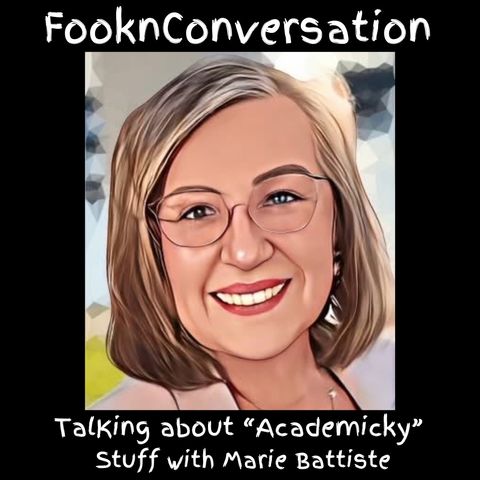
Dr. Marie Battiste
17 ott 2025 ·
58 min. 31 sec.
Scarica e ascolta ovunque
Scarica i tuoi episodi preferiti e goditi l'ascolto, ovunque tu sia! Iscriviti o accedi ora per ascoltare offline.
Descrizione
In Episode 67 Dr. https://uniweb.uottawa.ca/members/653 interviews https://thecanadianencyclopedia.ca/en/article/marie-battiste is a citizen of the https://micmac-nsn.gov/, a member of the https://potlotek.ca/ and the https://nativeamerica.travel/tribes/aroostook-band-of-micmacs in Maine. She is Professor Emerita at the https://www.usask.ca/ ...
mostra di più
In Episode 67 Dr. Nicholas Ng-A-Fook interviews Dr. Marie Battiste is a citizen of the Mi’kmaq Nation, a member of the Potlotek First Nation and the Aroostook Band of Micmacs in Maine. She is Professor Emerita at the University of Saskatchewan and one of the most influential scholars of Indigenous education in Canada. Her groundbreaking scholarship has advanced the work of decolonizing education, cognitive justice, and protecting Indigenous knowledges, shaping curriculum studies and educational policy across the country. Dr. Battiste has authored several books such as but not limited to Decolonizing Education: Nourishing the Learning Spirit, co-authored Protecting Indigenous Knowledge and Heritage: A Global Challenge and Protecting Indigenous Knowledge and Heritage: A Canadian Obligation with Dr. James (Sakej) Henderson, and edited several collections including Living Treaties and Visioning Mi’kmaw Humanities. Over her career, she has published more than 80 essays and reports, and her contributions have been recognized with six honorary degrees, election as a Fellow of the Royal Society of Canada, and numerous national and community distinctions. We discussed the following: The central role that her Mi’kma’ki/Unama’ki homeland has made in relation to scholarship, the intergenerational impact of settler colonial government policies of forced displacement and residential schooling on families and community life, graduate studies, career and family transitions, language revitalization through Mi’kmaw literacy and curriculum-making, cognitive imperialism, cognitive justice, restoration of Indigenous knowledge systems, influence of the American Indian and Civil Rights Movements, treaty education, and how trans-systemic approaches to law, knowledge creation, and education remain foundational to constitutional reconciliation, and advocates for rethinking university reward systems toward valuing Indigenous knowledge outside Eurocentric peer-review metrics and stresses our ethical responsibilities to protect land, water, air, each other, and more-than-human-kin.
mostra meno
Informazioni
| Autore | voicEd Radio |
| Organizzazione | voicEd Radio Canada |
| Sito | - |
| Tag |

Copyright 2026 - Spreaker Inc. an iHeartMedia Company

Commenti