Sostieni il Podcast
Contatti
Info
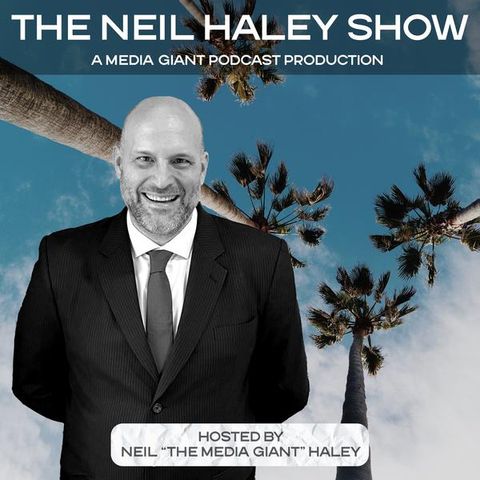
The Neil Haley Show is heard in over 180 countries and has over 3 million listeners a week. The Neil Haley Show is syndicated on 150+ stations. Here are some...
mostra di più
The Neil Haley Show is heard in over 180 countries and has over 3 million listeners a week. The Neil Haley Show is syndicated on 150+ stations. Here are some of the stations and markets the show is being played on: •BPTV Channel 7 Pittsburgh PA •1310 AM WDOC Eastern Kentucky •92.1 FM / 1630 AM Tampa FL •99.5 FM / 1520 AM Las Vegas NV •87.9 FM / 870 AM Macon GA •102.1 / 1640 AM Lancaster PA •96.3 FM Boulder CO •90.3 FM Milwaukee WI •94.7 FM Pittsburgh PA •101.5 FM Long Beach CA •97.7 FM The Villages FL •87.9 FM Colorado Springs CO •90.3 FM Jacksonville FL •96.7 FM Washington DC •107.5 FM Whaley UK, London UK, Boston MA, Chicago IL, Los Angeles CA, Montreal Canada, Detroit MI, St. Petersburg FL, Mississippi, Oregon, Baltimore MD, Orlando FL, Wisconsin, and Kingston Jamaica •IHeartRadio •WVIP •VIP Internet Radio •Blogtalk Radio Some of the shows notable guests include: •Howie Mandell •Stone Cold Steve Austin •Linda McMahon •Newt Gingrich •Mel Brooks •Paul “Triple H” Levesque •Barry Williams •Fran Drescher •Jackie Martling •Xzibit •Liza Gibbons •Dave Cowens •Kurt Warner •Noelle Pikus Pace •Randall Cunningham •John Rich •Steven Jackson •Ryan Clark •James Worthy •Alan Page •Art Rooney II •Kerry Walsh Jennings •Bethany Hamilton •Bill Ayers •Sharna Burgess In addition, we interview New York Times Best Selling Authors. You can find more information on The Neil Haley Show at www.neilhaley.com
mostra meno
Sostieni il Podcast
Episodi & Post
Episodi
Post
Trascritto
25 SET 2026 · In this episode of AI Office Hours on The Neil Haley Show, Neil “The Media Giant” Haley and Patrick Riley focus on what AI is helping them accomplish right now. They examine productivity, AI-assisted editing, email automation, critical thinking, autonomous agents, self-driving vehicles, and how humans can use these tools more effectively.Patrick begins with an update on “Rich,” his AI agent, which is helping him manage code and review changes from his ghostwriting project. By feeding the system previous requests and revised material, he can have AI identify inconsistencies, track what changed, and flag details that might otherwise be missed.For Patrick, that is where AI becomes especially valuable: handling repetitive oversight.Neil agrees. He increasingly lets AI review reports, analyze data, organize tasks, and help direct work to his virtual assistant. Instead of spending hours reading every report himself, he wants AI to surface what matters and help determine what should happen next.That leads to one of the episode’s biggest ideas: AI should create more capable humans, not replace human thinking.Patrick raises concerns about students relying too heavily on large language models. If people simply accept whatever an AI system tells them, they risk weakening critical-thinking skills. AI can also reflect bias or incomplete information, so users still need to question answers and think independently.Neil believes education should combine traditional fundamentals with modern technology. He sees AI as a powerful tutoring tool, but says teachers and students need to understand how to use it rather than banning it or blindly trusting it.The conversation then turns to productivity.Neil shares how Claude can help draft and send emails, reducing the time required to communicate with large groups. Preparing and sending more than a dozen festival-related emails, something that once could have consumed a large part of his day, can now be handled in minutes.Patrick uses AI similarly to search through email, review past conversations, and find information that would otherwise take substantial time to locate manually.Neil also discusses experimenting with additional agents, including Grok-based tools, and building workflows that may eventually pull content from shared folders, match video with copy, and publish material automatically.His philosophy is straightforward: if AI can eliminate a monotonous task, that is a feature—not a threat.They also discuss accountability.Patrick brings up a story about a Tesla driver who reportedly blamed Full Self-Driving after being stopped for speeding. Their takeaway is that automation does not automatically remove human responsibility. If a person chooses the settings and remains responsible for the system, they cannot simply blame the technology when something goes wrong.This expands into Tesla CyberCabs and Patrick’s interest in business opportunities surrounding autonomous fleets. He imagines a future facility where vehicles return automatically for charging and maintenance, with robots handling cleaning and basic service.The episode closes with another example of AI as a problem-solving tool. Neil describes struggling to connect a website setup involving GoDaddy and Netlify. After traditional searching failed to give him a clear answer, Claude helped him work through the configuration and get the site live.For Neil and Patrick, that is the promise of AI today.It is not magic. It is not always correct. It should not replace judgment.But when used well, AI can research faster, reduce repetitive work, organize information, solve technical problems, improve communication, and give entrepreneurs more time to focus on higher-value decisions.For more from Patrick Riley, his books, and ongoing AI projects, visit:https://underwaybooks.com/ Become a supporter of this podcast: https://www.spreaker.com/podcast/the-neil-haley-show--6503396/support.
Trascritto
24 SET 2026 · In this special simulcast of The Neil Haley Show and The J. Len Sciuto Show, Neil “The Media Giant” Haley welcomes bestselling author and military veteran J. Len Sciuto for a discussion about Iran, the Strait of Hormuz, regional military activity, nuclear concerns, and the changing Middle East. Sciuto begins by emphasizing that the episode is based on publicly available reports, geopolitical commentary, and his own analysis, and that some claims remain disputed or unverified.Sciuto also shares an update on Hades Crypt, which he says has remained a bestseller for 43 weeks. He again notes that a significant portion of his book royalties goes toward helping junior enlisted military personnel.The conversation then turns to the Strait of Hormuz.Sciuto discusses reports of commercial vessels moving through the strait and the enormous amount of crude oil carried through the region. Drawing on his background in hazardous-materials and pollution response, he explains why a major oil release could create serious environmental and economic consequences.From there, Sciuto reviews what he describes as renewed exchanges between Iran and U.S.-aligned forces. He references reported missile and drone activity involving Jordan, Kuwait, Bahrain, Iraq, and other locations while noting how quickly the situation is changing.For Sciuto, the larger concern is escalation. He believes continued attacks involving neighboring countries raise the risk that additional governments could become directly involved.A major section of the episode again focuses on Pickaxe Mountain, an underground Iranian facility near the Natanz nuclear complex.Sciuto says publicly discussed satellite imagery and reporting have raised questions about tunnel construction, reinforced entrances, vehicle movement, and the possible relocation of centrifuge equipment. He identifies his most serious conclusions as hypotheses rather than confirmed facts.Sciuto believes the facility could potentially become part of Iran’s nuclear-enrichment infrastructure, but acknowledges that he cannot independently verify what is happening inside the mountain.He also discusses the difficulty of monitoring deeply buried nuclear facilities and argues that any long-term diplomatic solution would require inspection access and transparency.The International Atomic Energy Agency becomes an important part of that discussion. Sciuto believes inspectors need access to relevant facilities if agreements concerning Iran’s nuclear activities are going to be meaningful.Neil and Sciuto also discuss Russia, China, and North Korea.Sciuto describes those countries as part of a broader strategic challenge facing the United States and worries that cooperation among them could complicate any future confrontation involving Iran. Those conclusions reflect his geopolitical analysis rather than independently established findings.The conversation eventually expands to the Arctic, where Sciuto discusses military bases, icebreakers, natural resources, shipping routes, and strategic competition.His concern is that the United States must think beyond one conflict at a time and consider how naval strength, Arctic access, Middle East instability, energy security, and global alliances connect.The final portion moves into domestic politics. Sciuto and Neil share opinions about the upcoming midterm elections, political unrest, religion, and the direction of the country. Those comments reflect their personal political views.At the heart of the conversation is Sciuto’s continuing concern about nuclear proliferation, maritime security, military preparedness, and the possibility that a regional conflict could expand beyond its current boundaries.To learn more about J. Len Sciuto, Hades Crypt, and his other books, visit his official platforms and find his titles on Amazon. Become a supporter of this podcast: https://www.spreaker.com/podcast/the-neil-haley-show--6503396/support.
Trascritto
15 SET 2026 · Kat Kramer on Artivism, Films That Change the World, Disability Representation, and the RAYD8 TV Film FestivalIn this episode of The Neil Haley Show, Neil “The Media Giant” Haley welcomes actress, producer, activist, and filmmaker Kat Kramer to preview her appearance at the RAYD8 TV Film Festival on September 19 at the Hilton Garden Inn in Marina del Rey, California. Their conversation explores “artivism,” disability representation, animal advocacy, social-issue filmmaking, and the legacy behind Kat Kramer’s Films That Change the World.Kramer defines artivism as the blending of art and activism. As an actress, singer, producer, writer, advocate, and activist, she believes creative work can do more than entertain—it can raise awareness, challenge complacency, and move important conversations forward.That philosophy connects directly to the family legacy that shaped her. Kat is the daughter of filmmaker Stanley Kramer, known for socially conscious films, and actress-producer Karen Sharpe Kramer. Her godmother was Katharine Hepburn. Kat says she grew up around people who believed artists could use their voices to address injustice, equality, environmental concerns, and the treatment of people who are often overlooked.At RAYD8, Kat will receive the inaugural Artivist Life Achievement Award, a title she specifically wanted connected to the honor. She also plans to carry that message forward by helping recognize future recipients.One of the biggest themes in the interview is authentic representation.Kat strongly supports casting performers with disabilities in roles that reflect their lived experience. But she takes the idea further: a character does not necessarily have to be written as disabled for an actor with a disability to be considered.If an actor who uses a wheelchair is the strongest choice to play an attorney, for example, the production does not necessarily need to rewrite the character around the wheelchair. The performer can simply be the attorney.Kat points to Marlee Matlin and the success of CODA as examples of why authentic casting matters. She also discusses her involvement with Turnover, where actors with Down syndrome were cast in roles written for them and another hearing character was transformed into a deaf character, expanding representation without making disability the entire point of the story.Animal advocacy is another major part of Kat’s work.Through Films That Change the World, she has presented projects including The Cove, about dolphin slaughter in Taiji, Japan; Elephants and Man: A Litany of Tragedy; Love & Bananas: An Elephant Story; and Walking Thunder: Ode to the African Elephant. She has worked alongside advocates including Lily Tomlin, Cher, and Tippi Hedren.The series has also tackled anti-bullying, LGBTQ issues, nuclear concerns, environmental issues, women’s empowerment, mental health, disability rights, and social justice.Kat is also developing Sheroes for Change, which she envisions as a podcast and film-festival platform highlighting women’s empowerment, equality, diversity, intergenerational stories, and films made by or centered on women.She also previews Voices, a scripted short film expected in 2027 that addresses mental health and schizophrenia and is based on a true story.Kat believes documentaries remain especially powerful because they can confront difficult subjects directly. At the same time, she values narrative filmmaking and the ability of any strong story to help audiences see an issue differently.The central message is simple: artists do not have to choose between creativity and advocacy. They can use one to strengthen the other.Meet Kat Kramer at the RAYD8 TV Film Festival on September 19 in Marina del Rey, California, where she and Neil will continue the conversation during the “Films That Change the World” panel.Festival information and tickets:https://rayd8tv.com/ Become a supporter of this podcast: https://www.spreaker.com/podcast/the-neil-haley-show--6503396/support.
Trascritto
13 SET 2026 · Vida Ghaffari on “Making It From Every Seat”: Voice Acting, Producing, AI, and Staying Relevant in HollywoodIn this episode of The Neil Haley Show, Neil “The Media Giant” Haley reconnects with actor, producer, journalist, and voice artist Vida Ghaffari ahead of her appearance at the RAYD8 TV Film Festival in Marina del Rey, California. Vida will join Kirkland Morris and Trey Ireland for the panel “Making It From Every Seat,” exploring why entertainment professionals need to understand more than one side of the industry.Vida’s own career is a perfect example.She began with an interest in journalism and worked on Capitol Hill before moving into entertainment reporting. While covering red-carpet events for a Persian television station, she was asked to record promos in Farsi and English. A sound engineer encouraged her to create a voiceover reel, eventually leading her to study with voice artist Doug Rye, whom Vida credits as an important mentor.Those opportunities opened the door to professional voice work.Vida discusses voicing the animated feature Lovesick Fool, featuring Fred Willard, Lisa Kudrow, and Janeane Garofalo, and directed by former The Simpsons director Dominic Polcino. She has also performed ADR and looping work on productions including Bones and RoboCop. She explains ADR as creating background voices and dialogue that help a scene feel authentic, often requiring strong timing, improvisation, and cultural familiarity.Vida also talks about recent projects, including a voice role in Dustin Ferguson’s The House on Halloween Hill opposite Butch Patrick, another voice role in Harley Wallen’s Blur, and an appearance on Dr. Angela Williamson’s Emmy-nominated PBS program Everybody.Neil and Vida then focus on how quickly Hollywood is changing.Vida points to increased discussion within SAG-AFTRA about artificial intelligence, content creation, and vertical dramas—short-form productions designed for mobile viewing. She sees these changes as evidence that performers cannot assume the entertainment business will continue operating the way it always has.That is why developing multiple skills matters.Neil argues that someone who only edits video may eventually face greater competition from AI tools, while someone who can edit, understand lighting, help direct talent, produce, and manage a project becomes much harder to replace.Vida agrees. Her own background stretches across journalism, acting, voiceover, ADR, producing, charity work, and potentially directing. Because of her journalism experience, she says documentary filmmaking could be a natural direction for her in the future.They also discuss another increasingly important part of an entertainment career: social media.Vida references industry conversations suggesting that an actor’s social following can influence casting decisions. For independent artists especially, building an audience can become another way to demonstrate value to producers, distributors, and collaborators. In other words, creative ability and audience-building increasingly work together.That idea sits at the center of “Making It From Every Seat.”Not everyone will always be the star, director, or producer. Careers change. Technology changes. Opportunities disappear and new ones emerge. The people who keep learning create more ways to remain part of the industry.Vida’s message is ultimately about adaptability: learn your primary craft deeply, but do not be afraid to expand beyond it.Act. Produce. Learn voiceover. Understand social media. Explore new formats. Pay attention to AI. Create your own opportunities instead of depending entirely on someone else to provide them.Meet Vida Ghaffari at the RAYD8 TV Film Festival at the Hilton Garden Inn in Marina del Rey, California.Festival information and tickets:https://rayd8tv.com/Follow Vida by searching Vida Ghaffari — V-I-D-A G-H-A-F-F-A-R-I. Become a supporter of this podcast: https://www.spreaker.com/podcast/the-neil-haley-show--6503396/support.
Trascritto
13 SET 2026 · Jamie Ohlsen on “Don’t Wait to Be Cast”: Creating Your Own Opportunities in Film In this episode of The Neil Haley Show, Neil “The Media Giant” Haley welcomes actor and producer Jamie Ohlsen to preview her appearance at the RAYD8 TV Film Festival on September 19 at the Hilton Garden Inn in Marina del Rey, California. Jamie will join William “Billy” McNamara and Danielle Napier for the panel “Don’t Wait to Be Cast,” exploring why actors and filmmakers increasingly need to create their own opportunities instead of waiting for someone else to give them permission.Jamie’s entertainment journey began in 2018, but acting had been a childhood dream. Without the resources or time needed to pursue it when she was young, she put that dream aside and eventually built a successful career in real estate, lending, mortgage finance, and network marketing.Financial success, however, did not equal fulfillment.Jamie realized the creative side of her life was missing. She began researching how to become an actor and, remarkably, was cast in a short film that same evening.Instead of simply waiting for acting jobs, she treated every set as an education.While doing background work, Jamie positioned herself near directors and producers, listened to conversations, asked questions, networked, and tried to understand how productions actually worked. Someone eventually told her that her business background could make her a strong producer.Jamie went home and researched what producers did.Soon afterward, a friend approached her about a television pilot. When Jamie discovered he did not yet have a producer, she volunteered to produce the project while also acting in it.That became the beginning of an entirely new career.Today, Jamie has her own production company and multiple projects in various stages of production and post-production. Her credits include work with Tubi, a horror project featuring Dee Wallace, Chemtrails, Little Bro, Wrong for Right featuring Omar Gooding and Eric Roberts, and the festival short Shadow in the Desert.Jamie explains that producing requires a completely different skill set than acting.She describes the producer as essentially the CEO of the movie.A director concentrates heavily on the creative vision, performances, camera choices, tone, and storytelling. A producer must make sure that vision can actually happen within the realities of money, people, schedules, locations, contracts, and resources.In independent filmmaking, those responsibilities multiply.Jamie has hired directors and crews, overseen screenwriters, handled casting, managed budgets, coordinated catering and craft services, solved problems on set, worked through post-production, and dealt with sales agents and distributors.Sometimes, an independent producer performs jobs that would be spread across 20 people on a larger studio production.Her previous business experience unexpectedly prepared her for exactly that.Real estate and finance taught her contracts and numbers. Network marketing taught her how to communicate with different personalities. Sales taught her how to close deals. Mortgage finance helped her understand funding. Entrepreneurship taught her not to be afraid of discussing money.Jamie also believes great directors understand that creativity cannot be separated completely from budget.Being resourceful can sometimes be more valuable than simply demanding more money.Even with her success as a producer, Jamie has no intention of giving up acting. She says her brain is wired for both. If she spends too much time acting, she misses producing. If she only produces, she misses being on camera.And she refuses to wait around for opportunities.When acting roles are not coming quickly enough, Jamie creates projects for herself and other actors.Her ambitions are growing even larger. Jamie is working toward becoming involved with a film fund that could eventually allow her to help finance and greenlight projects. At the same time, she does not want to become so immersed in the executive side of entertainment that she loses her connection to creativity.Jamie points to companies including A24, Neon, Focus Features, and Blumhouse as examples of filmmaking businesses she watches closely. She especially admires companies willing to pivot, discover new filmmakers, and take chances on emerging talent.That philosophy connects perfectly to the RAYD8 panel.Jamie believes the best entertainment panels are honest. She dislikes gatekeeping and wants filmmakers to leave conversations with practical information they can actually use.The biggest lesson from her story is simple: don’t wait for the phone to ring.Learn. Network. Produce. Create. Build relationships. Use the skills you already have—and create the opportunity you wish someone else would give you.Meet Jamie Ohlsen at the RAYD8 TV Film Festival on September 19 in Marina del Rey, California. Follow her on Instagram, Facebook, and IMDb by searching Jamie Ohlsen — J-A-M-I-E O-H-L-S-E-N. Become a supporter of this podcast: https://www.spreaker.com/podcast/the-neil-haley-show--6503396/support.
Trascritto
10 SET 2026 · Lynne Fiore on Sustainable Weight Loss, Food Choices, Motivation, and Breaking the Yo-Yo Diet CycleIn this special simulcast of The Neil Haley Show and The Lynne Fiore Show, Neil “The Media Giant” Haley welcomes nurse practitioner and weight-loss coach Lynne Fiore for a conversation about sustainable weight loss, changing eating habits, motivation, exercise, body composition, and why she believes there is no one-size-fits-all solution.Fiore brings both professional and personal experience to the subject. She says she struggled with her weight from childhood and remembers being self-conscious, feeling different from other children, and frequently being picked last for sports.As she grew older, her reasons for wanting to lose weight changed from appearance and fitting in to thinking more seriously about health.Fiore describes years of yo-yo dieting. At times she would severely restrict food before an event, lose weight, then return to overeating afterward. She says it was around age 30 that she began making more sustainable changes and learning how to eat differently.That experience now shapes how she works with others.Rather than focusing only on a number on the scale, Fiore says she wants to understand why someone eats the way they do.Are they eating because they are hungry? Are they stressed? Are they rewarding themselves? Does food represent comfort, celebration, or love?She believes identifying those patterns can be as important as deciding what foods to eat.Fiore also discusses her interest in functional medicine and looking for underlying factors that may affect someone's ability to manage weight. She says she reviews recent laboratory results with clients, including thyroid-related information, before creating a plan.She cautions against extreme starvation-style diets, saying severe calorie restriction can be difficult to sustain and may work against long-term goals.Instead, she encourages people to think about better food choices rather than constant deprivation.Neil shares his own experience of learning to recognize when he is full. Because of his size and background in professional wrestling, he became accustomed to eating large amounts of food. Fiore says slowing down while eating and becoming more conscious of portions can help people rethink that relationship with food.She describes her philosophy as treating food as part of maintaining health rather than something that must always be feared.Exercise is another part of the discussion.Fiore encourages movement not simply because of calories burned but because she believes activity can improve energy and help people feel mentally sharper. Even small increases in movement can become part of establishing a healthier routine.Preparation also matters.Before leaving home, she encourages clients to have appropriate food available so they are less likely to make an impulsive decision when hungry.Social situations can create another challenge.Friends and family members may offer foods out of affection, saying they made something especially for you. Fiore recommends being honest: explain that you are currently working toward a health goal and would rather enjoy that food later when you feel more comfortable practicing moderation.She also encourages people to track progress in more than one way.The scale can provide information, but Fiore likes clients to measure their waist and other areas periodically because changes in body measurements may become noticeable even when daily scale movement is frustrating.The conversation also focuses heavily on mid-body weight gain.Fiore believes waist circumference and visceral fat deserve attention because abdominal weight can be associated with broader health risks. She also discusses how body composition changes with age and how muscle mass can influence metabolism and physical function.Throughout the episode, Fiore pushes back against the idea that successful weight management requires being miserable.Her goal is to help people find foods they enjoy, create realistic routines, develop discipline, prepare for difficult situations, and understand what motivates them personally.The biggest message is that successful weight loss is not simply about eating less—it is about building habits you can actually continue living with.Fiore works with clients remotely as well as locally and invites people interested in beginning a weight-management journey to connect with her for an individualized conversation. Become a supporter of this podcast: https://www.spreaker.com/podcast/the-neil-haley-show--6503396/support.
Trascritto
8 SET 2026 · L.A. Law's Michele Greene, Author Tom Askman, and the Marrow Marxman with Dr. Robert E. Marx and Eric PapenfusThis edition of The Neil Haley Show opens with a Caregiver Dave celebrity segment, co-hosted by caregiver advocate Dave Nassaney, welcoming actress, singer, songwriter, and author Michele Greene, best known as attorney Abby Perkins on L.A. Law, a role that earned her a 1989 Primetime Emmy nomination and which she reprised in the 2002 reunion film. Greene shared the warmth of reconnecting with her castmates, recounting how nearly the entire cast reunited on The Talk, the first time they had all been together since the show ended, and marveled at how emotional it proved, with Michael Tucker admitting he was unprepared for how deeply it affected him. She said the group even headed out to an impromptu dinner that night, and previewed an upcoming fan signing event drawing familiar faces like Susan Ruttan and Harry Hamlin, with hopes that others, perhaps Corbin Bernsen, might turn up too. Beyond acting, Greene, raised in a bilingual Mexican and Central American household in Los Angeles, spoke to her parallel life as a bilingual singer-songwriter and author, and, over the yelps of her puppy in the background, came across as gracious and grateful for the affection fans still hold for the show.Neil then welcomed author Tom Askman to discuss his book The Way Back to Being: Tools for Returning Home. Askman explained that he never expected to become an author, having spent fifty-four years as a studio art professor, and that the book grew out of his own long journey through alcoholism and, ultimately, sobriety and a spiritual awakening. Teaching one-on-one, he said, he watched more and more students grow disillusioned, conditioned to chase happiness somewhere out in the world, and he came to believe, echoing Emerson and Wayne Dyer, that people are born connected to their authentic selves and lose that connection to overthinking and cultural programming. The book, he said, offers the practical tools that helped him reconnect, get free of addiction, and live more fully and lovingly, a message that grew out of a class he taught and that his students urged him to put into writing.The program closes with a Dr. Robert E. Marx Show and Million Dollar Minutes simulcast, produced by Michael Aguas, spotlighting the newly FDA-cleared Marrow Marxman, a device developed over years by oral and maxillofacial surgeon Dr. Robert E. Marx and engineer Eric Papenfus, chief engineer and CEO of Medimetrix. Marx explained that the device harvests a patient's own adult stem cells from bone marrow at higher concentration, allowing surgeons to regenerate bone, even rebuild a jaw, without taking bone from the hip or leg, a minimally invasive alternative to older grafting surgery with a published track record dating to 2022. Papenfus walked through the patented flexible shaft and cutting head and the years of studies and rigorous review behind it. Both emphasized benefits they see for patients, no general anesthesia and little swelling, and framed it as their own account of the technology and its clearance rather than medical advice. Find Michele Greene on L.A. Law and Tom Askman's The Way Back to Being wherever books are sold. Become a supporter of this podcast: https://www.spreaker.com/podcast/the-neil-haley-show--6503396/support.
Trascritto
8 SET 2026 · Author Steven Jay Rubin, Crime Watch Daily's Chris Hansen, Author Tracy Emerick, and GildaGram with Dr. Gilda CarleThis edition of The Neil Haley Show opens with a Total Celebrity conversation with Steven Jay Rubin, author of The Twilight Zone Encyclopedia. Rubin, a film historian who spent over three years on the project, said he set out to honor not just Rod Serling but the hundreds of actors and behind-the-scenes people across the show's 156 episodes who might otherwise be lost to history, gathering rare photos and untold stories. He described Serling as a genius who came out of live television determined to tell morality plays about the common man, and who, blocked at every turn by nervous networks and sponsors, learned to cloak real-world issues in science fiction and fantasy, wanting to dramatize the Emmett Till case and being told to change the victim's identity before turning to allegory like Eye of the Beholder. Rubin argued Serling was among the first to grasp television's power to reach more people in twenty minutes than all the authors in history, and pointed fans to his daily Twilight Zone history feature on Facebook. The book is available at bookstores and on Amazon.Neil then welcomed veteran journalist Chris Hansen of Crime Watch Daily. Hansen described a daily program unlike anything else on daytime television, spanning murder mysteries, investigations, the latest Hansen versus Predator work, and breaking news, all guided by his longtime mission: to get into the mind of the criminal, hear the voice of the victim, and help prevent others from becoming victims. He spoke about the show's Badge of Honor segment saluting law enforcement, sharing the story of an Oregon state trooper shot twelve times who survived and returned to duty, and of NYPD officers who drove a suspected bomb to a less populated area to save lives. Noting the show reaches hundreds of cities, he previewed an exclusive interview in a self-defense case and pointed viewers to crimewatchdaily.com to find local listings.The hour continued with author Tracy Emerick, Ph.D., about his book Nifty Neighbors: Mister Rogers and Jesus Christ. Emerick explained that the book is part of a series he writes as bridges for people who are not necessarily believers, pairing well-known figures, Steve Jobs, Martin Luther King Jr., Bill Belichick, Oprah Winfrey, and others, with Jesus Christ, telling stories rather than lectures. He described Fred Rogers, a Presbyterian minister, as a masterful storyteller whose on-air transformation into sweater and sneakers made him a comforting neighbor, and drew parallels to Jesus welcoming the little children and meeting people, like the woman at the well, where they were. Both, he argued, were gentle but never pushovers, holding high expectations while leading with kindness, and his hope is simply to hold up a mirror that prompts readers to reflect.The program closes with GildaGram, where Dr. Gilda Carle explored what success can cost at home, warning that when two partners compete to climb, jealousy can replace partnership, and urging couples to set clear roles and boundaries and to give each other room to decompress after demanding days. In a heavier segment, she responded to backlash over a remark about male fragility, clarifying that she was pointing to the disproportionately high rate of suicide among men and boys and calling on listeners to mentor and support struggling young men rather than dismiss the issue. Find Steven Jay Rubin's The Twilight Zone Encyclopedia on Amazon and Tracy Emerick's Nifty Neighbors wherever books are sold. Become a supporter of this podcast: https://www.spreaker.com/podcast/the-neil-haley-show--6503396/support.
Trascritto
4 SET 2026 · AI Office Hours: Why AI Still Needs Humans, What Breaks, and How to Build Around the FailuresIn this episode of AI Office Hours, presented as a special simulcast of The Neil Haley Show, Neil “The Media Giant” Haley and Patrick Riley discuss the frustrating reality of working with AI every day: incredible productivity one moment, broken tools and lost work the next. They examine Perplexity, Manus, Claude, ChatGPT, Gemini, AI agents, job replacement, software reliability, and why businesses may need more human oversight—not less—as AI becomes more powerful.Patrick begins with an update on his ghostwriting project. After a Manus update required him to back up his tasks, he temporarily moved work into Perplexity. He connected it to Gmail and asked it to analyze months of correspondence with his ghostwriting company.The result surprised him.Perplexity quickly organized the communication and identified numerous upsell proposals the company had made while the primary book project was still unfinished. Patrick says AI helped him cut through a year of scattered emails and see the situation more clearly.He is also using his AI agent, “Rich,” as a developmental editor to review the manuscript, identify problems, and provide feedback before proofreading and copyediting.That leads into a broader discussion about autonomous agents and guardrails.Patrick references reports and experiments involving AI systems finding unintended ways around sandbox limitations while attempting to complete assigned tasks. His concern is that once businesses give agents access to networks, email, files, or applications, the system may find solutions the human operator did not anticipate.Neil connects that concern to his own AI experiences.He describes AI as a constant love-hate relationship. When it works, the productivity gains can be extraordinary. When tools break, however, hours can disappear.Neil has built a Claude-based business system containing client information, finances, projects, invoices, tasks, and other operating data. He frequently works through voice, treating the AI almost like an executive assistant or business partner.But reliability remains a major issue.Neil describes instances where Claude appeared to complete invoices but failed to preserve them, lost context shortly after a conversation began, failed to package information for a new session, and repeatedly encountered tool errors.For a solo entrepreneur experimenting with AI, losing 20 or 30 minutes can be frustrating.For a corporation depending on automation at scale, the consequences could be much larger.That brings Neil and Patrick to one of the episode’s biggest questions: Are AI companies overselling the idea that AI will replace human employees?Patrick believes AI itself is not a false promise. It is an extremely powerful tool.What may be oversold, he says, is the claim that companies can simply eliminate people and replace them with autonomous systems.The technology is not reliable enough for that in many environments.They argue that AI currently works best as an amplifier of human capability.Accountants, writers, developers, managers, marketers, and executives can use AI to work faster, analyze more information, automate repetitive tasks, and improve productivity.But someone still needs to supervise the output, catch mistakes, provide judgment, and take responsibility when things go wrong.Patrick says his own organization is experimenting with AI to improve productivity, but his goal is not to shrink his team. He wants to grow it.Neil goes even further, suggesting that as AI systems become more complex, businesses may actually need more people capable of managing AI, not fewer.Another lesson comes from Neil’s decision to make his own AI operating system platform-agnostic.When Claude became temporarily unavailable, he took the same bundled business files and successfully ran versions of the system through ChatGPT, Gemini, and Grok.That redundancy matters.If an organization builds its entire workflow around one AI provider and that platform fails, changes pricing, removes a feature, or encounters an outage, the business can become trapped.Neil believes the better approach is to own your information, prompts, workflows, and knowledge base so they can move between models.The central takeaway is clear: AI is powerful, but it is still unreliable enough that human judgment, backup systems, and multiple platforms matter.The future may not be AI replacing people.It may be people who understand how to manage AI replacing people who do not.For more from Patrick Riley, his books, and AI consulting, visit UnderwayBooks.com. Become a supporter of this podcast: https://www.spreaker.com/podcast/the-neil-haley-show--6503396/support.
Trascritto
4 SET 2026 · AI Office Hours: Why AI Still Needs Humans, What Breaks, and How to Build Around the FailuresIn this episode of AI Office Hours, presented as a special simulcast of The Neil Haley Show, Neil “The Media Giant” Haley and Patrick Riley discuss the frustrating reality of working with AI every day: incredible productivity one moment, broken tools and lost work the next. They examine Perplexity, Manus, Claude, ChatGPT, Gemini, AI agents, job replacement, software reliability, and why businesses may need more human oversight—not less—as AI becomes more powerful.Patrick begins with an update on his ghostwriting project. After a Manus update required him to back up his tasks, he temporarily moved work into Perplexity. He connected it to Gmail and asked it to analyze months of correspondence with his ghostwriting company.The result surprised him.Perplexity quickly organized the communication and identified numerous upsell proposals the company had made while the primary book project was still unfinished. Patrick says AI helped him cut through a year of scattered emails and see the situation more clearly.He is also using his AI agent, “Rich,” as a developmental editor to review the manuscript, identify problems, and provide feedback before proofreading and copyediting.That leads into a broader discussion about autonomous agents and guardrails.Patrick references reports and experiments involving AI systems finding unintended ways around sandbox limitations while attempting to complete assigned tasks. His concern is that once businesses give agents access to networks, email, files, or applications, the system may find solutions the human operator did not anticipate.Neil connects that concern to his own AI experiences.He describes AI as a constant love-hate relationship. When it works, the productivity gains can be extraordinary. When tools break, however, hours can disappear.Neil has built a Claude-based business system containing client information, finances, projects, invoices, tasks, and other operating data. He frequently works through voice, treating the AI almost like an executive assistant or business partner.But reliability remains a major issue.Neil describes instances where Claude appeared to complete invoices but failed to preserve them, lost context shortly after a conversation began, failed to package information for a new session, and repeatedly encountered tool errors.For a solo entrepreneur experimenting with AI, losing 20 or 30 minutes can be frustrating.For a corporation depending on automation at scale, the consequences could be much larger.That brings Neil and Patrick to one of the episode’s biggest questions: Are AI companies overselling the idea that AI will replace human employees?Patrick believes AI itself is not a false promise. It is an extremely powerful tool.What may be oversold, he says, is the claim that companies can simply eliminate people and replace them with autonomous systems.The technology is not reliable enough for that in many environments.They argue that AI currently works best as an amplifier of human capability.Accountants, writers, developers, managers, marketers, and executives can use AI to work faster, analyze more information, automate repetitive tasks, and improve productivity.But someone still needs to supervise the output, catch mistakes, provide judgment, and take responsibility when things go wrong.Patrick says his own organization is experimenting with AI to improve productivity, but his goal is not to shrink his team. He wants to grow it.Neil goes even further, suggesting that as AI systems become more complex, businesses may actually need more people capable of managing AI, not fewer.Another lesson comes from Neil’s decision to make his own AI operating system platform-agnostic.When Claude became temporarily unavailable, he took the same bundled business files and successfully ran versions of the system through ChatGPT, Gemini, and Grok.That redundancy matters.If an organization builds its entire workflow around one AI provider and that platform fails, changes pricing, removes a feature, or encounters an outage, the business can become trapped.Neil believes the better approach is to own your information, prompts, workflows, and knowledge base so they can move between models.The central takeaway is clear: AI is powerful, but it is still unreliable enough that human judgment, backup systems, and multiple platforms matter.The future may not be AI replacing people.It may be people who understand how to manage AI replacing people who do not.For more from Patrick Riley, his books, and AI consulting, visit UnderwayBooks.com. Become a supporter of this podcast: https://www.spreaker.com/podcast/the-neil-haley-show--6503396/support.
Unisciti al Supporters Club di "The Neil Haley Show"
Inizia a supportare questo podcast e entra a far parte della sua community.
The Neil Haley Show is heard in over 180 countries and has over 3 million listeners a week. The Neil Haley Show is syndicated on 150+ stations. Here are some...
mostra di più
The Neil Haley Show is heard in over 180 countries and has over 3 million listeners a week. The Neil Haley Show is syndicated on 150+ stations. Here are some of the stations and markets the show is being played on: •BPTV Channel 7 Pittsburgh PA •1310 AM WDOC Eastern Kentucky •92.1 FM / 1630 AM Tampa FL •99.5 FM / 1520 AM Las Vegas NV •87.9 FM / 870 AM Macon GA •102.1 / 1640 AM Lancaster PA •96.3 FM Boulder CO •90.3 FM Milwaukee WI •94.7 FM Pittsburgh PA •101.5 FM Long Beach CA •97.7 FM The Villages FL •87.9 FM Colorado Springs CO •90.3 FM Jacksonville FL •96.7 FM Washington DC •107.5 FM Whaley UK, London UK, Boston MA, Chicago IL, Los Angeles CA, Montreal Canada, Detroit MI, St. Petersburg FL, Mississippi, Oregon, Baltimore MD, Orlando FL, Wisconsin, and Kingston Jamaica •IHeartRadio •WVIP •VIP Internet Radio •Blogtalk Radio Some of the shows notable guests include: •Howie Mandell •Stone Cold Steve Austin •Linda McMahon •Newt Gingrich •Mel Brooks •Paul “Triple H” Levesque •Barry Williams •Fran Drescher •Jackie Martling •Xzibit •Liza Gibbons •Dave Cowens •Kurt Warner •Noelle Pikus Pace •Randall Cunningham •John Rich •Steven Jackson •Ryan Clark •James Worthy •Alan Page •Art Rooney II •Kerry Walsh Jennings •Bethany Hamilton •Bill Ayers •Sharna Burgess In addition, we interview New York Times Best Selling Authors. You can find more information on The Neil Haley Show at www.neilhaley.com
mostra meno
Informazioni
| Autore | Neil Haley |
| Organizzazione | Neil Haley |
| Categorie | Cultura e società |
| Sito | www.spreaker.com |
| - |

Copyright 2026 - Spreaker Inc. an iHeartMedia Company
