Info
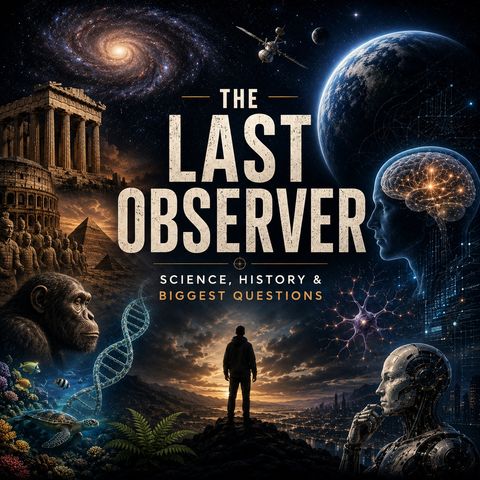
Exploring science, history, and the universe’s biggest questions. From ancient mysteries to the frontiers of reality, we seek truth through curiosity and wonder.
Episodi & Post
Episodi
Post
Contenuto generato con l’IA
Trascritto
28 SET 2026 · Star formation across the universe has been steadily collapsing for billions of years.
A major new survey of millions of galaxies shows the long-accepted explanation is wrong—and the real reason is far more surprising. This episode includes AI-generated content.
Contenuto generato con l’IA
Trascritto
24 SET 2026 · How did life emerge from nonliving chemistry on the early Earth?
Scientists are piecing together a fascinating story involving volcanic energy, hydrothermal vents, organic molecules, RNA, minerals, and primitive membranes. From simple chemistry to the first self-replicating protocells, the origin of life may have been a gradual process of increasing molecular complexity—though some of its biggest mysteries remain unsolved. This episode includes AI-generated content.
Contenuto generato con l’IA
Trascritto
21 SET 2026 · In 1518 Strasbourg, hundreds of people reportedly began dancing uncontrollably, creating one of history’s strangest mass outbreaks. Authorities initially made things worse by encouraging the dancing, while some victims reportedly died from exhaustion.
Centuries later, researchers still debate whether mass psychogenic illness, extreme social stress, or ergot poisoning triggered the bizarre phenomenon. This episode includes AI-generated content.
Contenuto generato con l’IA
Trascritto
17 SET 2026 · Science is beginning to treat aging as a biological process that may be modified. Researchers are exploring cellular senescence, epigenetic reprogramming, and other strategies to extend healthy lifespan.
Despite major challenges and risks, these breakthroughs could fundamentally change how we age—and potentially expand human longevity in the decades ahead. This episode includes AI-generated content.
Contenuto generato con l’IA
Trascritto
14 SET 2026 · The Early Middle Ages were far more innovative than the “Dark Ages” stereotype suggests. After Rome’s decline, Europe saw major advances in watermills and windmills, agriculture, transportation, and warfare.
The heavy plow, three-field rotation, horse collar, and stirrup boosted productivity and transformed society, while scholars preserved ancient knowledge and developed more standardized writing. These innovations helped lay the technological and cultural foundations of medieval Europe. This episode includes AI-generated content.
Contenuto generato con l’IA
Trascritto
10 SET 2026 · Were Ice Age cave paintings more than art? Researchers argue that sites like Lascaux and Altamira contain hidden star maps, lunar calendars, and geometric symbols used to track constellations, solstices, and seasonal cycles.
If correct, these remarkable caves may represent humanity's earliest scientific records, revealing that Paleolithic people combined careful sky observation with a sophisticated understanding of the natural world. This episode includes AI-generated content.
Contenuto generato con l’IA
Trascritto
7 SET 2026 · Human evolution wasn't a straight path—it was a genetic blend of multiple ancient human species. Using advanced DNA analysis, researchers have uncovered "ghost lineages" from extinct ancestors that left no fossils but still survive in our genomes.
These ancient genetic contributions helped shape our immune system, metabolism, and brain, revealing that modern humans are an evolutionary mosaic built from the legacy of several long-lost hominin groups. This episode includes AI-generated content.
Contenuto generato con l’IA
Trascritto
3 SET 2026 · Scientists are expanding the Search for Extraterrestrial Intelligence (SETI) by exploring higher radio frequencies long ignored in the hunt for alien signals. Using archived ALMA observations, researchers are searching for technosignatures while taking advantage of "stellar bycatch"—data that unintentionally includes millions of nearby stars.
The study suggests that existing telescope archives could dramatically broaden the search for extraterrestrial civilizations without requiring new observations. This episode includes AI-generated content.
Contenuto generato con l’IA
Trascritto
1 SET 2026 · A mile beneath the Black Hills of South Dakota, inside ten tons of ultrapure liquid xenon, something unexpected happened. On a single day in June, the LUX-ZEPLIN detector recorded a nuclear recoil that refuses to match any known background. It is only one event. The statistical significance is modest.
No one is claiming discovery. And yet the collaboration spent months trying—and failing—to explain it away.
In this episode we sit with that quiet, stubborn anomaly: the deepest dark-matter experiment on Earth, a particle that may be more than two hundred times heavier than a proton, and the strange possibility that the galactic halo just brushed against us for the first time. This episode includes AI-generated content.
Contenuto generato con l’IA
Trascritto
31 AGO 2026 · Is empty space truly empty? In this episode, we explore how modern physics reveals the quantum vacuum as a dynamic sea of invisible fields and constant energy fluctuations.
Discover how this hidden foundation gives particles mass, produces measurable quantum effects, and may have powered cosmic inflation while continuing to drive the universe's expansion through dark energy. This episode includes AI-generated content.
Exploring science, history, and the universe’s biggest questions. From ancient mysteries to the frontiers of reality, we seek truth through curiosity and wonder.
Informazioni
| Autore | Synthetic Universe |
| Organizzazione | Marcelo |
| Categorie | Scienze , Storia , Fisica |
| Sito | - |
| - |

Copyright 2026 - Spreaker Inc. an iHeartMedia Company
