Contatti
Info
The EbonLiner is about Entertainment, Culture, and More. It has the RODRocket show about vehicles, MAAPS is about biblical content on people from the African continent, Owensy is about famous...
mostra di più
The EbonLiner is about Entertainment, Culture, and More. It has the RODRocket show about vehicles, MAAPS is about biblical content on people from the African continent, Owensy is about famous African Americans with the name Owens, Movies Unmade, and a fiction podcast titled Dorsalee™.
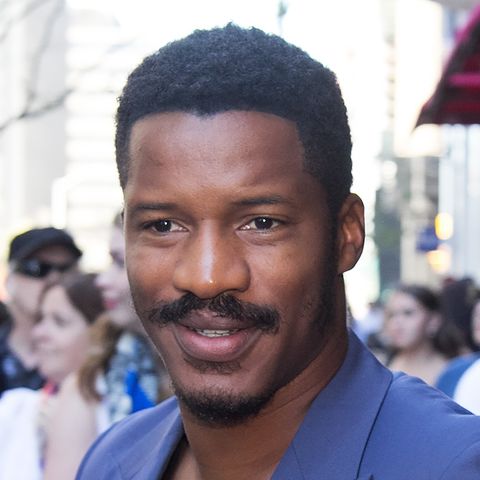
Photo Credit: Gordon Correll/Flickr.com
Usage: Some rights reserved. CC BY-SA 2.0
https://flic.kr/p/pcSm25
mostra meno
Photo Credit: Gordon Correll/Flickr.com
Usage: Some rights reserved. CC BY-SA 2.0
https://flic.kr/p/pcSm25
Episodi & Post
Episodi
Post
Trascritto
29 SET 2026 · The Story They Didn’t Tell You About the 1971 Pirates
l
September 1, 1971. Pittsburgh, Pennsylvania. Baseball history was made at Three Rivers Stadium.
The Pittsburgh Pirates took the field against the Philadelphia Phillies with a starting lineup made up entirely of Black and Afro-Latino players.
But here’s the part of the story that doesn’t always get told.
The players didn’t walk onto that field saying, “We’re about to make history.” They were baseball players doing what baseball players do.
Injuries and lineup changes helped create the unusual starting nine. And during the game, some of the players gradually realized just how remarkable the lineup was.
Gene Clines remembered looking around and recognizing what was happening.
Someone even compared the scene to the old Homestead Grays, Pittsburgh’s legendary Negro League baseball team.
Think about that.
The Pirates were now a Major League team — and their lineup had become a living reminder of Pittsburgh’s Negro League baseball history.
And there was another strange twist.
The Pittsburgh newspapers were on strike.
So when this historic game happened, Pittsburgh didn’t wake up the next morning to the kind of local newspaper coverage you might expect for such an important moment.
The history happened.
The game was played.
And the Pirates won, 10–7. But the story wasn’t over. That same Pirates team would go on to win the 1971 World Series. And standing in that historic lineup was Roberto Clemente, one of baseball’s greatest players.
So when we remember September 1, 1971, we shouldn’t remember it only as the night the Pirates fielded the first all-Black and Latino starting lineup in Major League history.
Remember the circumstances.
Remember the players.
Remember the Homestead Grays connection.
Remember that they didn’t necessarily realize the significance as it was happening.
And remember that history doesn’t always announce itself.
Sometimes…
history just walks onto the field and plays ball.
I’m Gail Nobles. And this is a story from baseball history that deserves another look. News, Culture, and Entertainment
Trascritto
27 SET 2026 · THE BLACK TOONIVERSE
Story by: Gail Nobles
Podcast Photo: Gail Nobles
I AM THE GREATEST: THE ADVENTURES OF MUHAMMAD ALI
When the Greatest stepped into animation
Before animated superheroes dominated Saturday mornings, boxing legend Muhammad Ali made his way into the world of cartoons.
I Am the Greatest: The Adventures of Muhammad Ali was an animated series starring the legendary boxer himself. What made the series especially distinctive was Ali’s participation as the voice of his animated character.
The series aired on NBC on Saturday mornings in the fall of 1977. It was produced by Fred Calvert’s independent production company, Farmhouse Films, bringing Ali’s larger-than-life personality into an animated setting.
Despite the star power behind the project, the series had a short run. It was cancelled after 13 episodes, following low ratings.
Today, I Am the Greatest: The Adventures of Muhammad Ali remains an interesting piece of television and animation history—a rare example of a major sports figure stepping directly into an animated series and performing his own voice.
I'm Gail Nobles. Thank you for listening to Ebonliner: The Black Tooniverse. News, Culture, and Entertainment
Trascritto
7 SET 2026 · Story by: Gail Nobles
Podcast cover by: Gail Nobles
Who is the Black Superman? You might think you know the answer. But before Calvin Ellis and Val-Zod, there was a real man who had already stepped into that kind of larger-than-life image. His name was Muhammad Ali.
In 1978, DC Comics brought Superman and Muhammad Ali together in Superman vs. Muhammad Ali. The story placed the world’s greatest superhero in the ring with the world’s most famous boxer. Under the conditions of a red sun, Ali defeated Superman.
That was fiction—but the connection between Ali and Superman went beyond the comic book.
Ali was already a larger-than-life figure whose confidence, athletic ability, personality, and public presence made him seem almost superhuman. He didn’t wear a cape, but he carried himself like a man who believed he could do the impossible.
Then, years later, DC introduced other Black men who would carry the Superman identity.
Calvin Ellis, introduced in 2009, became the Superman of Earth-23—and also its President.
Val-Zod, introduced in 2014, became the Superman of Earth-2, bringing a very different personality and philosophy to the role.
So when we look at the timeline, an interesting question comes up:
Who is that Black Superman?
Is it the man from another Earth?
Is it the man from a comic book?
Or could the idea of the Black Superman have already existed in the real world—in the form of Muhammad Ali?
That’s where I call him The Real Super Guy.
Ali didn’t need to be Superman. He was Muhammad Ali.
And maybe that’s the most interesting part of the story.
Do you ever wonder what could have happened if Ali’s Superman connection had gone beyond a comic book and into a movie?
I’m Gail Nobles, and you’re listening to Movies Unmade on Ebonliner. News, Culture, and Entertainment
Trascritto
5 SET 2026 · Story by: Gail Nobles
Podcast cover by: Gail Nobles
LL Cool J has longevity. He was built to last.
Over the years, LL Cool J has shown that he is more than a rapper. He has become an entertainer with a presence that can move from music to television and still remain strong.
One of his most recognized television roles was Special Agent Sam Hanna on NCIS: Los Angeles. I’ve watched some of the series, and Sam Hanna is a man of might, much like the man LL Cool J is.
Sam Hanna was a strong character against crime. He brought muscle, toughness, and heavy combat experience to the screen. Working in undercover operations, his character was trained to handle dangerous situations and protect the people around him.
LL Cool J did a number of episodes of NCIS: Los Angeles, and he made Sam Hanna a character that stood out. There was strength in the way he carried himself, and that strength became part of the character.
Now LL Cool J is moving from NCIS: Los Angeles toward NCIS: New York, continuing the legacy of Sam Hanna and bringing that same presence into a new chapter.
To me, this is another example of LL Cool J’s longevity. Some entertainers have a moment. Others are built to last. LL Cool J is built to last.
I'm Gail Nobles. Thank you for listening to Ebonliner. News, Culture, and Entertainment
Trascritto
4 SET 2026 · MOVIES UNMADE
Story by: Gail Nobles
Podcast Cover by: Gail Nobles
Movies Unmade — Introducing Silas
Big Daddy Kane is remembered as one of hip-hop’s legendary MCs, but he also showed audiences another side of his talent on the big screen. In Mario Van Peebles’ 1993 Western Posse, Kane played Father Time, a gambler who became part of the story’s memorable group of characters.
His performance deserves recognition. Kane brought a natural screen presence to the Western, and it is a role that makes you wonder what might have happened if he had been given more opportunities in the genre.
That brings me to a Movies Unmade idea: Silas.
What if Big Daddy Kane returned to the Western—not as Father Time, but as an entirely new character?
Silas is a legend. His enemies and the law believe he is dead, but no one ever found his body. Years have passed, and the legend of Silas has grown. Then, one day, whispers begin spreading across the West: Silas is alive.
This would give Big Daddy Kane the opportunity to step into a completely different Western character while giving audiences another chance to see his acting ability.
Silas is not a movie currently in production. It is a Movies Unmade concept—a story imagining what a return to the Western could look like for Big Daddy Kane.
Sometimes a legend doesn’t stay buried.
Silas rides again!
I’m Gail Nobles & you’re listening to Movies Unmade on Ebonliner. News, Culture, and Entertainment
Trascritto
2 SET 2026 · Story by: Gail Nobles
Podcast Cover by: Gail Nobles
We have seen superheroes fly through the skies for generations.
They soar above cities, glide between buildings and arrive from the heavens when someone needs help. But there is another kind of hero we don’t often imagine in the air: the police detective, the S.W.A.T. officer, or the LAPD sergeant.
That is what inspired my vision of Shemar Moore’s Daniel “Hondo” Harrelson from S.W.A.T.
Hondo is already a hero on the ground. As an LAPD S.W.A.T. sergeant, he leads a specialized tactical team whose mission is to protect people and save lives. But in my imagination, I wanted to take that heroism somewhere we rarely see it—into the sky.
In this vision, Hondo isn’t flying an airplane or riding in a helicopter. He is gliding through the air in a S.W.A.T.-style glider suit, becoming something almost like a real-world superhero.
The image changes the way we see the badge.
Suddenly, the S.W.A.T. sergeant isn’t only responding to danger from the streets. He’s looking down from above, moving through the open sky, watching over the city from an entirely different perspective.
That’s what makes the idea exciting to me.
Superheroes have always been allowed to fly. Police officers are usually shown driving patrol cars, running through streets, entering buildings, or arriving by helicopter. But what if we imagined the officer himself taking flight?
For me, Shemar Moore’s Hondo is the perfect character for that imaginative leap. He already carries the presence of a hero. Now the sky becomes his new environment.
Hondo in the air.
Not Superman.
Not Batman.
Not Falcon Man.
A S.W.A.T. sergeant imagined as an airborne protector.
The glider suit becomes a symbol of courage, movement and a new way of looking at law enforcement heroes. It takes something familiar and places it into a world of imagination.
Sometimes all it takes to create a new kind of hero is to ask one simple question:
“What if he could fly?”
And in my vision, Hondo doesn’t just look up at the sky.
He’s in it.
S.W.A.T. is a great show. According to Sony Pictures Entertainment, the new spinoff series S.W.A.T. Exiles premieres on STARZ on September 25, 2026, with Shemar Moore returning as Hondo.
I'm Gail Nobles. Thank you for listening to Ebonliner. News, Culture, and Entertainment
Trascritto
25 AGO 2026 · Story by: Gail Nobles
Podcast Cover by: Gail Nobles
Dolly Parton was pronounced dead today, and it made me very sad. I went back and dug up some old social media memories where I had written to her, even though she never wrote back.
Still, I felt that maybe she saw me. It was so long ago. I seem to remember that she may have liked one of my comments, although I can’t say for certain whether it was Dolly herself or someone else managing the profile. These days, it’s hard to tell. But the posts from her profile felt very real.
I remember one post in particular. Dolly had shared that her uncle, Bill Owens, had passed away a few years ago. I had written to Dolly to let her know that her uncle and my mom had the same last name.
I wasn’t saying that we were related. I simply noticed the name Owens and thought it was something worth telling her.
That’s one of those little social-media memories that stayed with me. And now, after all these years, finding those old messages again has given me another reason to remember Dolly Parton.
I'm Gail Nobles. Thank you for listening to Owensy. News, Culture, and Entertainment
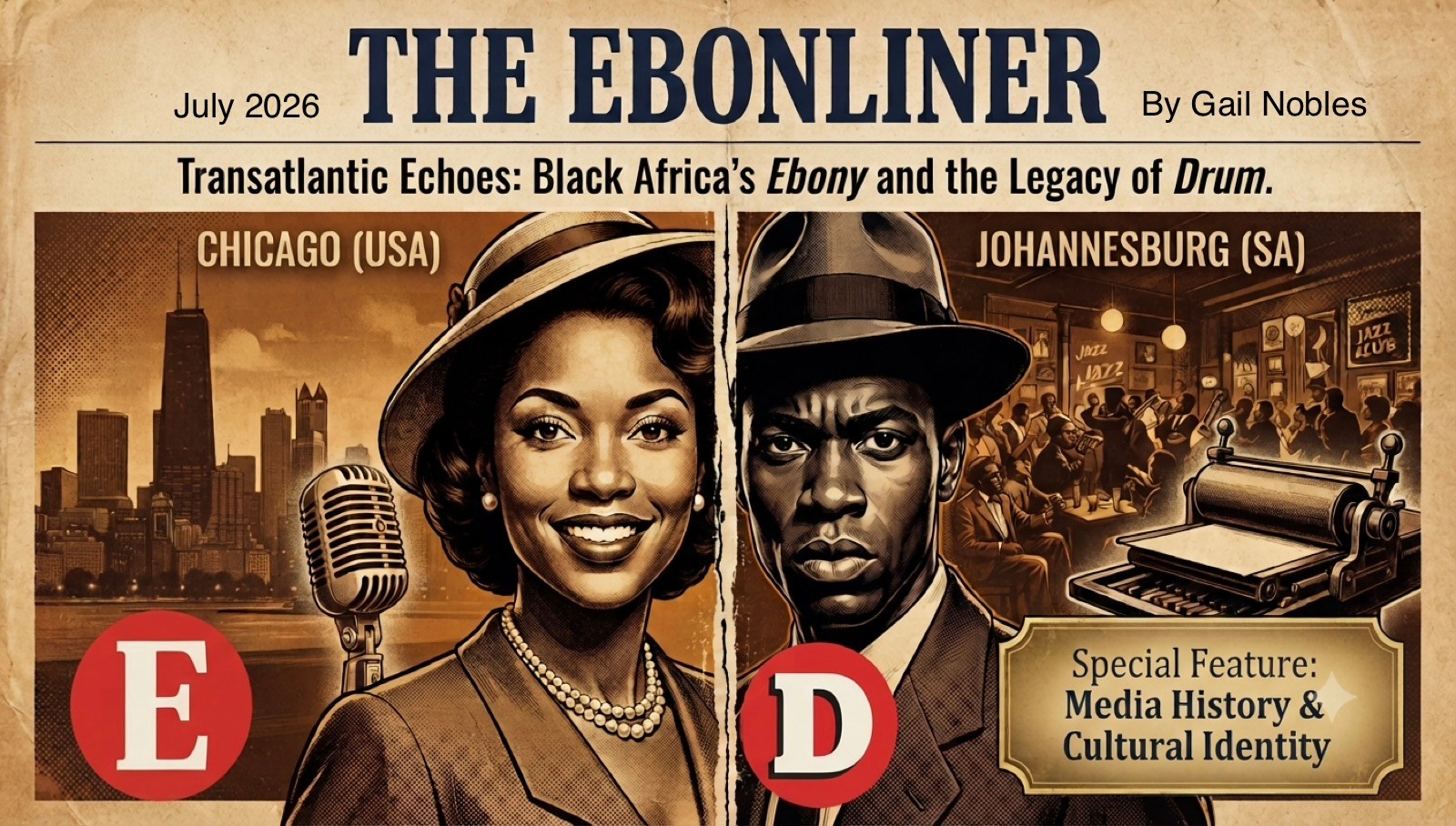
30 LUG 2026 · TRANSATLANTIC ECHOES: HOW SOUTH AFRICA’S DRUM and AMERICA’S EBONY DEFINED BLACK MEDIA
Story by: Gail Nobles 7.30.2026
Post cover by: Gail Nobles
When people explore modern digital news ecosystems—such as South Africa's prominent News24 network—they often discover a rich umbrella of dedicated lifestyle and cultural publications housed right alongside general headlines. Among them are historic titles that immediately spark a global connection, most notably Drum magazine.
To media historians and cultural observers, Drum has long held a famous title: Black Africa’s Ebony.
Though separated by oceans, distinct political landscapes, and unique cultural rhythms, Ebony in the United States and Drum in South Africa emerged with a shared, revolutionary mission: to center Black life, style, and identity in a world that routinely marginalized it.
Two Visions, Two Worlds
When John H. Johnson founded Ebony magazine in Chicago in 1945, he did so against the backdrop of Jim Crow America. Ebony became a mirror for a rising Black middle class, showcasing success, elegance, family life, and professional achievement. Its glossy pages and striking photography provided a powerful counter-narrative to the negative stereotypes or total invisibility common in mainstream American media.
Six years later, in 1951, Robert "Bob" Crisp's Drum magazine took root in Johannesburg, quickly becoming a powerhouse across the African continent. Operating under the tightening grip of apartheid, Drum could not look away from political oppression. It captured the vibrant, electric pulse of urban township life—the jazz, the fashion, and the nightlife—while simultaneously deploying fearless investigative journalists to expose systemic labor abuses and human rights violations.
The Tone: Ebony leaned heavily into aspiration, upward mobility, and dignity. Drum carried a sharper, urgent edge, documenting survival, resistance, and the raw realities of political struggle alongside cultural vibrancy.
The Visuals: Both publications relied on bold, iconic cover photography featuring confident, stylish Black subjects. These covers were not just aesthetic choices; they were declarations that Black beauty and modernity mattered.
The Digital Evolution
Today, looking at how legacy publications survive and adapt provides a fascinating study in media transition. Just as American Black-owned media had to navigate the shifts into television, digital archives, and modern web platforms, international publishing networks have brought historic titles into the digital age.
When platforms house diverse digital portfolios—bringing general-interest reporting together with deep-rooted cultural mainstays like Drum or True Love—it highlights an ongoing truth: audiences are hungry for stories that honor heritage.
The Shared Legacy
The transatlantic parallel between Ebony and Drum proves that the desire for authentic cultural storytelling is universal. Whether charting the rise of Black professionals in mid-century Chicago or chronicling the jazz-infused urban resilience of Johannesburg, these publications did more than fill pages. They built an enduring archive of identity, proving that Black stories—whether polished and aspirational or urgent and raw—deserve a permanent place on the global stage.
Trascritto
12 LUG 2026 · Story by: Gail Nobles
Keyboardist: Gail Nobles
Vocals: Gail Nobles
Podcast cover: Gail Nobles
I have a vivid memory of Obba Babatunde, if I'm not mistaken, playing a producer in a really good show back in the 80s, long before I saw him portray Berry Gordy. Unfortunately, I can't even recall the name of the show. I think it only aired one or two episodes—at least, that's all I saw before it vanished from the screen. That really bummed me out because I was excited to see more stories from it. I remember Obba's character asking someone to build him a studio, but the guy seemed to be doing everything but that.
There was also a jealous singer in the show who reminded me of Cindy Herron from En Vogue. I can't say for sure if she was the one singing back then, but she sure looked like her.
Then, there was a girl who played a lovely song called "Dream Inside Me." And when she played the piano, that jealous girl stepped in to take over the performance. I really liked that song.
One of the standout moments for me was a funny scene where a guy danced around singing "A-Tisket, A-Tasket" with a lady. Honestly, that's about all I clearly remember, and it feels like ages ago. This show was a rare Black musical that the networks seem to have tried to make everyone forget. These days, no one ever mentions it, and that makes me sad. I would love to see that show again.
You're listening to Ebonliner. I'm your host, Gail Nobles. News, Culture, and Entertainment
Trascritto
25 GIU 2026 · Story by: Gail Nobles
Intro by: Gail Nobles
Photo: https://commons.wikimedia.org/w/index.php?title=User:Jeffvespa&action=edit&redlink=1 - Own work
Usage: Wikipedia CC BY-SA 4.0
Casting Perspective: Alfre Woodard
In the world of serious film and biographical storytelling, casting is often about more than just a physical resemblance. It is about finding an actor who can channel the gravity of a life well-lived. As audiences reflect on the indelible mark left by the late gospel and soul icon Cissy Houston, who passed away in October 2024, some people are pointing to Alfre Woodard as the ideal talent to carry that mantle on screen.
The Authority
Cissy Houston was defined by her "straight-talk" approach, an uncompromising work ethic, and a protective spirit that shaped not only her own seven-decade career but the trajectory of her daughter, Whitney Houston. To capture her essence, a performer needs more than the ability to sing; they need to project an unshakable moral authority. Alfre Woodard famously led a spontaneous, stirring rendition of "Lift Every Voice and Sing" in June 2018, demonstrating that same capacity to command a space with spiritual depth and resolve.
More Than a Look
While some fans have noted a subtle physical similarity between the two women, the true argument for Woodard lies in her acting DNA. Cissy Houston navigated the high-pressure music industry with a blend of faith and grit that often felt like a performance of pure strength. Woodard’s craft is similarly grounded in "no-nonsense" authenticity. She has a rare, magnetic screen presence that audiences find deeply compelling—a trait necessary for a figure who was, in every sense of the word, an architect of modern soul music.
If a biographical project were to be developed, it would require a lead who understands the weight of a musical legacy. Alfre Woodard’s track record of playing complex, powerful women suggests she would not merely mimic Cissy Houston, but inhabit the deep spirit that made Houston a legend of the industry.
The conversation around such a casting choice serves as a reminder of how deeply Cissy Houston’s influence is still felt. It is a testament to the fact that, while her voice may be silent, the strength of the woman behind it continues to set a standard for excellence.
I’m Gail Nobles. Thank you for listening to Ebonliner. News, Culture, and Entertainment
The EbonLiner is about Entertainment, Culture, and More. It has the RODRocket show about vehicles, MAAPS is about biblical content on people from the African continent, Owensy is about famous...
mostra di più
The EbonLiner is about Entertainment, Culture, and More. It has the RODRocket show about vehicles, MAAPS is about biblical content on people from the African continent, Owensy is about famous African Americans with the name Owens, Movies Unmade, and a fiction podcast titled Dorsalee™.
Photo Credit: Gordon Correll/Flickr.com
Usage: Some rights reserved. CC BY-SA 2.0
https://flic.kr/p/pcSm25
mostra meno
Photo Credit: Gordon Correll/Flickr.com
Usage: Some rights reserved. CC BY-SA 2.0
https://flic.kr/p/pcSm25
Informazioni
| Autore | Gail Nobles |
| Organizzazione | Gail Nobles |
| Categorie | Tempo libero |
| Sito | - |
| leshontg@suddenlink.net |

Copyright 2026 - Spreaker Inc. an iHeartMedia Company
