
Sostieni il Podcast
Contatti
Info
The thoughts of two CIPS award winning procurement gods who want to share our love of procurement with newbies, oldies and the procurious. Generally we'll be talking nonsense about all...
mostra di più
The thoughts of two CIPS award winning procurement gods who want to share our love of procurement with newbies, oldies and the procurious. Generally we'll be talking nonsense about all things procurement, with the occasional nugget of priceless insight.
All views are our own - we're not affiliated in any way to anybody or anything!
Er, except Kodiak Hub...who are sponsoring our shows. How smart of them.
mostra meno
All views are our own - we're not affiliated in any way to anybody or anything!
Er, except Kodiak Hub...who are sponsoring our shows. How smart of them.
Sostieni il Podcast
Episodi & Post
Episodi
Post
Trascritto
21 SET 2026 · We get lots of questions from our listener(s) on Procurement Says No. Now you can listen to them all again in our series of mini bite-sized podcast chunks. Like dog food.
In episode 30 we've gone mostly cyber...
- What level of cyber security should I buy for my $200m pharma packaging business?
- What level of cyber security should I buy for my traditional weaving business using industrial looms?
- If you work in a cyber business, should you outsource your cyber security?
- What's the difference between a statement of work (SOW) and a works order (WO) (not a trick question)?
All of the procurement questions, all of the time. Woohoo.
www.procurementsaysno.com
Now sponsored by www.KodiakHub.com. The SRM suite that makes you smarter.
Like a smart thing. Become a supporter of this podcast: https://www.spreaker.com/podcast/procurement-says-no--5886102/support.
Trascritto
11 SET 2026 · How to do market research in Procurement. No need for those big research companies anymore. DIY with AI.
Another video which we said we'd never do. Except this is audio only.
They're on TikTok and YouTube (shorts) in full glorious video.
Now powered by www.KodiakHub.com. The smart SRM 3-piece suite. Become a supporter of this podcast: https://www.spreaker.com/podcast/procurement-says-no--5886102/support.
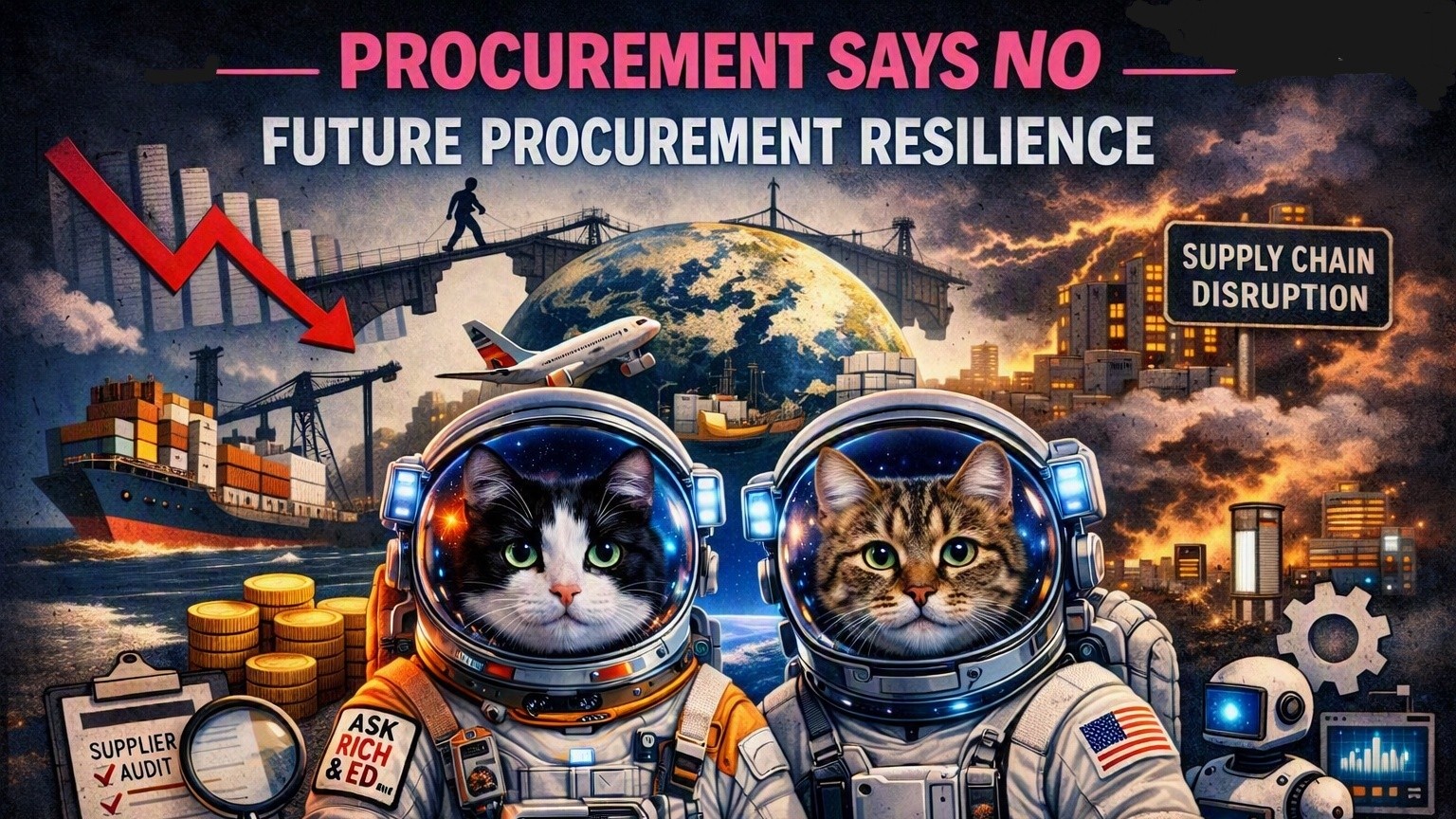
10 SET 2026 · It feels like a dream, or maybe a nightmare - but times are uncertain right now — and uncertainty is no longer a temporary condition.
It's ok though because Procurement feels it first.
Uncertainty is structural. Inflation, geopolitical tension, supply chain fragility, regulatory churn, and sudden supplier failure have shifted procurement’s centre of gravity. Luckily, procurement people love a risk register. And we also love a stakeholder who asks us to find a cheaper supplier by Friday.
Procurement says no. But politely. With a spreadsheet.
The future of procurement (especially in uncertain times) looks less like “running tenders” and more like running resilience: protecting continuity of supply, managing inflation-driven cost pressure, and actively reducing risk across a wider slice of the supplier base — not just the top 20 “strategic” suppliers.
You can see that shift clearly in the way leaders keep coming back to the same three priorities:
- Reduce third‑party cost
- Reduce the cost-to-procure
- Manage risk better
Everything else is noise.
Here’s what that future shape looks like — with real examples to bring it to life.
1. A tougher, more commercial core (cost + cash)
Inflation keeps pushing procurement into rapid value-for-money work, often crowding out “nice-to-haves”. The winners won’t just negotiate price; they’ll work total cost, demand management, specs, and should-cost.
What this looks like in practice:
- Total cost: A packaging supplier proposes a 9% uplift. Instead of arguing unit price, procurement models the full cost stack — logistics, minimum order quantities, waste, storage — and finds a 14% saving by changing pallet configuration and reducing over-spec materials.
- Demand management: A business unit wants to renew 300 software licences “just in case”. Procurement says: “You used 147 last year”, challenges usage data and renews only 180, saving £120k without reducing capability.
- Specification discipline: Engineering requests a premium-grade component with a 12-week lead time. Procurement: “You need the mid-grade component. You want the premium one.” Engineering: “But it’s nicer.” Procurement: “So is a Bentley. We’re buying a van.” Procurement proves the mid-grade version meets requirements and cuts cost by 22% while improving continuity.
- Should-cost: A supplier claims raw material inflation justifies a price increase. Procurement uses should-cost modelling to show the real impact is 3.4%, not 11%. The uplift disappears, but thank the supplier for their creativity.
Procurement Says No to soft justifications and “market conditions” that only exist in supplier PowerPoints.
Procurement Says Yes to commercial rigour.
2. Risk moves from a register to an operating discipline
Risk used to be a spreadsheet updated once a quarter. Now it’s a daily sport.
With “continuous shock” conditions — geopolitics, logistics disruption, supplier failure — procurement can’t treat risk as a static document. It becomes a daily operating rhythm.
What this looks like in practice:
- Dual sourcing: Procurement spots early signs of supplier distress (late deliveries, CFO resigns, LinkedIn posts get weird). Secondary supplier activated within 10 days. Production saved. Business thinks procurement is psychic.
- Continuity strategies: A critical chemical has a volatile global supply. Procurement builds a 45‑day buffer stock and negotiates a flexible call-off contract, stabilising production during a regional shutdown. Operations sleep better.
- Switching mechanisms: A logistics provider misses two consecutive KPIs. Procurement triggers a pre-agreed switch clause and transitions 40% of volume to an alternate carrier within 72 hours. Stakeholders ask: “Can we do this for everything?” Procurement Says No.
- Faster escalation playbooks: A regulatory change impacts a key supplier’s certification. Procurement uses a predefined escalation path — legal, compliance, technical — and resolves the issue in 5 days instead of 5 weeks. Supplier panics. Procurement does not.
Risk stops being theoretical. It becomes operational.
Procurement Says No to “we’ll review this next quarter”.
3. Supplier Management expands beyond classic SRM
Classic SRM focuses on the top 20 suppliers — the ones with glossy quarterly business reviews and branded cupcakes.
But the supplier that breaks your continuity is usually the tiny one nobody has spoken to since onboarding.
More focus on visibility, onboarding, compliance, and performance across the whole supply base, because a small unknown supplier can still break your supply chain. Hey, maybe take a look at Kodiak Hub!
What this looks like in practice:
- Onboarding discipline: A small subcontractor is onboarded without proper insurance checks. Procurement’s new onboarding workflow catches the gap before work begins, avoiding a £400k liability exposure. Finance sends a thank-you email. Procurement frames it.
- Compliance visibility: A long-tail supplier fails to meet new sustainability reporting rules. Procurement spots it early through automated compliance dashboards and replaces them before audit season. Sustainability team calls procurement “heroes”. Procurement pretends not to enjoy it.
- Performance monitoring: A niche supplier providing a critical component starts missing delivery windows. Procurement’s expanded monitoring flags the trend before it becomes a continuity issue. Operations assume procurement has installed cameras. Procurement Says No comment.
- Whole-base governance: Instead of quarterly reviews with the top 20 suppliers, procurement runs monthly risk scans across all 600 suppliers — identifying issues where nobody was previously looking. Business shocked. Procurement not shocked.
Procurement Says No to blind spots.
4. Agile sourcing models (less single-source fragility)
Uncertainty punishes rigidity. Expect more modular contracting, faster events, scenario-based awards, and regionalised supply options — especially where tariffs and trade rules can change quickly.
What this looks like in practice:
- Modular contracting: Instead of a single 5‑year IT contract, procurement breaks it into modules (hardware, support, cloud services) so each can be switched independently when markets shift. Stakeholders cheer.
- Faster events: A sudden tariff change hits a key category. Procurement runs a rapid 10‑day sourcing sprint and shifts 30% of volume to a tariff-neutral region. Finance calls procurement “agile”. Procurement blushes.
- Scenario-based awards: Procurement awards a contract with three pre-priced scenarios: stable market, inflationary market, and disrupted market — enabling automatic adjustment. No renegotiation needed. Supplier tries to renegotiate anyway. Procurement Says No.
- Regionalised supply: A global supplier faces port congestion. Procurement activates regional suppliers to maintain continuity and reduce lead times by 40%. Operations ask why this wasn’t done earlier. Procurement stares into the middle distance.
Procurement Says No to brittle supply chains.
5. Digital/AI grows — but slower than the hype
AI will creep into transactional work, analytics, and decision support — but transformation takes time, budgets, and clean data.
What this looks like in practice:
- Transactional automation: 60% of POs auto-generate from approved requisitions, freeing procurement capacity for commercial work. Someone suggests using that time for “more meetings”. Great.
- Analytics: AI flags a supplier whose delivery performance has declined 8% over three months — before the business notices. Supplier wonders how procurement knew. Procurement smiles mysteriously.
- Decision support: A sourcing bot drafts the first version of an RFP, saving two days of manual work. Procurement edits it heavily. Bot apologises. Procurement accepts. It's the AI 80:20 rule.
- Data reality: Procurement wants predictive risk modelling, but data quality delays rollout by six months. The future arrives — but incrementally, you know, one day at a time.
Procurement Says No to hype. Procurement Says Yes to useful.
Net-net: The future procurement function
The future procurement function is:
- Leaner
- More data-enabled
- More risk-forward
- More commercially disciplined
- More embedded in business decisions
Uncertainty turns procurement from “savings police” into a business continuity and value engine — the function that keeps the organisation running when everything else is wobbling.
Procurement Says No. To fragility. To surprises. To complacency. To reactive behaviour.
The future belongs to the resilient. Your Procurement team are heroes.
And then we woke up.
www.procurementsaysno.com
Trascritto
1 SET 2026 · In episode 47 of your favourite procurement-flavoured podcast, Rich and Ed bring you much news from the supply chain front line and beyond:
- Another dead rock star
- No CIPS news but plenty of Avios points
- Coupa's new CEO - it's not Roy Batty
- Kimberley Clark's new fibres
- Panama canal runs out of water - shock
- Gartner's AI ROI report
- BCG's Generative AI report
- Ford and GM's opposing views of China
- EU to buy from EU - shock
- Romanian vaccine whiplash
- New procurement software that's as cheap as crisps
Plus more of your questions on Ask Rich and Ed:
- Culture fit in job interviews
- Stakeholders giving work to their favourite suppliers without a PO - shock
- Are fake RFPs ever a good idea?
- Should we buy all of our oil and gas via the Strait of Hormuz?
Plus Ed becomes a mentor.
Plus plus Rich & Ed become Marxists.
Plus plus plus more on our wonderful "Ask Rich and Ed bot" AI companion app - which will answer all of your questions with genius and brilliance. We couldn't believe it! You won't either - so click the link below to be amazed...
https://mentaraiq.com/share/chatbot/0e874f81-612c-46e5-8c7d-b1a8fc7ee544
Procurement Says No is now sponsored by Kodiak Hub - The SRM suite that makes you super smart. Check you out with your fancy plaid suit. www.KodiakHub.com Become a supporter of this podcast: https://www.spreaker.com/podcast/procurement-says-no--5886102/support.
Trascritto
31 AGO 2026 · How to deal with a cold caller. Hint - don't!
Another video which we said we'd never do. Except this is audio only.
They're on TikTok and YouTube (shorts) in full glorious video.
Now powered by www.KodiakHub.com. The smart SRM suite-spot. Become a supporter of this podcast: https://www.spreaker.com/podcast/procurement-says-no--5886102/support.
Trascritto
12 AGO 2026 · We get lots of questions from our listener(s) on Procurement Says No. Now you can listen to them all again in our series of mini bite-sized podcast chunks. Like dog food.
In episode 29 we have more lovely questions including:
- Buying a trench - how much should it cost?
- Using strategic consultants with "should cost models" - is this better than going to market?
- Buying garments from a supplier in Pakistan with reported modern slavery in the supply chain - what's the next thing to do?
- If your boss is very close to a supplier - suggesting direct awards and sharing competitors' pricing - should you be suspicious?
All of the procurement questions, all of the time. Woohoo.
www.procurementsaysno.com
Now sponsored by www.KodiakHub.com. The SRM suite that makes you smarter. Become a supporter of this podcast: https://www.spreaker.com/podcast/procurement-says-no--5886102/support.
Trascritto
6 AGO 2026 · How to buy a car. Not necessarily a better car.
Another video which we said we'd never do. Except this is audio only.
They're on TikTok and YouTube (shorts) in full glorious video.
Now powered by www.KodiakHub.com. The smart SRM suite-spot. Become a supporter of this podcast: https://www.spreaker.com/podcast/procurement-says-no--5886102/support.
Trascritto
3 AGO 2026 · Procurement Says No is now sponsored by Kodiak Hub - The SRM suite that makes you super smart. Check you out with your splendid fancy pants. www.KodiakHub.com
Meanwhile it's almost time to set fire to the sky as various AI agents begin to attack one another in an "unprecedented" AI cyber-attack. Oooops. Don't worry, it's all contained in the sandbox, no wait...
Also in this episode...
- UK Military work out the best place to buy grenades. Not.
- CIPS funds the promotion of deforestation-free procurement in Wales.
- More Trump tariffs - this time for slavery in supply chains.
- It turns out that diamonds aren't forever.
- Who knew that the Suez Canal keeps closing and re-opening.
- New UK Government - sort of.
- Theme of resilience in procurement remains, er, resilient.
- Sainsbury's chicken eggs white supremacy madness.
All this plus more on our wonderful "Ask Rich and Ed bot" AI companion app - which will answer all of your questions with genius and brilliance. We couldn't believe it! You won't either - so click the link below to be amazed...
https://mentaraiq.com/share/chatbot/0e874f81-612c-46e5-8c7d-b1a8fc7ee544
And, yes there is a drone called the T-400. Not quite as good as the T-600. Yet. Become a supporter of this podcast: https://www.spreaker.com/podcast/procurement-says-no--5886102/support.
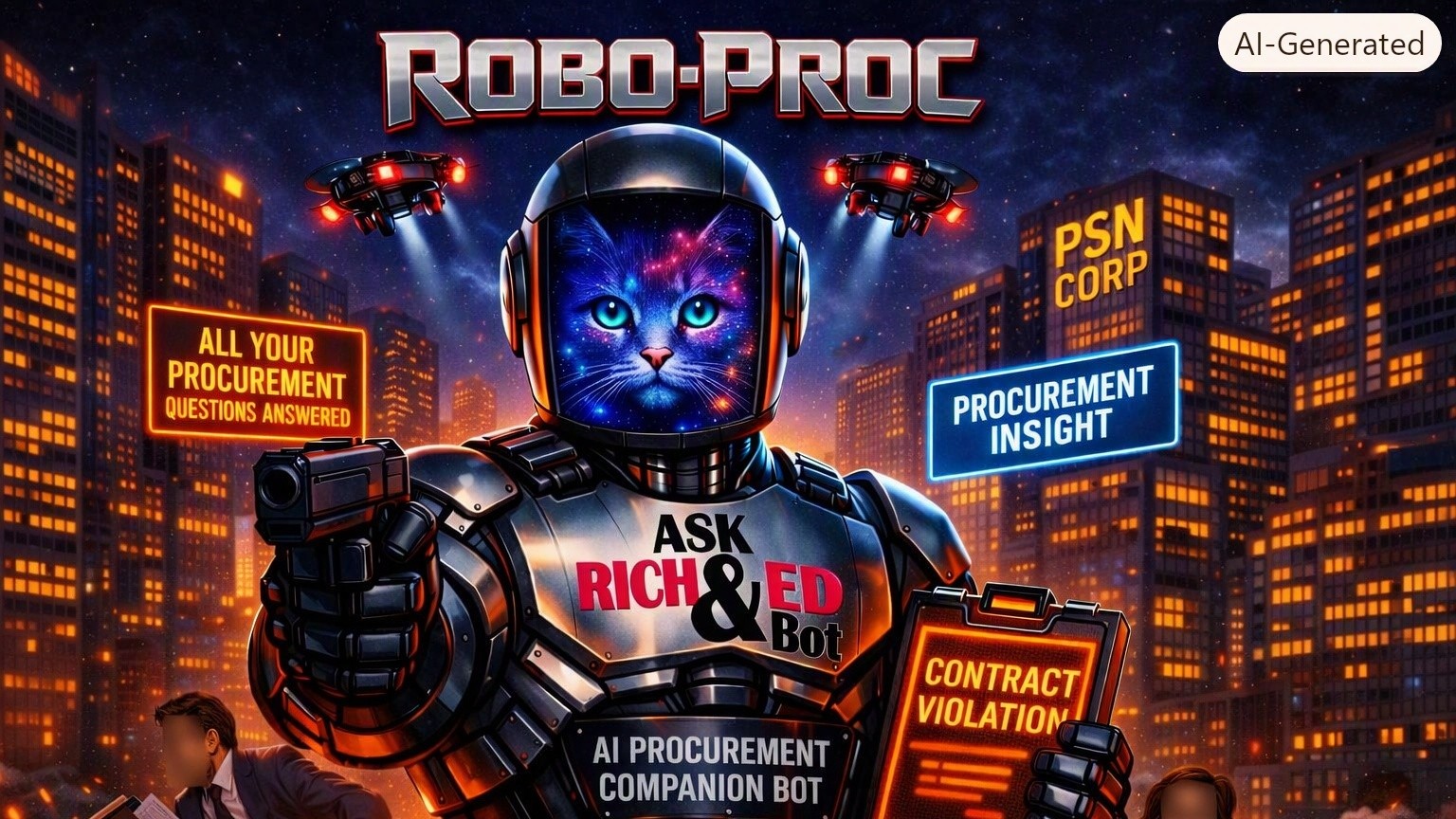
28 LUG 2026 · A follow‑up to our Procurebot9000 blog - now with the existential dread of RoboProc, and the launch of the Ask Rich and Ed-bot AI companion app.
For years, procurement has been promised a future filled with automation, digital transformation, and tools that would “revolutionise the function.”
Mostly, what we got were dashboards that required three logins, a chatbot that couldn’t understand the word invoice, and a supplier portal so unfathomable it became a rite of passage. But something has changed.
We’ve now embraced AI properly. We’ve been re-sprayed and are now living AI like procurement tech warriors.
Introducing the Ask Rich and Ed‑bot: A procurement companion built from three years of podcasting, 100 episodes, 75+ years of procurement experience, and the collective wisdom of our many special guests. It’s free, it’s fast, and it answers procurement questions with alarming competence.
You can try it right now — just use the link, create an account, and unleash the spacecats.
Copy and paste this into your browser:
https://mentaraiq.com/share/chatbot/0e874f81-612c-46e5-8c7d-b1a8fc7ee544
So… does this mean AI is about to take over procurement?
Well. Yes. And also absolutely not. And also maybe. And probably it will take over everything you secretly hate doing.
AI is already brilliant at:
- Reading contracts without crying
- Spotting risks you pretend aren’t there
- Predicting supplier failure before the supplier even knows
- Automating the “can you send me a PO?” loop
- Analysing spend without requiring a sacrificial intern
- Writing category strategies that don’t begin with “the market is challenging”
But AI is not brilliant at:
- Convincing Finance that your savings are real
- Negotiating with a supplier who has decided to live in a hedge
- Managing stakeholders who believe procurement is a suggestion
- Understanding why Janet insists on raising requisitions in Comic Sans
- Spotting when a supplier is lying because their left eyebrow twitches
Procurement is still a human sport — messy, political, relational, and occasionally surreal.
AI can handle the heavy lifting, but humans still need to steer the ship, charm the stakeholders, and stop the business from accidentally buying 14,000 unapproved widgets.
How should procurement people adopt and adapt?
Three rules:
1. Stop pretending AI is optional. If you’re still saying “I’ll wait until it’s more mature,” congratulations — you’re already behind. AI is in the building. AI has eaten your spend cube and found £1.2m of leakage.
2. Learn to ask better questions. AI is only as good as the prompts you feed it. If you ask “write me a procurement strategy,” you’ll get something bland. If you ask “write me a procurement strategy that terrifies the CFO,” you’ll get gold.
3. Become the human the AI needs. AI doesn’t replace procurement people — it replaces procurement people who refuse to evolve. Your job becomes interpretation, judgement, influence, creativity, and leadership. The robots do the grunt work. You do the clever work.
What about suppliers?
Suppliers fall into three categories:
1. The AI‑powered elite. Already using AI for forecasting, pricing, risk modelling, and proposal generation. They are not still using spreadsheets from 2014.
2. The “we’re exploring AI” crowd. They have one pilot project, one intern, and one slide deck. They are not exploring AI. They are exploring excuses.
3. The hedge‑dwellers. They will continue to send quotes in PDFs named “FINAL_FINAL_v7_revised”. AI will not save them. Only reincarnation will.
Which businesses are actively using AI in procurement now? Lots — and not just the tech giants. The leaders aren’t the ones with the biggest budgets — they’re the ones who stopped waiting for permission.
What AI is best at…
Analysis. AI can analyse 40,000 lines of spend data in seconds and tell you that your organisation has accidentally bought 17 different types of stapler. It will also politely point out that one supplier has been charging you £14.99 for “miscellaneous metal item” for three years.
Pattern recognition. AI will spot that Supplier A always submits invoices at 11:58am on Fridays, which correlates perfectly with their CFO’s weekly pub visit. It will also notice that Janet only raises requisitions after a full moon.
Drafting. Ask it for a category strategy and it will produce a beautifully structured document with charts, insights, and a conclusion that subtly implies your stakeholders are the problem. Ask it for a negotiation script and it will give you something that sounds like quick-fire Aaron Sorkin wrote it after three espressos.
Compliance checking. AI will read your NEC contract, highlight the clauses you’ve ignored, and gently ask whether you’re sure you want to proceed with that variation order. It will also detect that your supplier has replaced “shall” with “may” in section 4.2.1 — the procurement equivalent of a jump scare.
Risk detection. AI will tell you that Supplier B is showing signs of financial distress because their CEO has started posting inspirational quotes on LinkedIn. It will also flag that your preferred supplier’s parent company has quietly changed its name to “Phoenix Holdings Ltd”, which is never a good sign.
Workflow automation. AI will chase POs, send reminders, update trackers, and escalate issues — all without developing the deep resentment normally associated with these tasks. It will also send Janet a polite message reminding her that Comic Sans is not an approved font.
Turning chaos into clarity.
Give AI 12 conflicting emails, 4 spreadsheets, 3 meeting notes, and a photo of a whiteboard taken at a weird angle, and it will produce a coherent summary. It will also tell you that the real problem is that nobody knows who actually owns the widget category.
What humans must continue to do…
Negotiation. AI can draft your negotiation plan, but only you can look a supplier in the eye and say, “I’m not paying that,” with the correct level of English passive aggression. AI cannot replicate the subtle eyebrow raise that signals “we both know this price is nonsense.”
Relationship management. AI can remind you to call a supplier, but it cannot attend a meeting, drink terrible coffee, and pretend to be delighted about their new PowerPoint template. It also cannot detect when a supplier is lying because they blink too slowly.
Strategy. AI can generate 12 strategic options, but only humans can choose the one that won’t cause Finance to have a meltdown. It can’t foresee that your CEO will change direction halfway through the project because they read a magazine article on a plane.
Influence. AI can write a brilliant business case, but only humans can persuade Dave from Operations that “no, you cannot buy it on your corporate credit card.” AI cannot navigate the political minefield of a steering group where half the attendees don’t know why they’re there.
Creativity. AI can be too creative. Ask it for a supplier onboarding plan and it might hallucinate a ceremonial dance, a fog machine, and a QR code tattoo. Ask it to draft your contact details and it may invent a new phone number, a fictional postcode, and a job title you’ve never held.
Governance. AI can flag non‑compliance, but only humans can sit in a meeting and say, “No, we really can’t do that,” while everyone else stares at the table. AI cannot enforce a policy with the correct level of weary authority.
Saying “no” loudly and confidently. AI can suggest alternatives, but only humans can deliver the classic procurement “no” — the one that causes suppliers to reconsider their life choices. AI cannot replicate the tone that says, “I’m not angry, just disappointed.”
AI won’t replace procurement. But procurement with AI will absolutely replace procurement without AI. If you don’t adopt AI, you’ll become the person who still prints contracts. If you do adopt AI, you’ll become the person who delivers insights before anyone else has even opened Excel. The future belongs to the augmented, the curious, the adaptable — and the ones who aren’t afraid to ask a Spacecat for help.
Final thought
AI isn’t coming for procurement. AI is coming with procurement. If you haven’t tried the Ask Rich & Ed‑bot yet, now’s the moment. Click the link. Create an account. Ask it something difficult. See what happens when 75+ years of procurement experience meets actual intelligence.
And remember: In procurement, saying “no” is still an art. AI just helps you say it faster.
Procurement Says No. Now with added Ask Rich and Ed-bot - the first procurement AI companion app.
Trascritto
20 LUG 2026 · We get lots of questions from our listener(s) on Procurement Says No. Now you can listen to them all again in our series of mini bite-sized podcast chunks. Like dog food.
In episode 27 we have some random questions including:
- How to cope with your company reducing its stance on ESG when you don't want to
- How best to procure a kitchen renovation
- How to manage suppliers in administration who you've already paid (oh dear)
And we've specifically released ep27 after ep28, just to mix things up a little.
All of the procurement questions, all of the time. Woohoo.
www.procurementsaysno.com
Now sponsored by www.KodiakHub.com. The SRM suite that makes you smarter. Become a supporter of this podcast: https://www.spreaker.com/podcast/procurement-says-no--5886102/support.
Unisciti al Supporters Club di "Procurement Says No"
Inizia a supportare questo podcast e entra a far parte della sua community.
The thoughts of two CIPS award winning procurement gods who want to share our love of procurement with newbies, oldies and the procurious. Generally we'll be talking nonsense about all...
mostra di più
The thoughts of two CIPS award winning procurement gods who want to share our love of procurement with newbies, oldies and the procurious. Generally we'll be talking nonsense about all things procurement, with the occasional nugget of priceless insight.
All views are our own - we're not affiliated in any way to anybody or anything!
Er, except Kodiak Hub...who are sponsoring our shows. How smart of them.
mostra meno
All views are our own - we're not affiliated in any way to anybody or anything!
Er, except Kodiak Hub...who are sponsoring our shows. How smart of them.
Informazioni
| Autore | Richard Beattie / Ed Cross |
| Organizzazione | Richard Beattie |
| Categorie | Gestione , Economia , Commedia |
| Sito | www.procurementsaysno.com |
| richardjbeattie@msn.com |

Copyright 2026 - Spreaker Inc. an iHeartMedia Company
