Esplicito
Trascritto
The Tory War
12 ago 2026 ·
1 h 4 min. 48 sec.
Scarica e ascolta ovunque
Scarica i tuoi episodi preferiti e goditi l'ascolto, ovunque tu sia! Iscriviti o accedi ora per ascoltare offline.
The Tory War
Questa trascrizione automatica è offerta da
Sounder.AI
Questa è una trascrizione generata automaticamente. Si prega di notare che non è garantita la completa accuratezza.
Descrizione
In June of 1780, on a hill outside what's now Lincolnton, North Carolina, more than a thousand men killed each other in fog so thick you couldn't see fifty feet....
mostra di più
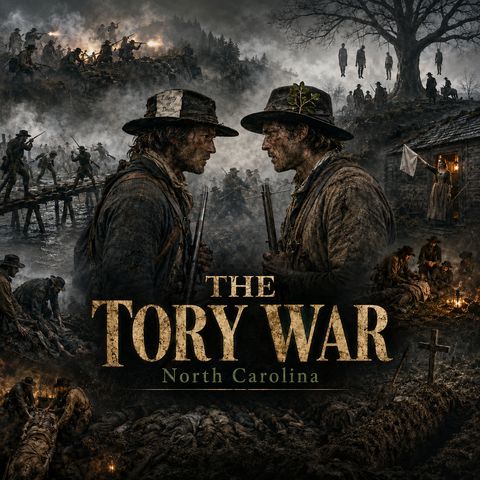
In June of 1780, on a hill outside what's now Lincolnton, North Carolina, more than a thousand men killed each other in fog so thick you couldn't see fifty feet. There was no British army there. There was no Continental army there.
Every man on that field was an American, and the only thing separating one side from the other was a scrap of white paper pinned to a hat or a green twig stuck in a hatband. When it was over, nobody could tell the dead apart, so they stopped trying and put them in a hole together.
That mass grave is still up there, next to an elementary school, and nobody knows the names. This episode is about the half of the American Revolution we left off the monuments. In the Carolina backcountry between 1780 and 1782, the war wasn't a fight against a foreign occupier.
It was neighbors hunting neighbors through their own counties, and the National Park Service, NCpedia, and the North Carolina Department of Natural and Cultural Resources all use the same word for it without flinching. Civil war. Brian traces it back to where it actually starts, which isn't 1775 at all. It's 1771, when royal governor William Tryon crushed a farmers' revolt at Alamance and then hanged six men outside Hillsborough and made the townspeople stand there and watch.
Four years later, the same eastern gentry who had ridden with Tryon came to the backcountry asking those farmers to take up arms for liberty. A lot of them declined, and some of them did considerably more than decline.
From there the episode moves through the greased bridge at Moore's Creek, where Highland Scots who had already lost one war against King George's family charged across two soap-slicked logs into cannon fire, and eight hundred and fifty of them went into captivity.
Through Ramsour's Mill, and the two-hundred-year-old story that Thomas Costner killed his own brother Peter on that hill and buried him under a pile of stones rather than let him go into the mass grave.
Brian digs into a piece of research published this past March by a Costner descendant that takes the story apart, finds Thomas's own 1832 pension statement doesn't put him at the battle at all, and can't quite close the case either way.
What survives the scrutiny is stranger than the legend: not whether it happened, but that for two centuries nobody who heard it ever said it couldn't have.
Then Kings Mountain, the largest all-American fight of the entire war, where exactly one man on the field held a British commission, and where the shooting continued into groups of men who had already surrendered.
The drumhead court held in a field a week later at the Biggerstaff plantation, where North Carolina magistrates convicted three dozen of their neighbors under North Carolina law and hanged nine of them from an oak tree, three at a time. Pyle's Hacking Match, where Henry Lee's green-coated Legion was mistaken for Tarleton's dragoons and let the mistake stand, and several hundred Loyalists were cut down at arm's length while shouting that they were the king's men — ninety-three dead against one American wounded and one horse killed.
The House in the Horseshoe, where Temperance Alston walked out the front door carrying a white cloth in front of eighty armed men to keep them from killing her husband, and where you can still put your hand in the bullet holes today. David Fanning riding into the state capital under fog and kidnapping the governor and most of the General Assembly. And the Quakers of Cane Creek walking out onto the field at Lindley's Mill in the dark to collect the men who were still breathing, joined by Dr. John Pyle himself, seven months after his own command was slaughtered, treating the wounded on both sides.Yorktown didn't end it.
In Randolph County, on a Sunday morning in March of 1782, five months after Cornwallis surrendered, Fanning and twenty-five men dragged a colonel's sister and young daughter off him and shot him in the head on the floor of his own house. The peace treaty was still a year away.Brian brings sixteen years of law enforcement experience to the sourcing here, and it shows in how carefully the episode separates what's documented from what's tradition, where the numbers genuinely disagree, and where the record simply runs out.
This is the Revolution as the people who lived through it in Lincoln, Orange, Randolph, and Chatham counties actually experienced it — not a war against somebody else, but a war against each other, with no neutral ground left to stand on.
Disturbing History is written, produced, and narrated by Brian King-Sharp for Paranormal World Productions. If the show means something to you, the best thing you can do is tell one person about it. Contact and full show archive at paranormalworldproductions.com.
Have a forgotten historical mystery, disturbing event, unsolved crime, or hidden conspiracy you think deserves investigation?
Send your suggestions to brian@paranormalworldproductions.com.
Disturbing History is a dark history podcast exploring unsolved mysteries, secret societies, historical conspiracies, lost civilizations, and the shadowy stories buried beneath the surface of the past.
Follow the show and enable automatic downloads so you never miss a deep dive into history’s most unsettling secrets.
Because sometimes the truth is darker than fiction.
mostra meno
Every man on that field was an American, and the only thing separating one side from the other was a scrap of white paper pinned to a hat or a green twig stuck in a hatband. When it was over, nobody could tell the dead apart, so they stopped trying and put them in a hole together.
That mass grave is still up there, next to an elementary school, and nobody knows the names. This episode is about the half of the American Revolution we left off the monuments. In the Carolina backcountry between 1780 and 1782, the war wasn't a fight against a foreign occupier.
It was neighbors hunting neighbors through their own counties, and the National Park Service, NCpedia, and the North Carolina Department of Natural and Cultural Resources all use the same word for it without flinching. Civil war. Brian traces it back to where it actually starts, which isn't 1775 at all. It's 1771, when royal governor William Tryon crushed a farmers' revolt at Alamance and then hanged six men outside Hillsborough and made the townspeople stand there and watch.
Four years later, the same eastern gentry who had ridden with Tryon came to the backcountry asking those farmers to take up arms for liberty. A lot of them declined, and some of them did considerably more than decline.
From there the episode moves through the greased bridge at Moore's Creek, where Highland Scots who had already lost one war against King George's family charged across two soap-slicked logs into cannon fire, and eight hundred and fifty of them went into captivity.
Through Ramsour's Mill, and the two-hundred-year-old story that Thomas Costner killed his own brother Peter on that hill and buried him under a pile of stones rather than let him go into the mass grave.
Brian digs into a piece of research published this past March by a Costner descendant that takes the story apart, finds Thomas's own 1832 pension statement doesn't put him at the battle at all, and can't quite close the case either way.
What survives the scrutiny is stranger than the legend: not whether it happened, but that for two centuries nobody who heard it ever said it couldn't have.
Then Kings Mountain, the largest all-American fight of the entire war, where exactly one man on the field held a British commission, and where the shooting continued into groups of men who had already surrendered.
The drumhead court held in a field a week later at the Biggerstaff plantation, where North Carolina magistrates convicted three dozen of their neighbors under North Carolina law and hanged nine of them from an oak tree, three at a time. Pyle's Hacking Match, where Henry Lee's green-coated Legion was mistaken for Tarleton's dragoons and let the mistake stand, and several hundred Loyalists were cut down at arm's length while shouting that they were the king's men — ninety-three dead against one American wounded and one horse killed.
The House in the Horseshoe, where Temperance Alston walked out the front door carrying a white cloth in front of eighty armed men to keep them from killing her husband, and where you can still put your hand in the bullet holes today. David Fanning riding into the state capital under fog and kidnapping the governor and most of the General Assembly. And the Quakers of Cane Creek walking out onto the field at Lindley's Mill in the dark to collect the men who were still breathing, joined by Dr. John Pyle himself, seven months after his own command was slaughtered, treating the wounded on both sides.Yorktown didn't end it.
In Randolph County, on a Sunday morning in March of 1782, five months after Cornwallis surrendered, Fanning and twenty-five men dragged a colonel's sister and young daughter off him and shot him in the head on the floor of his own house. The peace treaty was still a year away.Brian brings sixteen years of law enforcement experience to the sourcing here, and it shows in how carefully the episode separates what's documented from what's tradition, where the numbers genuinely disagree, and where the record simply runs out.
This is the Revolution as the people who lived through it in Lincoln, Orange, Randolph, and Chatham counties actually experienced it — not a war against somebody else, but a war against each other, with no neutral ground left to stand on.
Disturbing History is written, produced, and narrated by Brian King-Sharp for Paranormal World Productions. If the show means something to you, the best thing you can do is tell one person about it. Contact and full show archive at paranormalworldproductions.com.
Have a forgotten historical mystery, disturbing event, unsolved crime, or hidden conspiracy you think deserves investigation?
Send your suggestions to brian@paranormalworldproductions.com.
Disturbing History is a dark history podcast exploring unsolved mysteries, secret societies, historical conspiracies, lost civilizations, and the shadowy stories buried beneath the surface of the past.
Follow the show and enable automatic downloads so you never miss a deep dive into history’s most unsettling secrets.
Because sometimes the truth is darker than fiction.
Informazioni
| Autore | Paranormal World Productions |
| Organizzazione | Sasquatch Odyssey |
| Sito | - |
| Tag |

Copyright 2026 - Spreaker Inc. an iHeartMedia Company

Commenti