Esplicito
Trascritto
The 1990's
30 set 2026 ·
1 h 12 min. 27 sec.
Scarica e ascolta ovunque
Scarica i tuoi episodi preferiti e goditi l'ascolto, ovunque tu sia! Iscriviti o accedi ora per ascoltare offline.
The 1990's
Questa trascrizione automatica è offerta da
Sounder.AI
Questa è una trascrizione generata automaticamente. Si prega di notare che non è garantita la completa accuratezza.
Descrizione
On July 16, 1990, Time magazine put a group of young adults on its cover beneath the word “twentysomething” and asked whether they were laid back, late blooming, or simply...
mostra di più
On July 16, 1990, Time magazine put a group of young adults on its cover beneath the word “twentysomething” and asked whether they were laid back, late blooming, or simply lost. The story said they struggled to make decisions, would rather hike the Himalayas than climb the corporate ladder, and had no anthems, no heroes, and an attention span as short as one click of the remote. Those young adults were the same kids who had been labeled “at risk” in the 1980s.
Now they were entering adulthood under a new set of warnings. This is the fifth episode in the Disturbing History series on the American decades, and this time Brian looks back at the 1990s, the decade he grew up in.
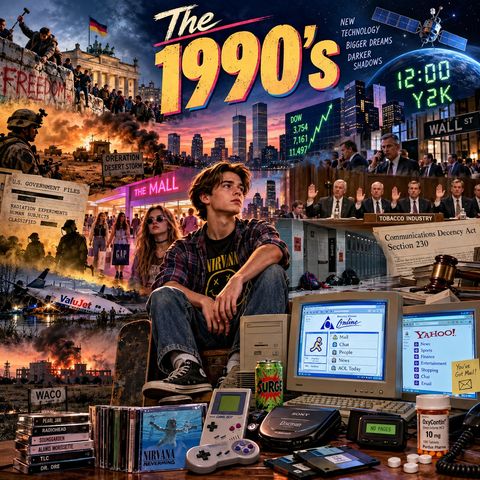
The story begins just before the decade officially started, on November 9, 1989, when the Berlin Wall came down. From there, the episode follows the same path as the rest of the series: beginning with the version of the decade America remembers, then digging into the stories it often forgot. And there was plenty to celebrate. Unemployment fell from 7.8 percent in 1992 to 4 percent by the end of 1999. The Dow climbed from 2,753 to 11,497. The federal government recorded its first budget surplus since 1969. Homicides dropped dramatically.
Teen birth rates declined. Juvenile murder arrests fell by roughly two-thirds.And the generation supposedly unable to make decisions helped build the internet. Then the story moves beneath the surface. Brian examines the 1990s panic over so-called juvenile “super-predators,” a prediction that helped reshape laws across the country even as youth violence was already falling.
He follows that fear into a string of school shootings in Pearl, West Paducah, Jonesboro, and Springfield before arriving at Columbine on April 20, 1999.The episode looks at the propane bombs that were intended to be the real centerpiece of the Columbine attack, the music and video games blamed afterward, and a search warrant affidavit drafted against one of the shooters more than a year earlier that was never presented to a judge. The decade’s fear of the internet gets similar treatment.
A 1995 Time cover story warning about cyberporn relied heavily on a flawed undergraduate study. The panic helped fuel the Communications Decency Act. Most of that law was struck down by the Supreme Court in 1997, but 26 words survived and became Section 230.Brian also follows the internet boom itself, from Netscape’s 1995 IPO to the rise of Amazon, eBay, Google, and Napster. Then comes the money underneath it all: the 1998 collapse of Long-Term Capital Management, the emergency meetings in New York, and the 1999 repeal of Glass-Steagall.From there, the episode turns to what the government was not saying.
In March 1991, U.S. forces demolished an Iraqi nerve agent depot at Khamisiyah. Nearly 100,000 American troops may have been downwind. The Pentagon denied the exposure for years.In Albuquerque, reporter Eileen Welsome uncovered the story of people secretly injected with plutonium during the early Cold War. Once government files were opened, investigators found thousands of radiation experiments, including radioactive oatmeal fed to schoolboys and radioactive iron given to pregnant women.
President Bill Clinton formally apologized in 1995.Then there was Waco. Federal authorities denied for years that incendiary tear gas rounds had been used during the final assault on April 19, 1993. That admission did not come until 1999.And in December 1995, the FDA approved a new painkiller called OxyContin with language on its label that would later become central to one of the largest pharmaceutical scandals in American history.
The episode also revisits the seven tobacco executives who raised their hands before Congress in 1994 and denied that nicotine was addictive, followed by the $206 billion tobacco settlement four years later.It covers the deadly Chicago heat wave of 1995, when hundreds died in a single week. It examines the mislabeled oxygen generators that contributed to the crash of ValuJet Flight 592 in the Everglades in 1996.
Brian also looks at the West Memphis Three, the Y2K panic, the satellites that really did experience problems at midnight, and the customs inspector in Port Angeles, Washington, who stopped a rental car in December 1999 and discovered explosives intended for Los Angeles International Airport.
The decade ends where it began: with Time magazine judging a new generation.On May 20, 2013, the magazine ran another cover story asking what was wrong with young adults.
This time, one of the people doing the judging belonged to the very generation Time had questioned back in 1990.
Different decade. Different generation.
Email Brian
Get Brian's Books
Leave Us A Voicemail
Visit Our Website
Have a forgotten historical mystery, disturbing event, unsolved crime, or hidden conspiracy you think deserves investigation?
Send your suggestions to brian@paranormalworldproductions.com.
Disturbing History is a dark history podcast exploring unsolved mysteries, secret societies, historical conspiracies, lost civilizations, and the shadowy stories buried beneath the surface of the past.
Follow the show and enable automatic downloads so you never miss a deep dive into history’s most unsettling secrets.
Because sometimes the truth is darker than fiction.
mostra meno
Now they were entering adulthood under a new set of warnings. This is the fifth episode in the Disturbing History series on the American decades, and this time Brian looks back at the 1990s, the decade he grew up in.
The story begins just before the decade officially started, on November 9, 1989, when the Berlin Wall came down. From there, the episode follows the same path as the rest of the series: beginning with the version of the decade America remembers, then digging into the stories it often forgot. And there was plenty to celebrate. Unemployment fell from 7.8 percent in 1992 to 4 percent by the end of 1999. The Dow climbed from 2,753 to 11,497. The federal government recorded its first budget surplus since 1969. Homicides dropped dramatically.
Teen birth rates declined. Juvenile murder arrests fell by roughly two-thirds.And the generation supposedly unable to make decisions helped build the internet. Then the story moves beneath the surface. Brian examines the 1990s panic over so-called juvenile “super-predators,” a prediction that helped reshape laws across the country even as youth violence was already falling.
He follows that fear into a string of school shootings in Pearl, West Paducah, Jonesboro, and Springfield before arriving at Columbine on April 20, 1999.The episode looks at the propane bombs that were intended to be the real centerpiece of the Columbine attack, the music and video games blamed afterward, and a search warrant affidavit drafted against one of the shooters more than a year earlier that was never presented to a judge. The decade’s fear of the internet gets similar treatment.
A 1995 Time cover story warning about cyberporn relied heavily on a flawed undergraduate study. The panic helped fuel the Communications Decency Act. Most of that law was struck down by the Supreme Court in 1997, but 26 words survived and became Section 230.Brian also follows the internet boom itself, from Netscape’s 1995 IPO to the rise of Amazon, eBay, Google, and Napster. Then comes the money underneath it all: the 1998 collapse of Long-Term Capital Management, the emergency meetings in New York, and the 1999 repeal of Glass-Steagall.From there, the episode turns to what the government was not saying.
In March 1991, U.S. forces demolished an Iraqi nerve agent depot at Khamisiyah. Nearly 100,000 American troops may have been downwind. The Pentagon denied the exposure for years.In Albuquerque, reporter Eileen Welsome uncovered the story of people secretly injected with plutonium during the early Cold War. Once government files were opened, investigators found thousands of radiation experiments, including radioactive oatmeal fed to schoolboys and radioactive iron given to pregnant women.
President Bill Clinton formally apologized in 1995.Then there was Waco. Federal authorities denied for years that incendiary tear gas rounds had been used during the final assault on April 19, 1993. That admission did not come until 1999.And in December 1995, the FDA approved a new painkiller called OxyContin with language on its label that would later become central to one of the largest pharmaceutical scandals in American history.
The episode also revisits the seven tobacco executives who raised their hands before Congress in 1994 and denied that nicotine was addictive, followed by the $206 billion tobacco settlement four years later.It covers the deadly Chicago heat wave of 1995, when hundreds died in a single week. It examines the mislabeled oxygen generators that contributed to the crash of ValuJet Flight 592 in the Everglades in 1996.
Brian also looks at the West Memphis Three, the Y2K panic, the satellites that really did experience problems at midnight, and the customs inspector in Port Angeles, Washington, who stopped a rental car in December 1999 and discovered explosives intended for Los Angeles International Airport.
The decade ends where it began: with Time magazine judging a new generation.On May 20, 2013, the magazine ran another cover story asking what was wrong with young adults.
This time, one of the people doing the judging belonged to the very generation Time had questioned back in 1990.
Different decade. Different generation.
Email Brian
Get Brian's Books
Leave Us A Voicemail
Visit Our Website
Have a forgotten historical mystery, disturbing event, unsolved crime, or hidden conspiracy you think deserves investigation?
Send your suggestions to brian@paranormalworldproductions.com.
Disturbing History is a dark history podcast exploring unsolved mysteries, secret societies, historical conspiracies, lost civilizations, and the shadowy stories buried beneath the surface of the past.
Follow the show and enable automatic downloads so you never miss a deep dive into history’s most unsettling secrets.
Because sometimes the truth is darker than fiction.
Informazioni
| Autore | Paranormal World Productions |
| Organizzazione | Sasquatch Odyssey |
| Sito | - |
| Tag |

Copyright 2026 - Spreaker Inc. an iHeartMedia Company

Commenti