Trascritto
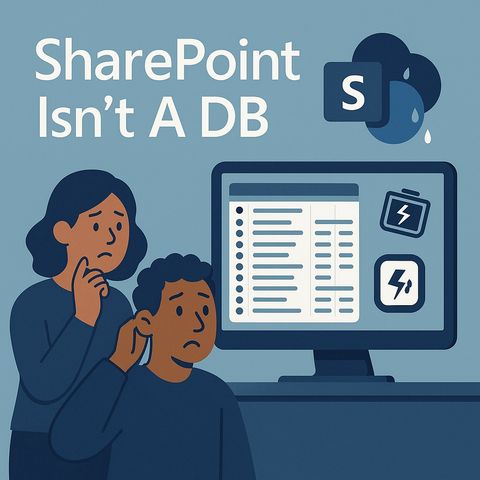
SharePoint is not a database: why your Power Apps will collapse at scale
8 nov 2025 ·
22 min. 46 sec.
Scarica e ascolta ovunque
Scarica i tuoi episodi preferiti e goditi l'ascolto, ovunque tu sia! Iscriviti o accedi ora per ascoltare offline.
SharePoint is not a database: why your Power Apps will collapse at scale
Questa trascrizione automatica è offerta da
Sounder.AI
Questa è una trascrizione generata automaticamente. Si prega di notare che non è garantita la completa accuratezza.
Capitoli
Descrizione
In this episode of M365.fm, Mirko Peters tears down the myth that SharePoint can act as a real database for Power Apps and shows why “we’ll just use a SharePoint...
mostra di più
In this episode of M365.fm, Mirko Peters tears down the myth that SharePoint can act as a real database for Power Apps and shows why “we’ll just use a SharePoint list” quietly destroys performance, scalability, and data integrity as your app grows. He contrasts what proper databases like SQL Server and Dataverse actually do—schemas, indexing, relationships, execution plans, and concurrency control—with what SharePoint was built for: collaboration, documents, and light metadata, not transactional systems. You will hear why using SharePoint as a free “backend” feels fine for a few hundred records but quickly becomes a performance time bomb once lists hit thousands of items and multiple users start hammering the same data.
Mirko dives into the delegation wall and the scale myth behind Microsoft’s “30 million items” number, explaining how Power Apps ends up pulling data client‑side, turning every user’s device into a fake database server and triggering slow galleries, long load times, and random throttling. He unpacks how limited indexing, shallow lookups, and lack of real referential integrity create “lookup chaos,” data drift, and silent corruption when you try to treat SharePoint like SQL—especially once you add multiple related lists and heavy filters. Through real‑world stories of “CRM on SharePoint lists” that worked for a month and then fell apart at 5,000+ records, he shows how physics, not Wi‑Fi, kills your app.
You also get a practical architecture playbook: when a SharePoint list is perfectly fine (small, low‑risk apps, simple tracking, collaboration scenarios) and when you must move to Dataverse or SQL before launch. Mirko outlines how to spot the tipping points—growing record counts, complex relationships, multi‑user edits, reporting needs—and how to plan a Dataverse migration path before tech debt, performance complaints, and governance gaps explode. He shares concrete patterns for data modeling, concurrency handling, and performance testing so your next Power App is built on an engine, not on a filing cabinet pretending to be one.
WHAT YOU WILL LEARN
Power Apps can connect to SharePoint, but that does not make SharePoint a database. If you treat lists like SQL tables, delegation walls, throttling, and concurrency issues will eventually turn your “free backend” into expensive techdebt, while Dataverse or SQL give you the real engine you needed from day one.
WHO THIS EPISODE IS FOR
This episode is ideal for Power Apps makers, solution architects, COE teams, and IT leaders who are tempted to ship production apps on sharepoint lists because they are “already included.” It is especially valuable if you are already feeling performance pain or planning your next app and want clear criteria for when to stay on lists and when to invest in dataverse or SQL before users suffer.
ABOUT THE HOST
Mirko Peters is a Microsoft 365 consultant and digital workplace architect focused on building governed, scalable platforms with Power Platform, Dataverse, Microsoft 365, and modern architecture patterns. Through M365.fm, he shares practical data‑modeling stories, migration playbooks, and governance models that help organizations avoid SharePoint‑as‑a‑database traps and build Power Apps on foundations that actually scale.
Become a supporter of this podcast: https://www.spreaker.com/podcast/m365-fm-a-microsoft-mvp-podcast-by-mirko-peters--6704921/support.
mostra meno
Mirko dives into the delegation wall and the scale myth behind Microsoft’s “30 million items” number, explaining how Power Apps ends up pulling data client‑side, turning every user’s device into a fake database server and triggering slow galleries, long load times, and random throttling. He unpacks how limited indexing, shallow lookups, and lack of real referential integrity create “lookup chaos,” data drift, and silent corruption when you try to treat SharePoint like SQL—especially once you add multiple related lists and heavy filters. Through real‑world stories of “CRM on SharePoint lists” that worked for a month and then fell apart at 5,000+ records, he shows how physics, not Wi‑Fi, kills your app.
You also get a practical architecture playbook: when a SharePoint list is perfectly fine (small, low‑risk apps, simple tracking, collaboration scenarios) and when you must move to Dataverse or SQL before launch. Mirko outlines how to spot the tipping points—growing record counts, complex relationships, multi‑user edits, reporting needs—and how to plan a Dataverse migration path before tech debt, performance complaints, and governance gaps explode. He shares concrete patterns for data modeling, concurrency handling, and performance testing so your next Power App is built on an engine, not on a filing cabinet pretending to be one.
WHAT YOU WILL LEARN
- What makes a real database (schema, indexes, relationships, execution plans) vs. what SharePoint actually is.
- How delegation limits, 2,000‑item ceilings, and throttling turn large SharePoint‑backed apps into performance nightmares.
- Why lookup‑heavy designs create “lookupchaos,” data inconsistencies, and slow, chatty OData queries.
- When SharePoint lists are fine and when you must move to Dataverse or SQL for serious Power Apps workloads.
- How to plan models, scalability, and migrations so you avoid rebuilding your app once it becomes successful.
Power Apps can connect to SharePoint, but that does not make SharePoint a database. If you treat lists like SQL tables, delegation walls, throttling, and concurrency issues will eventually turn your “free backend” into expensive techdebt, while Dataverse or SQL give you the real engine you needed from day one.
WHO THIS EPISODE IS FOR
This episode is ideal for Power Apps makers, solution architects, COE teams, and IT leaders who are tempted to ship production apps on sharepoint lists because they are “already included.” It is especially valuable if you are already feeling performance pain or planning your next app and want clear criteria for when to stay on lists and when to invest in dataverse or SQL before users suffer.
ABOUT THE HOST
Mirko Peters is a Microsoft 365 consultant and digital workplace architect focused on building governed, scalable platforms with Power Platform, Dataverse, Microsoft 365, and modern architecture patterns. Through M365.fm, he shares practical data‑modeling stories, migration playbooks, and governance models that help organizations avoid SharePoint‑as‑a‑database traps and build Power Apps on foundations that actually scale.
Become a supporter of this podcast: https://www.spreaker.com/podcast/m365-fm-a-microsoft-mvp-podcast-by-mirko-peters--6704921/support.
Informazioni
| Autore | Mirko Peters (M365 Consultant) |
| Organizzazione | m365 FM |
| Sito | www.m365.fm |
| Tag |

Copyright 2026 - Spreaker Inc. an iHeartMedia Company

Commenti