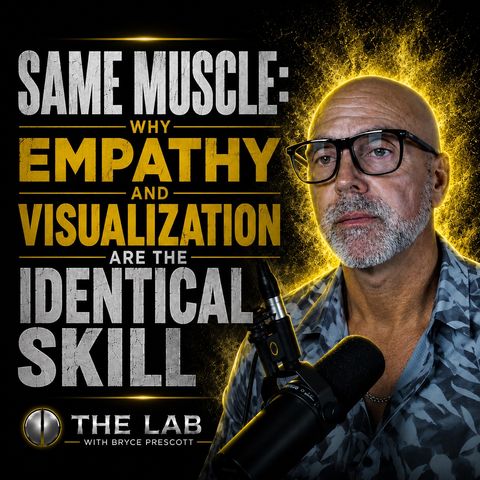
Same Muscle: Why Empathy And Visualization Are The Identical Skill
21 lug 2026 ·
23 min. 22 sec.
Scarica e ascolta ovunque
Scarica i tuoi episodi preferiti e goditi l'ascolto, ovunque tu sia! Iscriviti o accedi ora per ascoltare offline.
Descrizione
A comment from someone Bryce can't stand sent him into four seconds of jaw-clenched rage — and then gave him one of the clearest lessons of the series. In this...
mostra di più
A comment from someone Bryce can't stand sent him into four seconds of jaw-clenched rage — and then gave him one of the clearest lessons of the series. In this episode, he traces that moment to a single skill that sits underneath almost every fight, every failed relationship, and every conflict you've never fully resolved: the ability to see yourself from outside yourself. From there, he unpacks a three-part accountability framework that most people collapse into one, makes the case that incompatibility is diagnosed far more often than it actually exists, and draws a straight line between the empathy required to repair a relationship and the visualization required to build the life you actually want. Same muscle. Two completely different applications.
Listen in!
Takeaways:
Thanks for listening to this episode of The LAB Podcast!
Your story is waiting to be told, and we're here to help you tell it better.
If you’d like to join The Lab, our weekly group coaching experience please visit BrycePrescott.com/thelabgroup and follow the prompts. We’re ready to give you the right information, guidance and community needed for your next level of success!
Please visit BrycePrescott.com to learn more about how to work with us relating to your podcast production, creation or consulting needs.
Please follow our host on Instagram @bryceprescott
mostra meno
Listen in!
Takeaways:
- People don't usually attack what they don't understand. They attack what they're afraid is true about themselves. Understanding that changes the cost a comment or insult has on you.
- Compassion is not the same as approval. You can understand someone's damage without inviting it back into your life.
- The skill that sits underneath almost every relationship problem, every conflict, and every failure of accountability is one thing: the ability to see yourself from outside yourself.
- Accountability has three parts — acknowledging what you did, acknowledging the impact it had on someone else, and not doing it again. We've collapsed all three into just the first one and started calling it brave.
- Acknowledgment without impact and without change isn't accountability. It's a confession — and confession feels good as a release valve without repairing anything or preventing it from happening again.
- Step two of accountability — sitting in the impact your actions had on another person — is the hardest because it requires you to actually leave your own head and stand in theirs.
- Incompatibility is one of the most overused explanations for relationship failure. What's actually happening, far more often, is a skill deficit dressed in a costume that looks like incompatibility.
- People who don't know how to communicate under pressure, process conflict without turning it into war, or actually forgive — not just stop bringing it up — are not incompatible. They are under-skilled.
- Incompatibility is an easier story to reach for because it puts the failure out there in some cosmic mismatch instead of in a skill you could have built but didn't.
- Victim culture has made actual accountability rare. The form of it — confessing — has become celebrated as the whole thing. It isn't.
- Seeing yourself from outside yourself is a learnable skill, not a personality trait. You can get better at it through deliberate practice.
- The visualization muscle — putting yourself inside a future version of your life and experiencing it through all five senses — is the exact same muscle as putting yourself in someone else's perspective and seeing yourself through their eyes.
- VACOG: Visual, Auditory, Kinesthetic, Olfactory, Gustatory. Every dimension of a future experience can be accessed internally right now. The watermelon example proves the mechanism is already working in you.
- If you can conjure the taste of watermelon just by thinking about it, you can conjure the feeling of having the life you want — and that internal experience is what starts to create the external one.
- One assignment: pick one relationship with strain in it and this week actually stand in the other person's seat. Not guessing — going there. Seeing yourself the way they see you. That's the whole thing.
Thanks for listening to this episode of The LAB Podcast!
Your story is waiting to be told, and we're here to help you tell it better.
If you’d like to join The Lab, our weekly group coaching experience please visit BrycePrescott.com/thelabgroup and follow the prompts. We’re ready to give you the right information, guidance and community needed for your next level of success!
Please visit BrycePrescott.com to learn more about how to work with us relating to your podcast production, creation or consulting needs.
Please follow our host on Instagram @bryceprescott
Informazioni
| Autore | Big Picture Labs |
| Organizzazione | Bryce Prescott |
| Sito | - |
| Tag |

Copyright 2026 - Spreaker Inc. an iHeartMedia Company

Commenti