Protecting Your Peace The Wrong Way
29 set 2026 ·
27 min. 53 sec.
Scarica e ascolta ovunque
Scarica i tuoi episodi preferiti e goditi l'ascolto, ovunque tu sia! Iscriviti o accedi ora per ascoltare offline.
Descrizione
"Protect your peace" is the most popular philosophy nobody is benefiting from. In this episode, Bryce delivers one of the most direct and practically grounded episodes in the series —...
mostra di più
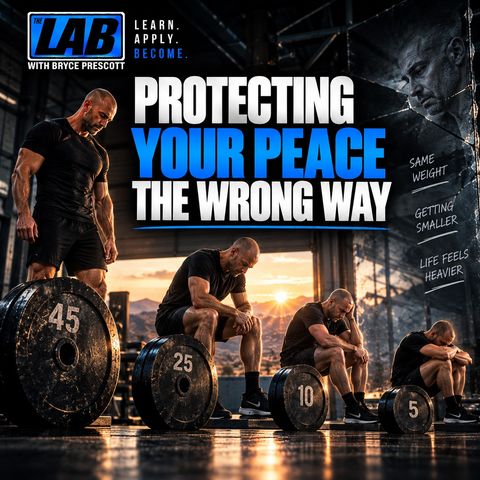
"Protect your peace" is the most popular philosophy nobody is benefiting from. In this episode, Bryce delivers one of the most direct and practically grounded episodes in the series — a full-on challenge to the mantra that has taken over self-care culture. Using a gym metaphor built around a 45-pound plate, he traces exactly how avoidance compounds into fragility, why people with the richest therapeutic vocabulary are often the least equipped to handle real life, and where the line actually is between a wall that should be walked away from and a weight that needs to be lifted. The episode closes with a shadow on a bedroom wall — and the reminder that most of what we're running from isn't actually dangerous. It just looks that way in the dark.
Listen in!
Takeaways:
Thanks for listening to this episode of The LAB Podcast!
Your story is waiting to be told, and we're here to help you tell it better.
If you’d like to join The Lab, our weekly group coaching experience please visit BrycePrescott.com/thelabgroup and follow the prompts. We’re ready to give you the right information, guidance and community needed for your next level of success!
Please visit BrycePrescott.com to learn more about how to work with us relating to your podcast production, creation or consulting needs.
Please follow our host on Instagram @bryceprescott
mostra meno
Listen in!
Takeaways:
- A 45-pound plate weighs the same for everyone. What changes is your capacity to carry it. When you keep setting it down, the weight doesn't get lighter — you get weaker. And from the inside, that feels like the world getting heavier.
- "Protect your peace" as a life philosophy is quietly making people smaller, more fragile, and more miserable — while telling them they're healing. That's the trap.
- The nice guy phenomenon is this same mechanism in slow motion: continually putting yourself last, never saying the hard thing, minimizing your own feelings until you can't handle ordinary life anymore.
- The problem with the therapeutic vocabulary explosion isn't the language — it's that knowing the language of the gym doesn't make you strong. People with exceptional vocabulary for their pain and zero reps trying to fix it are not healing. They're narrating.
- There is a genuine and important distinction between walls and weights. Walls — abuse, repeated lies, real danger — you get out from underneath. No nuance, no debate. But most things people are calling walls are actually weights. That misdiagnosis is costing them everything.
- When you've been lifting five-pound plates long enough, anything heavier feels like an attack. Feedback feels like prosecution. Care feels like being fixed. Truth feels like disrespect. And the person most likely to help you starts to feel most dangerous.
- Telling someone a hard truth is an act of love — not comfort. The person who tells you something difficult is picking up a weight of their own for your benefit. Walking out of that conversation to protect your peace is walking out of your own intervention.
- The clearest example of love isn't people agreeing with you. It's people sitting in a room and reading you a letter because they can't watch you hurt yourself anymore. That's what an intervention is. Most daily truth-telling is a smaller version of exactly that.
- The gym model applies in life: start with a weight that makes you shake — not 225 on day one. One hard conversation. One honest admission. One rep. Then do it again. Strength is built in the accumulation of reps, not a single lift.
- Get a spotter. A great coach, a friend who loves you enough to tell you the truth — these people exist so you can go heavier than you'd go alone. Pushing them away in the name of peace is why everything feels so dangerous.
- Rest is not the same as retreating. Recovery is part of the process. But rest without a plan to come back is just quitting with a nicer name.
- Very small things cast very big shadows. Most of what you're protecting your peace from isn't actually dangerous — it just looks that way in the dark. The only way to find out what you're actually dealing with is to turn on the light and do the hard thing.
- Avoiding hard things didn't just make Bryce smaller and quieter — it made him an egomaniac. He expected a seat at the table with men who had done the reps, without having done any of them himself. That's what skipping the work produces.
- You can be clinically depressed and still have agency over your environment. Both things are true. The hard thing in that season might not be the confrontation — it might just be getting some sunlight, letting someone in, going to sleep. Those are 45-pound plates too.
- The purpose of life is expansion. Everything you actually want — the experiences, the relationships, the person you're becoming — is on the other side of doing more hard things, not fewer. That is the whole game.
Thanks for listening to this episode of The LAB Podcast!
Your story is waiting to be told, and we're here to help you tell it better.
If you’d like to join The Lab, our weekly group coaching experience please visit BrycePrescott.com/thelabgroup and follow the prompts. We’re ready to give you the right information, guidance and community needed for your next level of success!
Please visit BrycePrescott.com to learn more about how to work with us relating to your podcast production, creation or consulting needs.
Please follow our host on Instagram @bryceprescott
Informazioni
| Autore | Big Picture Labs |
| Organizzazione | Bryce Prescott |
| Sito | - |
| Tag |

Copyright 2026 - Spreaker Inc. an iHeartMedia Company

Commenti