Precision Machining: Essential Guide for 2026
27 ott 2026 ·
9 min. 6 sec.
Scarica e ascolta ovunque
Scarica i tuoi episodi preferiti e goditi l'ascolto, ovunque tu sia! Iscriviti o accedi ora per ascoltare offline.
Descrizione
Precision machining achieves dimensional tolerances as tight as $\pm$0.0001 inches—a fraction of the diameter of a human hair. In critical industrial applications spanning oil and gas drilling, heavy aggregate processing,...
mostra di più
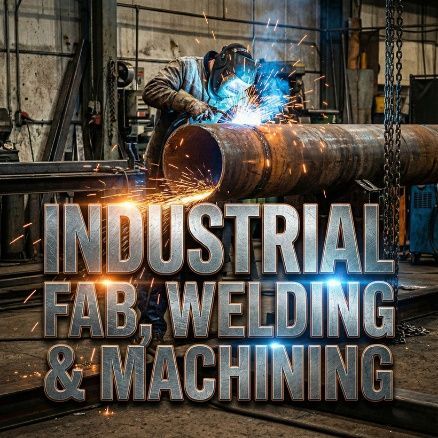
Precision machining achieves dimensional tolerances as tight as $\pm$0.0001 inches—a fraction of the diameter of a human hair. In critical industrial applications spanning oil and gas drilling, heavy aggregate processing, recycling systems, and aerospace, this level of precision separates high-reliability operations from catastrophic mechanical failure. Maintaining these tight tolerances requires a balance of machine kinematics, specialized cutting tool geometry, environmental temperature controls, and Coordinate Measuring Machine (CMM) verification.On this episode of Industrial Fab, Welding & Machining, the precision manufacturing team at LTJ Industrial Services breaks down the technical differences between conventional and precision CNC machining, tool wear mechanics across difficult alloys, and integrated turnkey fabrication.Technical Comparison: Conventional Machining vs. Precision CNC Machining
Read more
Learn more about LTJ Industrial Services at www.ltjindustrial.com/
mostra meno
- Dimensional Tolerance & Repeatability:
- Conventional Machining: Operates within standard industrial tolerances of $\pm$0.005 inches, suitable for general structural framing and low-speed mechanical assemblies.
- Precision CNC Machining: Consistently holds tolerances of $\pm$0.0002 to $\pm$0.0001 inches using rigid CNC lathes, multi-axis mills, and Swiss-type turning centers.
- Tooling Geometry & Wear Resistance:
- Conventional Machining: Uses standard high-speed steel (HSS) or general carbide tooling with rapid edge breakdown on difficult alloys.
- Precision CNC Machining: Utilizes indexable micro-grain carbide, Polycrystalline Diamond (PCD), and Cubic Boron Nitride (CBN) inserts engineered to withstand high thermal loads and prevent tool deflection during continuous production runs.
- Thermal & Environmental Controls:
- Conventional Machining: Conducted in open-bay shop environments where ambient temperature fluctuations cause uncontrolled dimensional drift on workpieces.
- Precision CNC Machining: Utilizes climate-controlled production environments calibrated to 68°F (20°C) alongside onboard machine thermal compensation systems to offset spindle heat and ball-screw expansion.
- Metrology & Inspection Telemetry:
- Conventional Machining: Relies on manual vernier calipers and micrometers for post-process checks.
- Precision CNC Machining: Implements Statistical Process Control (SPC), optical silhouette comparators, and automated 3D touch-probe/laser Coordinate Measuring Machines (CMM) for First Article Inspections (FAI).
- Carbon & Alloy Steels: Offer predictable chip formation and uniform response to post-machining heat treatment, making them ideal for high-stress industrial shafts, pins, and heavy bushings.
- Austenitic & Duplex Stainless Steels: Deliver exceptional chemical and corrosion resistance for petrochemical fluid handling, but require rigid machine setups and sharp positive-rake inserts to prevent severe work-hardening during cutting.
- Titanium Alloys & Exotic Nickel Superalloys: Provide high strength-to-weight ratios in aerospace and downhole drilling tools, but exhibit low thermal conductivity and chemical reactivity with cutting tools, requiring high-pressure through-spindle coolant and optimized chip loads.
- Conduct First Article Inspection (FAI): Validate CNC G-code programming, fixture rigidity, and initial dimensional offsets on a CMM prior to initiating production runs.
- Control Machine Backlash & Spindle Run-Out: Perform scheduled dynamic calibration checks on CNC linear guides, ball screws, and spindle run-out to eliminate mechanical vibration before machining critical bearing journals.
- Consolidate Machining with Heavy Fabrication: Source components from facilities that house both certified welding/fabrication and precision CNC machining under one roof. This single-source workflow eliminates coordinate mismatch when machining critical mounting surfaces on complex welded assemblies.
Read more
Learn more about LTJ Industrial Services at www.ltjindustrial.com/
Informazioni
| Autore | Don Markland |
| Organizzazione | Don Markland |
| Sito | - |
| Tag |

Copyright 2026 - Spreaker Inc. an iHeartMedia Company

Commenti