Trascritto
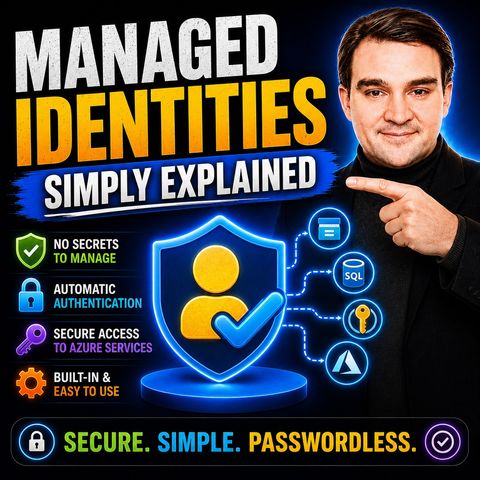
Managed Identities - Simply Explained
16 lug 2026 ·
16 min. 52 sec.
Scarica e ascolta ovunque
Scarica i tuoi episodi preferiti e goditi l'ascolto, ovunque tu sia! Iscriviti o accedi ora per ascoltare offline.
Managed Identities - Simply Explained
Descrizione
Managing passwords, connection strings, client secrets, and certificates has always been one of the biggest challenges when building secure cloud applications. Every application that connects to Azure Storage, Azure Key...
mostra di più
Managing passwords, connection strings, client secrets, and certificates has always been one of the biggest challenges when building secure cloud applications. Every application that connects to Azure Storage, Azure Key Vault, Azure SQL Database, or other Azure services traditionally required credentials that had to be stored, protected, rotated, and monitored. Over time, this creates secret sprawl, increases security risks, and adds operational complexity. In this episode of Microsoft Knowledge Nuggets, we explain Azure Managed Identities in simple terms and show why Microsoft considers them the future of authentication for Azure workloads. You'll discover how Managed Identities completely eliminate the need to store secrets while making your applications more secure, easier to manage, and ready for modern cloud architectures.
HOW MANAGED IDENTITIES WORK AND WHY THEY MATTER
Instead of storing passwords or client secrets inside your application, Azure automatically creates a trusted identity in Microsoft Entra ID for your workload. Whenever your application needs access to Azure Storage, Key Vault, Cosmos DB, Service Bus, SQL Database, or another Azure service, it simply requests a temporary access token through the Azure Instance Metadata Service (IMDS). Azure validates the workload's identity, issues a short-lived OAuth token, and handles all certificate rotation behind the scenes. Your application never stores, generates, or even sees a password, dramatically reducing the attack surface while simplifying authentication for developers and administrators alike.
SYSTEM-ASSIGNED VS USER-ASSIGNED MANAGED IDENTITIES
One of the most important concepts covered in this episode is understanding the difference between System-Assigned and User-Assigned Managed Identities. You'll learn when a System-Assigned Identity is the ideal choice for a single Azure resource such as an App Service, Azure Function, or Virtual Machine, and when a User-Assigned Identity provides greater flexibility by allowing multiple Azure resources to share the same identity and permissions. We also discuss lifecycle management, regional considerations, migration scenarios, and practical recommendations that help you choose the right identity model for production workloads.
REAL-WORLD IMPLEMENTATION, SECURITY BENEFITS, AND BEST PRACTICES
Beyond the theory, this episode walks through a complete real-world deployment from local development to production. You'll see how DefaultAzureCredential automatically selects the correct authentication method, how Azure RBAC replaces connection strings with permission-based access, and how Managed Identities integrate seamlessly with Azure Storage, Azure Key Vault, Azure SQL, Azure Service Bus, Event Hubs, and many other Microsoft services. We also compare traditional service principals with Managed Identities, explain when Managed Identities cannot be used, and explore workload identity federation for hybrid and multi-cloud environments. By the end of the episode, you'll understand why passwordless authentication has become Microsoft's recommended security model for modern Azure applications and why every new Azure project should start with Managed Identities instead of secrets.
Become a supporter of this podcast: https://www.spreaker.com/podcast/m365-fm-microsoft-365-azure-cloud-power-platform-ai--6704921/support.
mostra meno
HOW MANAGED IDENTITIES WORK AND WHY THEY MATTER
Instead of storing passwords or client secrets inside your application, Azure automatically creates a trusted identity in Microsoft Entra ID for your workload. Whenever your application needs access to Azure Storage, Key Vault, Cosmos DB, Service Bus, SQL Database, or another Azure service, it simply requests a temporary access token through the Azure Instance Metadata Service (IMDS). Azure validates the workload's identity, issues a short-lived OAuth token, and handles all certificate rotation behind the scenes. Your application never stores, generates, or even sees a password, dramatically reducing the attack surface while simplifying authentication for developers and administrators alike.
SYSTEM-ASSIGNED VS USER-ASSIGNED MANAGED IDENTITIES
One of the most important concepts covered in this episode is understanding the difference between System-Assigned and User-Assigned Managed Identities. You'll learn when a System-Assigned Identity is the ideal choice for a single Azure resource such as an App Service, Azure Function, or Virtual Machine, and when a User-Assigned Identity provides greater flexibility by allowing multiple Azure resources to share the same identity and permissions. We also discuss lifecycle management, regional considerations, migration scenarios, and practical recommendations that help you choose the right identity model for production workloads.
REAL-WORLD IMPLEMENTATION, SECURITY BENEFITS, AND BEST PRACTICES
Beyond the theory, this episode walks through a complete real-world deployment from local development to production. You'll see how DefaultAzureCredential automatically selects the correct authentication method, how Azure RBAC replaces connection strings with permission-based access, and how Managed Identities integrate seamlessly with Azure Storage, Azure Key Vault, Azure SQL, Azure Service Bus, Event Hubs, and many other Microsoft services. We also compare traditional service principals with Managed Identities, explain when Managed Identities cannot be used, and explore workload identity federation for hybrid and multi-cloud environments. By the end of the episode, you'll understand why passwordless authentication has become Microsoft's recommended security model for modern Azure applications and why every new Azure project should start with Managed Identities instead of secrets.
Become a supporter of this podcast: https://www.spreaker.com/podcast/m365-fm-microsoft-365-azure-cloud-power-platform-ai--6704921/support.
Informazioni
| Autore | Mirko Peters M365, Azure & AI |
| Organizzazione | m365 FM |
| Sito | - |
| Tag |

Copyright 2026 - Spreaker Inc. an iHeartMedia Company

Commenti