Trascritto
Azure Virtual WAN - Simply Explained
16 lug 2026 ·
14 min. 53 sec.
Scarica e ascolta ovunque
Scarica i tuoi episodi preferiti e goditi l'ascolto, ovunque tu sia! Iscriviti o accedi ora per ascoltare offline.
Azure Virtual WAN - Simply Explained
Descrizione
Building a global Azure network manually becomes increasingly difficult as your organization grows. What starts as a simple hub-and-spoke deployment quickly turns into a maze of virtual network peerings, route...
mostra di più
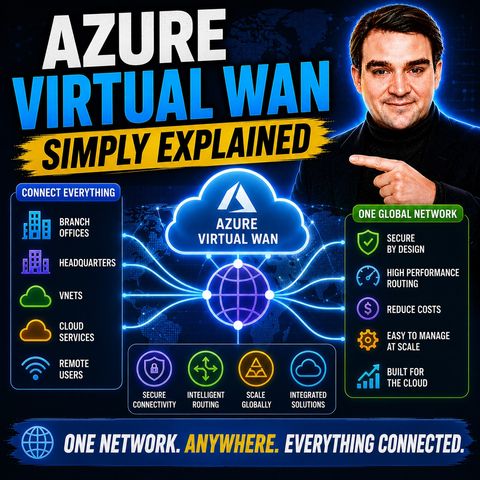
Building a global Azure network manually becomes increasingly difficult as your organization grows. What starts as a simple hub-and-spoke deployment quickly turns into a maze of virtual network peerings, route tables, VPN gateways, firewall rules, and regional connectivity challenges. Every new Azure region introduces additional complexity, making network management harder, slower, and more expensive. In this episode of m365.fm, we explain Azure Virtual WAN in plain English and show how Microsoft's managed networking platform simplifies global connectivity by replacing complex manual networking with an intelligent cloud-native backbone. Whether you're connecting branch offices, remote users, data centers, or Azure workloads across multiple regions, Azure Virtual WAN provides a scalable networking foundation built for modern enterprises.
WHY TRADITIONAL HUB-AND-SPOKE REACHES ITS LIMITS
Hub-and-spoke architecture remains an excellent networking model for smaller Azure environments, but as organizations expand globally, maintaining hundreds of peerings, user-defined routes, firewall policies, and VPN gateways becomes increasingly difficult. We explain why traditional networking creates operational overhead, how routing complexity grows exponentially with every new region, and why many large enterprises eventually struggle to manage their Azure connectivity. Through practical examples, you'll understand why Azure Virtual WAN was designed to eliminate manual networking tasks while preserving centralized security, routing, and governance across geographically distributed Azure environments.
VIRTUAL HUBS, MICROSOFT'S GLOBAL BACKBONE, AND CONNECTIVITY
At the heart of Azure Virtual WAN are Virtual Hubs—Microsoft-managed regional networking hubs that automatically connect your virtual networks, branch offices, ExpressRoute circuits, VPN gateways, and remote users through Microsoft's global private backbone. This episode explains the Virtual WAN resource, Virtual Hubs, spoke virtual networks, Site-to-Site VPN, Point-to-Site VPN, ExpressRoute, Microsoft Entra ID authentication, and automatic inter-hub routing using simple analogies that make enterprise networking easy to understand. Instead of manually configuring dozens of peerings and routing tables, Azure Virtual WAN allows organizations to connect each workload once while Microsoft manages the global routing infrastructure automatically.
BUILT-IN ROUTING, SECURITY, AND AZURE FIREWALL INTEGRATION
Azure Virtual WAN doesn't just simplify connectivity—it also simplifies security. Learn how Routing Intent automatically directs traffic through Azure Firewall or supported third-party next-generation firewalls without requiring complex User Defined Routes (UDRs). We explain secured Virtual Hubs, Azure Firewall integration, IPsec encryption, ExpressRoute, Azure Firewall Manager, Zero Trust networking principles, and centralized policy management across multiple Azure regions. You'll discover how Virtual WAN creates a globally consistent security model where routing, inspection, and policy enforcement are managed centrally rather than separately for every virtual network.
WHEN TO USE AZURE VIRTUAL WAN
The episode concludes by comparing Azure Virtual WAN with traditional Hub-and-Spoke networking and helping you choose the right architecture for your environment. We discuss deployment scenarios including global retailers, multinational enterprises, remote workforces, hybrid cloud environments, MPLS replacement projects, and cloud-first organizations expanding into multiple Azure regions. We also cover migration strategies, Virtual WAN Standard versus Basic, operational cost savings, Microsoft Learn resources, and practical deployment recommendations. Whether you're designing a new enterprise Azure network or modernizing an existing cloud infrastructure, this episode provides the practical knowledge needed to understand when Azure Virtual WAN becomes the right architectural choice—and how it helps organizations scale global networking without scaling operational complexity.
Become a supporter of this podcast: https://www.spreaker.com/podcast/m365-fm-a-microsoft-mvp-podcast-by-mirko-peters--6704921/support.
mostra meno
WHY TRADITIONAL HUB-AND-SPOKE REACHES ITS LIMITS
Hub-and-spoke architecture remains an excellent networking model for smaller Azure environments, but as organizations expand globally, maintaining hundreds of peerings, user-defined routes, firewall policies, and VPN gateways becomes increasingly difficult. We explain why traditional networking creates operational overhead, how routing complexity grows exponentially with every new region, and why many large enterprises eventually struggle to manage their Azure connectivity. Through practical examples, you'll understand why Azure Virtual WAN was designed to eliminate manual networking tasks while preserving centralized security, routing, and governance across geographically distributed Azure environments.
VIRTUAL HUBS, MICROSOFT'S GLOBAL BACKBONE, AND CONNECTIVITY
At the heart of Azure Virtual WAN are Virtual Hubs—Microsoft-managed regional networking hubs that automatically connect your virtual networks, branch offices, ExpressRoute circuits, VPN gateways, and remote users through Microsoft's global private backbone. This episode explains the Virtual WAN resource, Virtual Hubs, spoke virtual networks, Site-to-Site VPN, Point-to-Site VPN, ExpressRoute, Microsoft Entra ID authentication, and automatic inter-hub routing using simple analogies that make enterprise networking easy to understand. Instead of manually configuring dozens of peerings and routing tables, Azure Virtual WAN allows organizations to connect each workload once while Microsoft manages the global routing infrastructure automatically.
BUILT-IN ROUTING, SECURITY, AND AZURE FIREWALL INTEGRATION
Azure Virtual WAN doesn't just simplify connectivity—it also simplifies security. Learn how Routing Intent automatically directs traffic through Azure Firewall or supported third-party next-generation firewalls without requiring complex User Defined Routes (UDRs). We explain secured Virtual Hubs, Azure Firewall integration, IPsec encryption, ExpressRoute, Azure Firewall Manager, Zero Trust networking principles, and centralized policy management across multiple Azure regions. You'll discover how Virtual WAN creates a globally consistent security model where routing, inspection, and policy enforcement are managed centrally rather than separately for every virtual network.
WHEN TO USE AZURE VIRTUAL WAN
The episode concludes by comparing Azure Virtual WAN with traditional Hub-and-Spoke networking and helping you choose the right architecture for your environment. We discuss deployment scenarios including global retailers, multinational enterprises, remote workforces, hybrid cloud environments, MPLS replacement projects, and cloud-first organizations expanding into multiple Azure regions. We also cover migration strategies, Virtual WAN Standard versus Basic, operational cost savings, Microsoft Learn resources, and practical deployment recommendations. Whether you're designing a new enterprise Azure network or modernizing an existing cloud infrastructure, this episode provides the practical knowledge needed to understand when Azure Virtual WAN becomes the right architectural choice—and how it helps organizations scale global networking without scaling operational complexity.
Become a supporter of this podcast: https://www.spreaker.com/podcast/m365-fm-a-microsoft-mvp-podcast-by-mirko-peters--6704921/support.
Informazioni
| Autore | Mirko Peters (M365 Consultant) |
| Organizzazione | m365 FM |
| Sito | - |
| Tag |

Copyright 2026 - Spreaker Inc. an iHeartMedia Company

Commenti