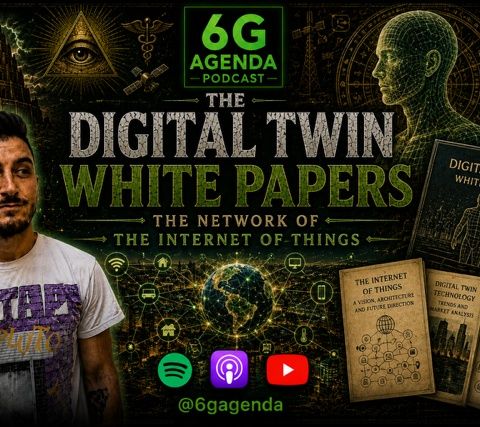
#157: The Digital Twin Network
Scarica e ascolta ovunque
Scarica i tuoi episodi preferiti e goditi l'ascolto, ovunque tu sia! Iscriviti o accedi ora per ascoltare offline.
#157: The Digital Twin Network
Questa è una trascrizione generata automaticamente. Si prega di notare che non è garantita la completa accuratezza.
Descrizione
Yes, those ads are annoying, but it helps support the show! For Early Access, Ad-Free video episodes become a member on https://open.spotify.com/show/65gsXCokZNOvvLCGklEd23?si=076421c4ece64437, https://www.youtube.com/@6gAgenda/streamsor https://patreon.com/6GAgenda?utm_medium=unknown&utm_source=join_link&utm_campaign=creatorshare_creator&utm_content=copyLink! In this episode of 6G Agenda,...
mostra di piùFor Early Access, Ad-Free video episodes become a member on Spotify, YouTube or Join Patreon!
In this episode of 6G Agenda, we take a deep dive into the rapidly developing world of digital twins and the emerging architecture sometimes described as the Internet of Everything—where people, places, machines, biological systems, and microscopic devices can increasingly be represented, monitored, and modeled digitally.We begin with the concept of the digital twin: a continuously updated digital representation of a physical object, environment, system, or even a human being. Modern research is moving beyond simple simulations toward increasingly sophisticated “living” models capable of receiving real-world sensor data, analyzing it with AI, and potentially influencing the physical system they represent.
Recent 6G research even distinguishes between passive digital twins used for monitoring and active-control twins capable of interacting with the systems they model. (arXiv)From there, we move through the evolution of the Internet of Things (IoT) into the Internet of NanoThings (IoNT) and the Internet of BioNanoThings (IoBNT). Research in this field envisions networks of nanoscale biological or artificial devices capable of sensing, processing information, and communicating within living systems. Proposed applications include biomedical monitoring, biosensing, targeted drug delivery, and bio-cyber interfaces connecting molecular activity with external computing systems. (IEEE Communications Society)
We examine how molecular communication could create an entirely different layer of networking—one where information isn’t necessarily transmitted through conventional radio waves, but through biochemical signals, engineered biological systems, DNA-based messaging, and microscopic sensing devices. Some current research even explores software-defined architectures for coordinating networks of these proposed bionanomachines. The episode then expands into MEMS, electromagnetic sensors, nano-sensors, smart dust, and ubiquitous sensing. We look at how increasingly tiny sensors can collect information about their environment and how networks of connected devices could eventually create detailed digital representations of physical spaces.A building can have a digital twin. A factory can have one. A city can have one. A machine can have one. A wireless environment can have one. And emerging research is exploring increasingly sophisticated models of biological systems and human health.We explore the convergence of:
- Internet of Things (IoT)
- Internet of Everything
- Internet of NanoThings (IoNT)
- Internet of BioNanoThings (IoBNT)
- Digital twins of people, places, and machines
- MEMS and nanoscale sensors
- Smart dust and ubiquitous sensing
- Molecular communications
- Biosensors and bio-cyber interfaces
- DNA-based information systems
- AI-driven digital twins
- 6G and massive machine-type communications
- Electromagnetic sensing and wireless environments
- Smart cities and connected infrastructure
- Human-machine and biological computing
6G Agenda — We Talk About What They Won’t.
Become a supporter of this podcast: https://www.spreaker.com/podcast/6g-agenda--6645757/support.
Thanks for checking us out! Links Below!!
Join Our Discord!
Support the show below
Tap here for our LINKTREE
To escape these ads and enjoy video go to our YouTube.
We do all of our shows live on there.
Informazioni
| Autore | 6G Agenda |
| Organizzazione | 6G Agenda |
| Sito | - |
| Tag |

Copyright 2026 - Spreaker Inc. an iHeartMedia Company

Commenti